
Otago Exercise Programme: Home-Based Strength and Balance Protocol for Elderly Fall Prevention
In short
The Otago Exercise Programme demonstrates a thirty-five percent reduction in geriatric falls across global trials. Discover how this home-based protocol is adapted for Indian living spaces.
In this guide (6 sections)
The Otago Exercise Programme (OEP) is an internationally validated, evidence-based fall prevention intervention designed specifically for older adults living independently. Originally formulated at the University of Otago Medical School, the protocol combines progressive lower-limb muscle strengthening, specific balance retraining exercises, and an active walking plan. Rigorous randomised controlled trials demonstrate that consistent implementation reduces fall rates by thirty-five percent in community-dwelling seniors. Implementing this structured regimen at home helps older individuals maintain physical independence without requiring specialised gym infrastructure.
Domestic and Cultural Indian Realities
Adapting the Otago protocol to Indian homes requires careful environmental and cultural alignment. Indian living spaces often present slippery Kota stone or vitrified flooring, where exercising barefoot can lead to slips if plantar sweat diminishes surface grip. Exercising in traditional loose apparel, such as lengthy nighties, flared sarees, or loose dhotis, introduces fabric entanglement risks during stepping drills. Furthermore, Indian joint families frequently encourage elderly grandparents to remain seated, delegating all household errands to younger relatives or domestic help. While intended as a gesture of care (seva), this cultural habit accelerates sedentary sarcopenia. The Otago protocol re-engages elders within their home routine, utilising sturdy dining chairs for support and establishing structured exercise spaces free of loose rugs and low furniture.
Clinical Biomechanics and Postural Control Decay
Age-associated muscle weakness primarily targets the anti-gravity musculature of the lower extremities, including the quadriceps femoris, gluteus medius, gastrocnemius, and tibialis anterior. Sarcopenia involves selective denervation and loss of fast-contracting type II glycolytic muscle fibres. This loss diminishes peak torque generation during rapid postural perturbations. When a senior stumbles, weak ankle dorsiflexors fail to lift the foot sufficiently, causing the toes to catch on floor irregularities. Concurrently, insufficient hip abductor force allows excessive lateral pelvic tilt (Trendelenburg drop), shifting the body's centre of mass outside the lateral base of support. The Otago protocol counteracts this biomechanical degradation by using progressive cuff weights to stimulate mechanical tension and muscular hypertrophy in key postural stabilisers.
Functional Assessment and Risk Stratification
Before initiating the Otago Exercise Programme, a qualified physiotherapist assesses baseline neuromuscular capacity using the 30-Second Chair Stand Test, Four-Stage Balance Test, and gait speed measurement over four metres. Patients demonstrating gait speeds below 0.8 metres per second or unable to complete eight unassisted chair stands in thirty seconds receive modified introductory resistance. The protocol comprises five strengthening exercises utilising variable ankle weights (ranging from 0.5 kg to 3 kg) and twelve balance exercises graded across four difficulty tiers. Ongoing reassessment every eight weeks ensures safe progression of resistance and balance challenges.
Targeted Strength and Balance Exercises
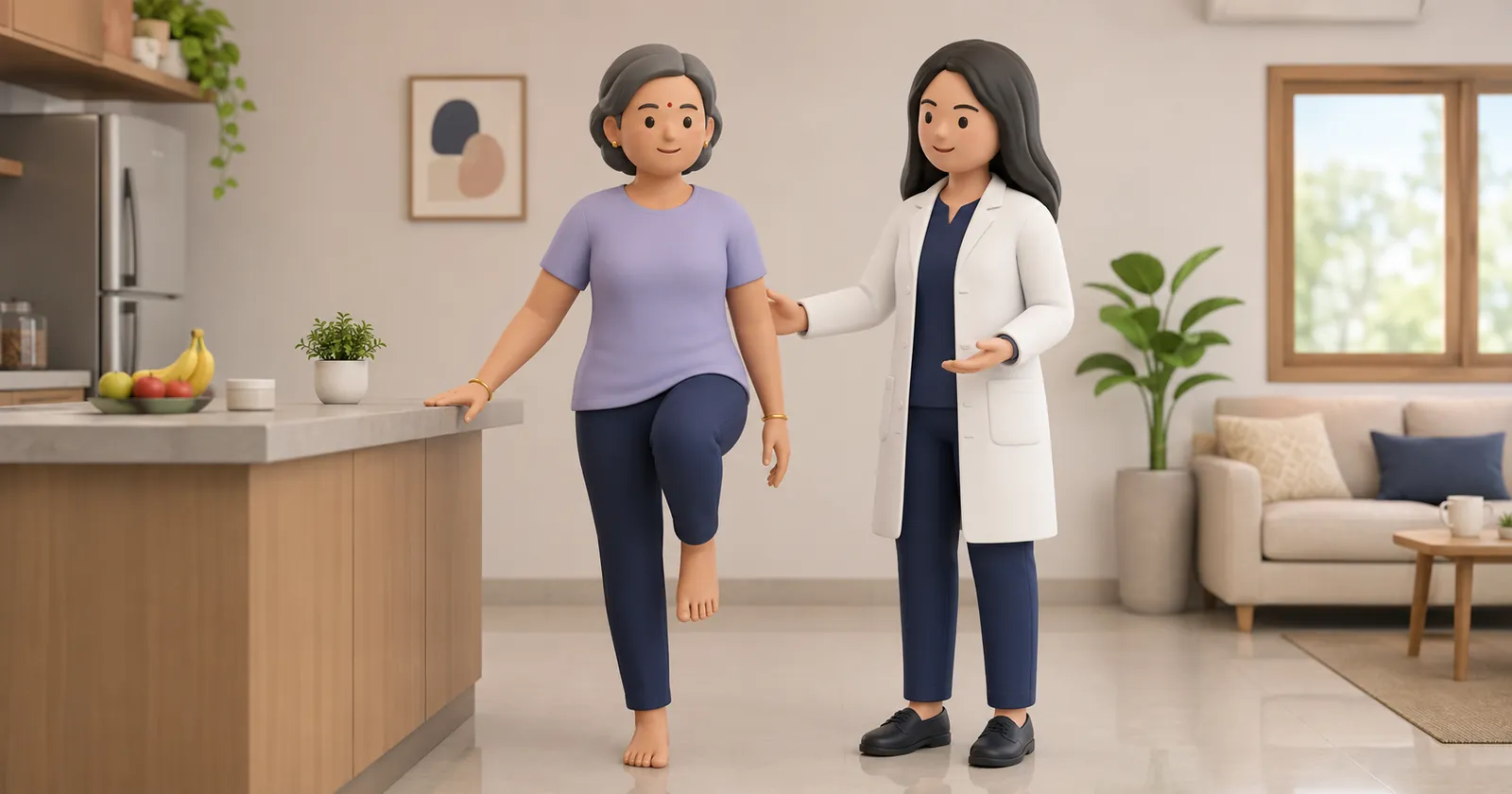
Otago strengthening exercises are performed three times per week on non-consecutive days, while dynamic balance drills can be practiced up to five days per week. Balance tasks advance systematically: starting with two-handed support, progressing to single-handed support, hovering fingertips, and finally performing movements completely unsupported. Safety remains the governing principle; exercises must be conducted adjacent to solid support surfaces such as heavy wooden dining tables or corridor walls.
Otago Progressive Knee Extensor Strengthening
Objective: Rebuild concentric and eccentric quadriceps force output for safer sit-to-stand transfers and stair descent
- 1Sit upright in a firm dining chair with your back supported and feet resting flat on the floor.
- 2Secure a comfortable 1 kg ankle cuff weight firmly above the ankle joint of your exercising leg.
- 3Straighten your knee steadily over a three-second count until your leg is fully extended parallel to the floor.
- 4Hold the fully extended position for two seconds while pulling your toes back toward your shin.
- 5Lower the foot back down smoothly over a controlled three-second count without letting it drop abruptly.
| Module Component | Target Anatomical Muscle or Synergy | Clinical Functional Goal |
|---|---|---|
| Knee Extension and Flexion | Quadriceps femoris and Hamstring complex | Improves transfer power and knee stability during foot strike |
| Hip Abduction | Gluteus medius and Tensor fasciae latae | Prevents lateral pelvic collapse and uncontrolled lateral sway |
| Calf and Toe Raises | Gastrocnemius, Soleus, and Tibialis anterior | Restores ankle push-off power and toe clearance during swing phase |
| Tandem and Backward Walking | Dynamic multi-sensory postural synergies | Challenges anticipatory control and narrow-base dynamic gait |
Red Flags and Emergency Post-Fall Escalation
Patients participating in home-based protocols must stop exercising immediately if they experience sudden presyncope, severe shortness of breath, angina-like retrosternal chest pain, or irregular cardiac palpitations. If a fall occurs during daily activities, check for signs of fracture before moving the patient. Palpate the greater trochanter and groin; sharp exquisite tenderness coupled with shortened external limb rotation indicates a femoral neck fracture. In such cases, avoid moving the limb, immobilise the patient on the floor, and summon emergency medical transport immediately.
Frequently Asked Questions
How long does it take for the Otago Exercise Programme to show results?
Clinical studies indicate measurable improvements in lower-limb strength and static balance within six to eight weeks of consistent Otago training. The programme aims to reduce fall risk and build functional balance over a six-month continuum, progressively challenging neuromuscular control to ensure lasting physical stability.
Can an older adult start the Otago Exercise Programme without professional supervision?
Initial assessment and exercise prescription should always be conducted by a qualified physiotherapist to determine appropriate starting cuff weights and balance difficulty tiers. Under the NCAHP Act 2021, Indian patients have direct access to registered physiotherapists. BookPhysio.in enables direct consultation with verified professionals and pay-direct home visits without platform fees.
Related recovery guides & articles
BookPhysio.in Editorial Team
The BookPhysio.in editorial team writes and maintains this content, checking it against reliable clinical sources. Content follows our medical review policy: general information only, and no page claims a clinical review until a named registered physiotherapist has signed it off.
Read our medical review policy