
Passive Limb Mobilisation: Avoiding Painful Spindle Reflexes
In short
Aggressive stretching triggers painful muscle spasms in terminal illness. Discover how gentle, low-velocity passive movements preserve joint mobility safely.
In this guide (5 sections)
Passive limb mobilisation in palliative oncology aims to preserve joint comfort, maintain capsular elasticity, and promote venous return without causing pain. In advanced disease, neuro-metabolic changes and electrolyte disturbances make skeletal muscle highly irritable. Quick or aggressive stretching triggers hyperactive muscle spindle afferents, eliciting protective guarding spasms, severe pain, and sympathetic distress. Palliative physiotherapy relies on slow, low-velocity passive movements that respect soft tissue resistance and preserve patient comfort.
Domestic and Cultural Indian Realities
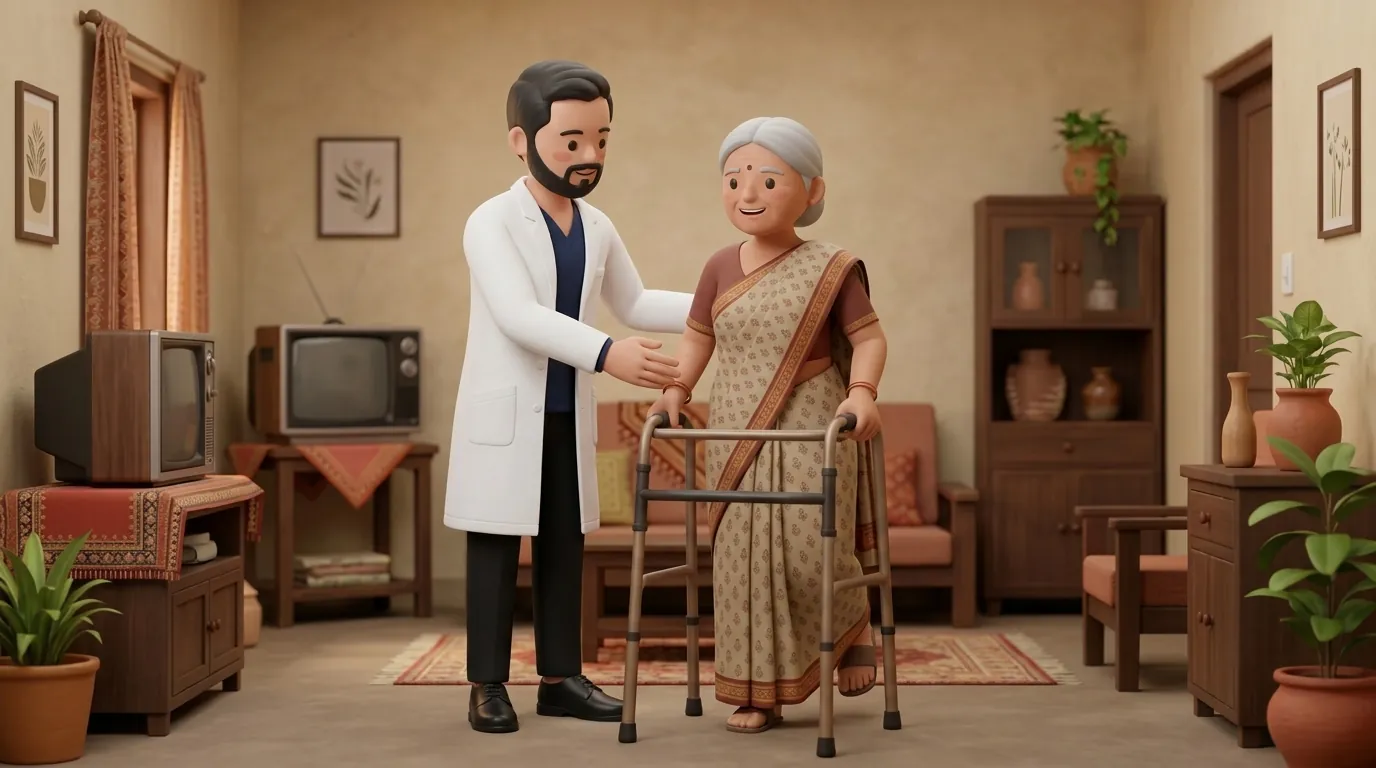
In Indian households, family members often believe that stiff limbs must be forcefully pulled or stretched to keep the elder mobile. Traditional masseurs or well-intentioned relatives may manipulate contracted knees or shoulders with vigorous speed, causing intense grimacing, tachycardia, and tears. Palliative physiotherapists explain to families that forceful manipulation causes microscopic muscle tears and triggers intense protective guarding. Clinicians teach caregivers how to cradle limbs gently, using slow, rhythmic movements that relax the nervous system.
Neurophysiology of Muscle Spindles and Stretch Reflexes
Muscle spindles contain intrafusal fibers wrapped by primary type Ia sensory afferents that are highly sensitive to the rate of muscle length change (velocity). When a muscle is stretched rapidly, type Ia afferents fire high-frequency impulses into the spinal cord, directly exciting alpha motor neurons to produce an instantaneous, involuntary contraction of the stretched muscle. In contrast, moving a limb at an ultra-low, constant velocity avoids threshold firing of primary spindle afferents, allowing smooth excursion through the available joint range.
Low-Velocity Passive Mobilisation Protocols
Caregivers must always support the moving limb across two anatomical joints, using broad open palms rather than fingertip pressure. Movements are performed slowly, taking at least 5 to 6 seconds to complete an excursion from flexion to extension. The movement stops immediately at the first point of soft tissue resistance, never pushing into end-range capsular stretch or causing facial grimacing.
Supported Low-Velocity Hip and Knee Mobilisation
Objective: Maintain lower extremity joint mobility and circulation without provoking spasms
- 1Position the patient comfortably supine on a supportive, pressure-relieving mattress.
- 2Place one open hand beneath the patient knee and cradle the heel smoothly in your other hand.
- 3Slowly glide the heel along the bed surface, guiding the hip and knee into gentle flexion over 6 seconds.
- 4Pause softly for 3 seconds at the first hint of resistance, watching the patient facial expression.
- 5Smoothly glide the heel back down along the mattress, returning the leg to full resting extension.
| Parameters | Aggressive Forceful Stretching | Palliative Low-Velocity Care |
|---|---|---|
| Movement Velocity | Rapid or abrupt limb pulling | Ultra-slow, continuous glide (5-6 seconds per arc) |
| Spindle Response | High-frequency type Ia afferent firing; muscle spasm | Spindle threshold unreached; soft tissues relax |
| End-Range Handling | Forcing movement past resistance barriers | Halting immediately at the first soft tissue resistance |
| Hand Placement | Narrow grip using fingers; lever-arm pulling | Broad, open-palm support cradling adjacent joints |
Oncological Red Flags and Specialist Escalation
Passive mobilisation is strictly contraindicated across bones affected by known osteolytic metastases due to high fracture risks. The emergence of acute joint warmth, localized redness, sudden severe pain on passive motion, or asymmetric calf swelling requires immediate medical evaluation to rule out deep vein thrombosis or septic arthritis.
Frequently Asked Questions
What should a caregiver do if an elder grimaces during passive movements?
If the elder grimaces, holds their breath, or pulls away, stop the movement immediately. Return the limb gently to its resting position, reassure the elder, and reduce both the speed and range of motion during subsequent attempts.
Do I need a doctor referral to consult a home palliative physiotherapist?
Under the National Commission for Allied and Healthcare Professions (NCAHP) Act 2021, patients in India enjoy direct access to registered physiotherapists without requiring a mandatory doctor referral. At BookPhysio.in, you consult verified physiotherapists and pay directly per session without hidden fees or platform commissions.
Related recovery guides & articles
BookPhysio.in Editorial Team
The BookPhysio.in editorial team writes and maintains this content, checking it against reliable clinical sources. Content follows our medical review policy: general information only, and no page claims a clinical review until a named registered physiotherapist has signed it off.
Read our medical review policy