
Pisa Syndrome (Lateral Trunk Flexion): Postural Re-Education and Taping
In short
Pisa syndrome pulls the trunk sideways into a persistent lateral tilt. Discover specialised postural re-education, trunk elongation, and kinesiology taping protocols.
In this guide (6 sections)
Pisa syndrome, clinically termed pleurothotonus, is a subacute or chronic lateral trunk flexion deformity exceeding 10 degrees that worsens during standing and walking, but completely resolves when the patient is in a supine position or supported passively. Most commonly observed in Parkinson's disease and atypical parkinsonism, Pisa syndrome causes the patient to lean continuously to one side like the Leaning Tower of Pisa. It leads to severe axial back pain, impaired balance, asymmetric weight-bearing, and frequent falls toward the side of the tilt.
Domestic and Cultural Indian Realities
In Indian domestic environments, Pisa syndrome creates major practical hurdles. When sitting on a sofa or dining chair, the patient progressively leans sideways, often wedging themselves against the armrest or sliding off the chair. Walking down narrow home corridors or passing through doorway thresholds (chaukhat) leads to painful collisions of the shoulder and arm against door frames. Sitting on the floor for pooja rituals or family meals is impossible due to severe lateral instability. Lateral elongation exercises, mirror biofeedback, and posture taping help realign the trunk.
Clinical Biomechanics and Basal Ganglia Neuroplasticity
The pathophysiology of Pisa syndrome involves asymmetric basal ganglia outflow resulting in lateralized axial dystonia of the paraspinal muscles, quadratus lumborum, and internal/external obliques. Compounding this dystonia is a failure of vestibular and somatosensory verticality perception: subjective visual vertical (SVV) and subjective postural vertical (SPV) testing reveals that patients genuinely perceive their tilted posture as perfectly upright. Physiotherapy uses external visual biofeedback to recalibrate the distorted central representation of verticality.
Clinical Assessment of Lateral Trunk Tilt
Evaluation involves measuring the degree of lateral flexion using a wall goniometer, plumb line, or digital photograph analysis. The clinician notes whether the tilt is toward the side most affected by parkinsonism (ipsilateral) or the opposite side (contralateral). Reducibility is confirmed by asking the patient to lie flat in a supine position on a firm plinth: if the spine straightens completely, Pisa syndrome is confirmed, distinguishing it from fixed structural scoliosis.
Targeted High-Amplitude and Balance Protocols
Treatment combines active stretching and myofascial release of the contracted, hypertonic lateral flexors (on the side of the tilt) with active strengthening of the overstretched, weakened contralateral lateral stabilizers. Therapeutic kinesiology taping applied along the stretched lateral paraspinals provides continuous cutaneous mechanoreceptive feedback, stimulating corrective neuromuscular righting reflexes.
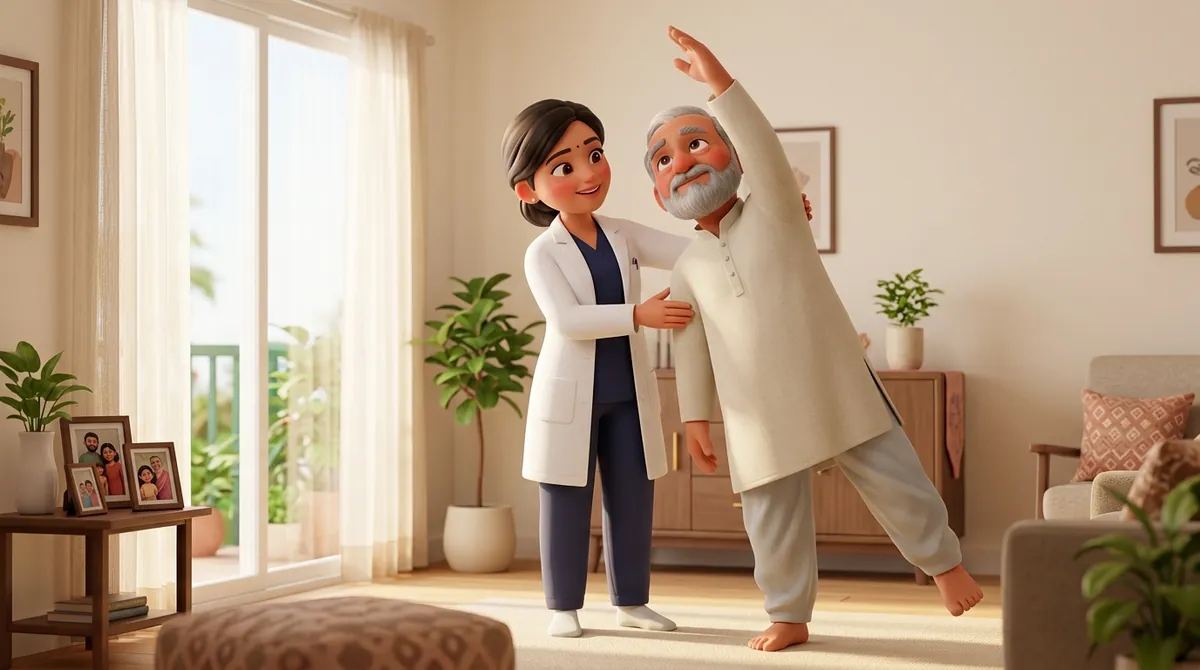
Seated Lateral Elongation and Mirror Biofeedback Drill
Objective: Lengthen contracted lateral trunk musculature and restore perceived postural midline
- 1Sit upright on a firm wooden chair directly in front of a full-length mirror, feet flat on the floor.
- 2Notice your lateral tilt in the mirror, identifying how your shoulder drops toward the side of the bend.
- 3Slowly raise the arm on the side of the tilt, reaching your fingertips up toward the ceiling.
- 4Gently reach up and over toward the opposite side, feeling a firm, comfortable stretch along your contracted side flank.
- 5Use the mirror to align your nose, sternum, and navel into one straight vertical line.
- 6Hold this corrected midline position for 15 seconds while breathing deeply into your ribs.
| Therapeutic Modality | Mechanism of Action | Clinical Target | Dosing / Application Guideline |
|---|---|---|---|
| Mirror Visual Biofeedback | Overrides distorted vestibular-proprioceptive verticality | Subconscious trunk tilting during quiet sitting | 10 minutes twice daily in front of full-length mirror |
| Therapeutic Kinesiology Taping | Cutaneous sensory cueing triggering lateral righting reflexes | Fatigue-induced tilting during prolonged walking | Y-strip applied from iliac crest to lower ribs on stretched side |
| Quadratus Lumborum Stretch | Elongates hypertonic, shortened lateral axial muscles | Side-bend contracture and deep flank muscular ache | Gentle passive lateral trunk elongation held for 30 seconds |
| Core Stabilization on Swiss Ball | Activates reciprocal trunk co-contraction | Impaired dynamic seated balance reactions | Gentle seated lateral pelvis tilts with therapist support |
Red Flags and Medical Escalation
Subacute onset of Pisa syndrome over days to weeks following changes in dopaminergic medication (such as the introduction of dopamine agonists, entacapone, or rapid dose titration of levodopa) requires urgent medical consultation for pharmacological re-balancing. If lateral flexion is fixed, rigid, and accompanied by radicular leg pain or urinary incontinence, urgent spinal imaging is required to evaluate for spinal stenosis or acute lumbar disc extrusion.
Frequently Asked Questions
can physiotherapy help manage Pisa syndrome completely?
Physiotherapy cannot helps manage Pisa syndrome or alter underlying basal ganglia pathology. However, targeted neuro physiotherapy helps manage motor fluctuations and improve mobility by stretching contracted lateral muscles, strengthening underactive stabilizers, and restoring vertical posture.
Do I need a doctor referral to see a physiotherapist for Pisa syndrome in India?
No doctor prescription is needed. Under the National Commission for Allied and Healthcare Professions (NCAHP) Act 2021, registered physiotherapists in India are autonomous healthcare practitioners. BookPhysio.in enables direct consultation with verified neuro physiotherapists with transparent pay-direct billing.
Related recovery guides & articles
BookPhysio.in Editorial Team
The BookPhysio.in editorial team writes and maintains this content, checking it against reliable clinical sources. Content follows our medical review policy: general information only, and no page claims a clinical review until a named registered physiotherapist has signed it off.
Read our medical review policy