
Polished Italian Marble and Granite Floor Slips: Indian Apartment Safety Strategies
In short
Mirror-finish marble and granite floors are prized in Indian apartments, but their low friction coefficient creates severe fall hazards. Discover how to protect seniors on slick stone surfaces.
In this guide (6 sections)
Polished Italian marble, crystalline granite, and mirror-finish vitrified tiles are widely installed across modern Indian apartments. While valued for their aesthetic appeal and cooling properties in tropical heat, these high-gloss stone surfaces present a formidable environmental fall risk for ageing occupants. Polishing processes eliminate microscopic surface asperities, creating an ultra-smooth finish with a very low dry coefficient of friction. When exposed to microscopic moisture, talcum powder, or vegetable oil splatters, these surfaces become practically frictionless, precipitating rapid slip-induced falls.
Domestic and Cultural Indian Realities
Indian domestic customs inadvertently amplify stone flooring hazards. The practice of walking barefoot or wearing smooth-soled cotton socks inside the home is widespread. Bare skin contact on polished stone provides marginal traction when completely dry, but foot perspiration quickly forms a lubricating liquid film that eliminates grip. Furthermore, daily domestic routines introduce unexpected hazards: wet-mopping (pocha) performed by household domestic workers leaves invisible thin water films that take long periods to evaporate. Dropped kitchen ingredients such as mustard seeds, spilled tea, ghee splatters, or stray prayer flower petals turn glossy marble walkways into severe slip zones for unsuspecting elderly residents.
Clinical Biomechanics and Postural Control Decay
A slip occurs when the frictional shear force between the shoe or foot and the floor is lower than the horizontal forward push during the heel-strike phase of walking. This friction deficiency is known as the required coefficient of friction (RCOF). On standard dry surfaces, safe walking demands an RCOF of approximately 0.35 to 0.50. High-gloss polished Italian marble drops to an RCOF below 0.20 when wet or greasy. At heel strike, the forward-moving foot slides forward uncontrollably. Because age-related sensory neuropathy delays foot-slip detection by fifty to eighty milliseconds, older adults cannot initiate an emergency hamstring contraction or backward trunk lean in time. The centre of mass remains behind the slipping foot, resulting in a violent backward fall onto the sacrum or hip.
Functional Assessment and Risk Stratification
Evaluating an older adult's vulnerability on polished stone requires assessing slip-recovery reactions and dynamic gait adaptations. Physiotherapists evaluate step length, cadence, and base of support. Seniors exhibiting a stiff, guarded gait with shortened steps and prolonged double-support time often have high fear of falling. Clinical slip-perturbation screening helps determine whether an individual possesses the reactive knee flexor torque needed to arrest an unexpected foot slide before hip ground impact occurs.
Targeted Strength and Balance Exercises
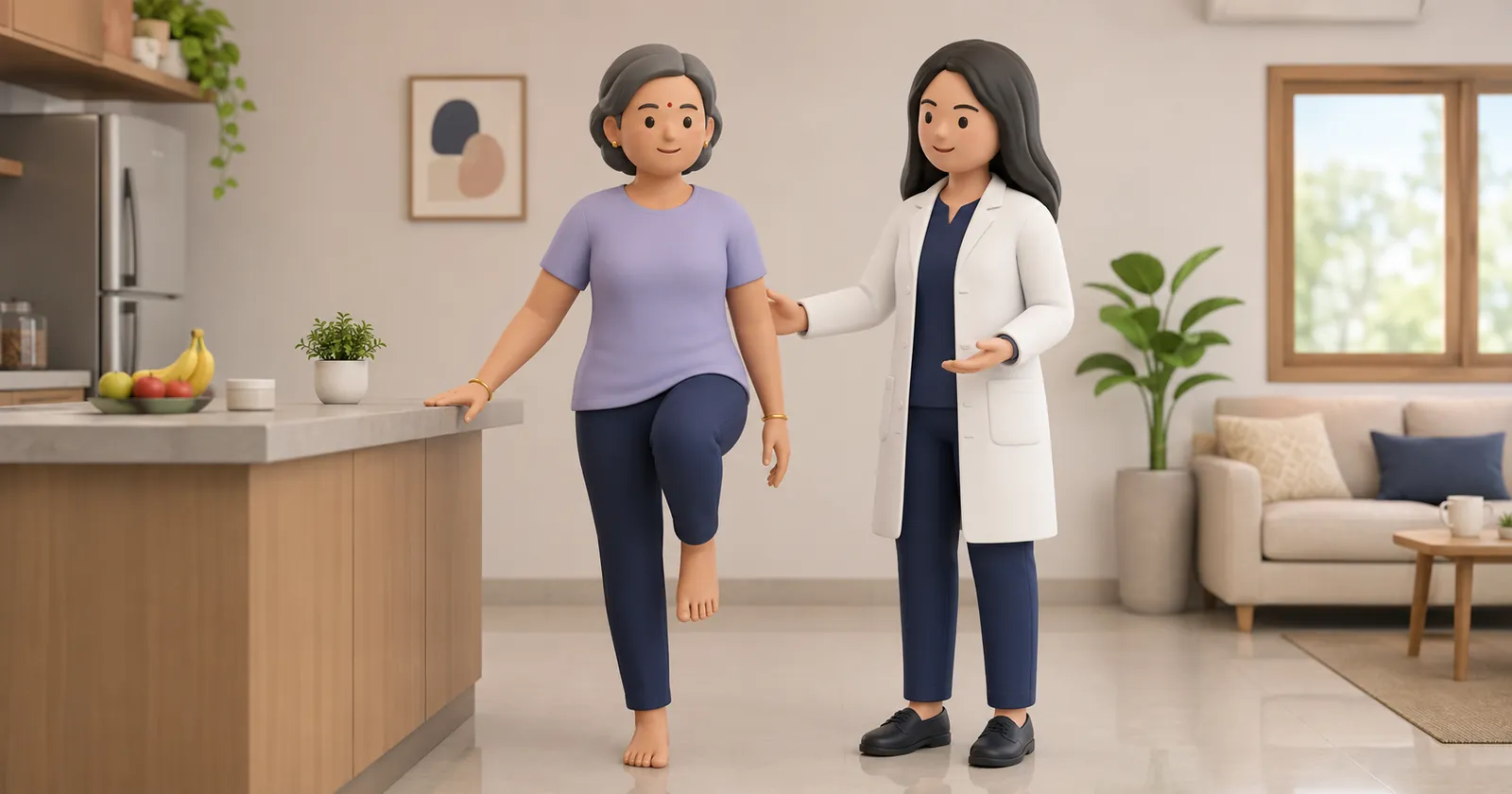
Rehabilitation focuses on retraining protective stepping reactions and building eccentric hamstring and gluteal strength. When slipping on slick surfaces, the primary biomechanical requirement is rapid knee flexion and hip extension to pull the slipping limb back beneath the body's centre of mass. Functional balance training also teaches seniors the 'penguin gait' adaptation: widening the base of support, taking shorter steps, and keeping the centre of gravity directly over the forward foot when navigating slick floors.
Reactive Eccentric Hamstring Pullbacks on Gliding Surface
Objective: Strengthen rapid posterior leg pulling mechanics required to recover from forward heel slips
- 1Stand tall with your back straight, holding onto the edge of a heavy, immovable wooden dining table.
- 2Place a small hand towel under the sole of your right foot on the smooth marble floor.
- 3Slide your right foot forward forty centimetres as if taking a step, keeping twenty percent of your weight on that foot.
- 4Quickly and forcefully dig your right heel down and pull the towel back under your hip using your hamstring muscles.
- 5Reset smoothly and repeat the movement with controlled rhythm before switching to the left leg.
| Flooring Material and Condition | Dynamic Coefficient of Friction (DCOF) | Elderly Safety Risk Classification |
|---|---|---|
| Polished Italian Marble (Dry) | 0.30 to 0.40 | Moderate slip hazard for frail seniors with impaired gait |
| Polished Italian Marble (Wet or Mopped) | 0.10 to 0.18 | Extreme fall hazard; immediate slip probability on heel strike |
| Honed or Flamed Granite (Dry) | 0.55 to 0.65 | Safe baseline surface for independent geriatric ambulation |
| Anti-Skid Treated Ceramic or Matte Tile | 0.60 or higher (Wet) | Meets international elderly wet safety benchmark standards |
Red Flags and Emergency Post-Fall Escalation
A high-impact slip on unyielding marble flooring frequently causes acute skeletal trauma. If an older adult slips and lands hard on their hip or lower back, avoid immediate attempts to lift them upright. Check for excruciating localized groin pain, hip deformity, or inability to perform an active straight leg raise, which indicate a fractured femoral neck or pelvic ring fracture. Direct impact to the occiput requires cervical spine stabilization and emergency medical evaluation to rule out acute intracranial hemorrhage or cervical disc rupture.
Frequently Asked Questions
How can families make slippery marble floors safer for elderly parents without replacing them?
Families can apply invisible microscopic chemical anti-slip etching treatments that increase the dynamic coefficient of friction without altering stone gloss. In addition, anchoring rubber-backed runner carpets along high-traffic corridors and enforcing non-skid indoor footwear significantly reduce slip hazards.
Can physiotherapy help an older person overcome severe fear of walking on slick floors?
Targeted balance retraining aims to reduce fall risk and build functional balance by improving reactive stepping, ankle stability, and postural confidence. BookPhysio.in connects families directly with qualified physiotherapists who provide home-based mobility assessments with direct session-based payment and no platform commission.
Related recovery guides & articles
BookPhysio.in Editorial Team
The BookPhysio.in editorial team writes and maintains this content, checking it against reliable clinical sources. Content follows our medical review policy: general information only, and no page claims a clinical review until a named registered physiotherapist has signed it off.
Read our medical review policy