
Polymyalgia Rheumatica Rehabilitation: Proximal Girdle Mobility and Gentle Motion
In short
Polymyalgia rheumatica produces profound bilateral shoulder and pelvic girdle aching with debilitating morning stiffness. Learn gentle proximal mobility sequences, active-assisted wand routines, and corticosteroid tapering pacing.
In this guide (6 sections)
Polymyalgia rheumatica is an inflammatory rheumatic disorder predominantly affecting adults over the age of 50, characterized by severe, symmetrical aching and stiffness across the shoulder girdle, pelvic girdle, and neck. While patients experience profound difficulty performing basic functional tasks such as raising their arms to comb hair or rising from a low chair, true muscle weakness is absent; movement restriction is primarily driven by excruciating pain originating from bilateral subacromial-subdeltoid bursitis, biceps tenosynovitis, and hip trochanteric bursitis. While systemic glucocorticoid therapy induces rapid symptomatic relief, structured physiotherapy is vital to prevent secondary adhesive capsulitis, correct compensatory movement patterns, and counteract steroid-induced muscle catabolism.
Domestic and Cultural Indian Realities
In Indian households, elderly individuals developing polymyalgia rheumatica often struggle silently with everyday morning rituals. Fastening a saree blouse behind the back, donning a kurta, or lifting a brass lota of water during morning prayers becomes nearly impossible due to bilateral shoulder stiffness. Getting up from low floor-level mattresses, rope charpoys, or traditional squatting pans triggers intense pain across the pelvic girdle and trochanteric regions. Families must provide supportive wooden armchairs with high seat bases (at least 18 inches), install sturdy grab bars beside Western commodes, and introduce front-opening garments to eliminate extreme shoulder internal rotation during dressing until morning stiffness recedes.
Clinical Biomechanics and Inflammatory Pathology
The anatomical epicenter of polymyalgia rheumatica is the periarticular synovial structures rather than glenohumeral or acetabulofemoral articular cartilage. Ultrasound and magnetic resonance imaging characteristically demonstrate bilateral subacromial-subdeltoid bursitis, long head of biceps tenosynovitis, and greater trochanteric bursitis. Marked systemic inflammation is driven by interleukin-6 (IL-6) overproduction. Because the bursal walls become thickened and vascularized, active arm elevation creates painful subacromial impingement, while hip abduction compresses inflamed trochanteric bursae. Physiotherapy protocols must emphasize passive and active-assisted movements in scapular planes to maintain capsular excursion without compressing irritated bursal tissues.
Clinical Assessment and Functional Staging
Clinical staging combines the EULAR/ACR provisional criteria with objective functional measurements. Clinicians assess bilateral active and passive shoulder elevation, external rotation, and hip abduction using a standard goniometer. Inflammatory markers, specifically erythrocyte sedimentation rate (ESR) and C-reactive protein (CRP), are monitored closely in coordination with the rheumatologist to calibrate exercise intensity alongside oral steroid tapering. The Timed Up and Go (TUG) test and 30-Second Chair Stand test provide objective markers of pelvic girdle functional progression.
Targeted Mobility and Joint Preservation Exercises
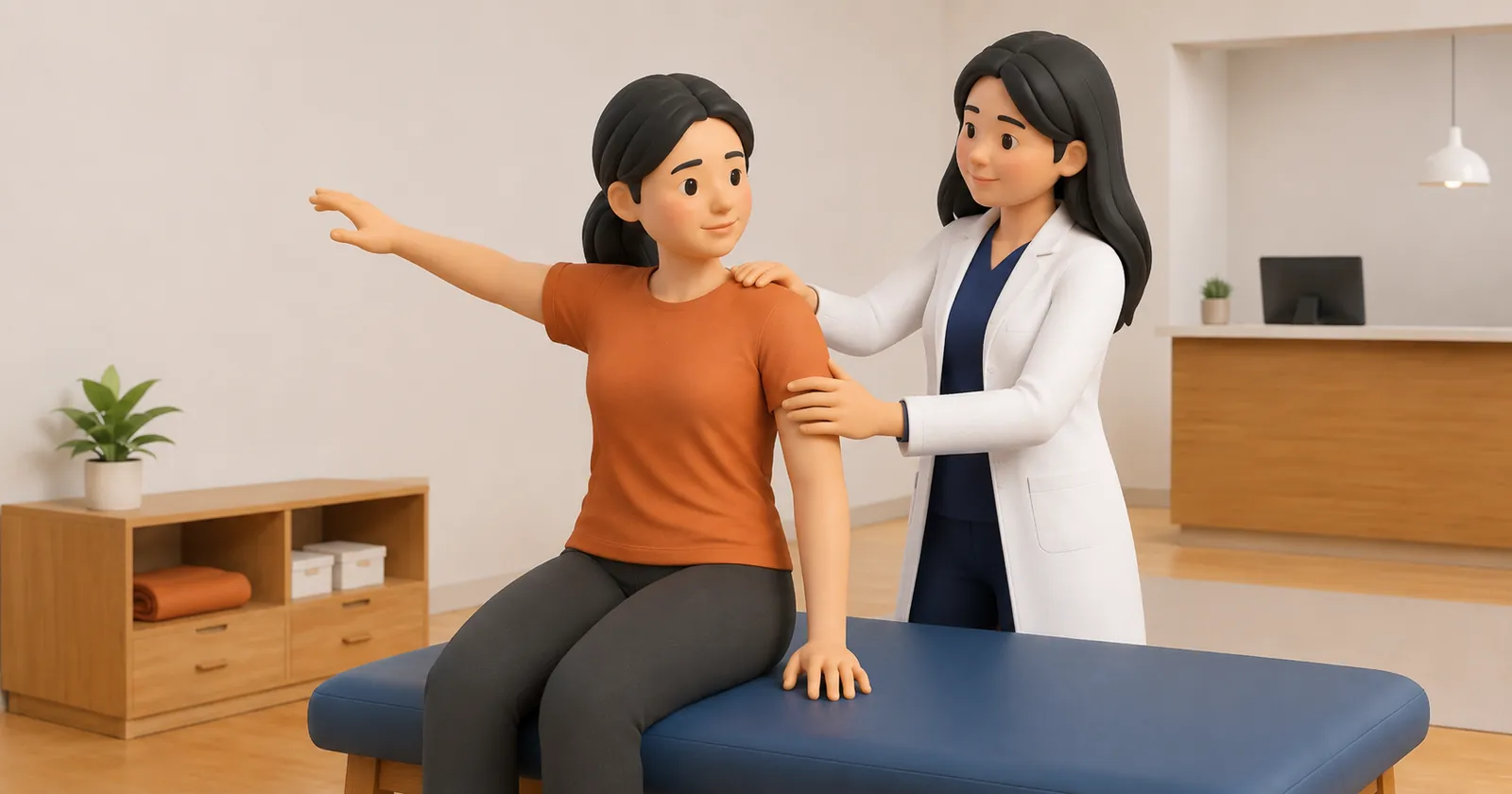
During initial rehabilitation, all shoulder movements should be performed in the plane of the scapula (approximately 30 degrees anterior to the coronal plane) using an active-assisted wand to eliminate muscular strain across the inflamed rotator cuff.
Supine Active-Assisted Scapular Plane Wand Elevation
Objective: Restore glenohumeral forward elevation without provoking subacromial bursal impingement or neck guarding
- 1Lie flat on your back on a firm bed with your knees bent and feet flat, holding a lightweight wooden dowel or walking stick across your hips with both hands.
- 2Keep your elbows straight and grip the stick shoulder-width apart with your palms facing downward.
- 3Slowly raise the stick upward toward the ceiling and overhead into a comfortable arc, using your unaffected arm to guide the movement.
- 4Pause at the comfortable limit of motion for 3 seconds, then slowly lower the stick back to your thighs while exhaling smoothly.
| Recovery Stage | Acute Inflammatory Stage (High ESR/CRP) | Tapering & Maintenance Stage |
|---|---|---|
| Shoulder Mobility | Supine active-assisted wand exercises within pain-free boundaries; pendulum swings | Active unassisted multi-plane mobility, wall slides, and scapular retraction |
| Pelvic Girdle Care | Supported sit-to-stand from elevated 20-inch chair; gentle supine bridging | Closed-chain mini-squats, side-stepping, and progressive gluteal strengthening |
| Resistance Training | Zero external resistance; avoid loading inflamed rotator cuff and trochanteric bursae | Light elastic band resistance and light hand weights to combat steroid muscle atrophy |
| Cardiovascular Work | Short 10-minute bouts of level indoor walking on flat supportive surfaces | Progressive 30-minute outdoor or treadmill walking and low-impact stationary cycling |
Red Flags and Immediate Rheumatology Escalation
Up to 20 percent of patients with polymyalgia rheumatica develop concurrent giant cell arteritis (temporal arteritis), which represents a sight-threatening medical emergency. Immediate medical escalation is mandatory if the patient experiences new-onset temporal headache, scalp tenderness while combing hair, jaw claudication (fatigue or pain while chewing), or sudden visual disturbances such as transient blurring, double vision, or loss of sight. Urgent high-dose systemic corticosteroid therapy is required to prevent permanent blindness.
Frequently Asked Questions
Can physiotherapy replace steroid medications in polymyalgia rheumatica?
No. Polymyalgia rheumatica is driven by severe systemic immune inflammation that requires systemic medical therapy, usually oral corticosteroids prescribed by a physician or rheumatologist. Physiotherapy does not replace medication, but it helps manage morning stiffness, restores functional girdle mobility, and prevents corticosteroid-induced muscle wasting and osteopenia.
How do I book a qualified home physiotherapist for polymyalgia rheumatica on BookPhysio.in?
Under the National Commission for Allied and Healthcare Professions (NCAHP) Act 2021, patients in India can consult registered physiotherapists directly without a doctor prescription. On BookPhysio.in, you select a verified home-care clinician in your city. Payment is made directly to the therapist at your home appointment via cash or UPI; BookPhysio.in does not process booking fees online.
Related recovery guides & articles
BookPhysio.in Editorial Team
The BookPhysio.in editorial team writes and maintains this content, checking it against reliable clinical sources. Content follows our medical review policy: general information only, and no page claims a clinical review until a named registered physiotherapist has signed it off.
Read our medical review policy