
Pooja Chowki Elevation for Arthritic Joints: Preserving Elderly Knees and Hips in Prayer
In short
Traditional low-level prayer chowkis impose devastating shear loads on arthritic knees and hips. Learn how elevating pooja chowkis, using supportive prayer chairs, and adopting safe sit-to-stand mechanics preserve spiritual rituals without joint destruction.
In this guide (6 sections)
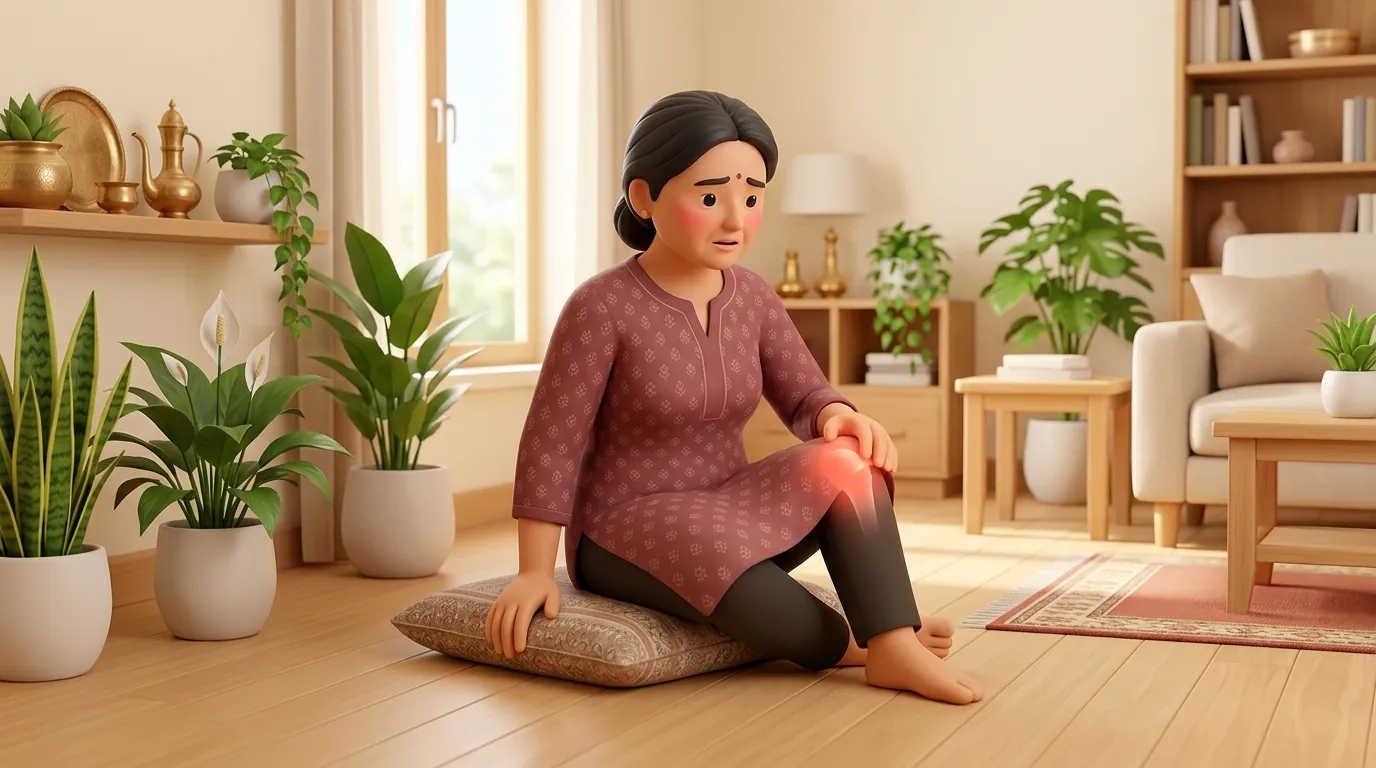
In Indian society, spiritual worship and daily pooja rituals are cornerstone elements of emotional and cultural well-being, particularly for elderly individuals. Traditional devotional practices frequently require sitting on a very low wooden stool (chowki or patla) measuring merely 2 to 4 inches off the floor, or sitting directly on a floor mat in cross-legged posture for extended periods. For an older adult managing rheumatoid arthritis or severe osteoarthritis of the knees and hips, descending to and rising from a low chowki imposes massive compressive forces across eroded articular cartilage. The extreme knee flexion past 120 degrees generates patellofemoral joint contact pressures exceeding seven times body weight. Elevating the pooja chowki and adapting worship ergonomics is critical to preserve joint integrity while supporting cultural devotion.
Domestic and Cultural Indian Realities
Many elderly individuals in Indian families experience intense internal guilt or fear of religious disrespect if they do not sit on the floor during prayers or when bowing before sacred idols. Patients will frequently endure excruciating joint pain, relying on family members to haul them up from the floor by their arms, which risks shoulder subluxation. Families must reframe this perception: devotion is spiritual, not postural. Introducing an aesthetically designed, raised wooden prayer chowki measuring 18 to 20 inches in height, equipped with sturdy bilateral wooden armrests and comfortable padding, enables elders to conduct prayers with dignity, comfort, and zero joint destruction.
Clinical Biomechanics and Inflammatory Pathology
The biomechanics of rising from low surfaces reveal that knee joint reaction force rises non-linearly as seat height decreases below knee level. At a seat height of 4 inches, the quadriceps extensor mechanism must generate enormous tensile forces to overcome the large external moment arm created by the trunk. In rheumatoid arthritis, where synovial pannus has thinned the retropatellar cartilage and weakened the cruciate ligaments, these excessive contact pressures cause rapid cartilage shearing and severe anterior knee pain. By elevating the seat height to 18 or 20 inches, the required knee flexion angle is reduced to 90 degrees, decreasing peak patellofemoral compressive force by more than 60 percent and enabling safe, independent sit-to-stand transfers.
Clinical Assessment and Functional Staging
Functional evaluation focuses on transfer independence and quadriceps power. Physiotherapists administer the 30-Second Chair Stand Test using standardized chair heights, assessing knee stability, trunk flexion compensation, and hand support reliance. Active and passive knee flexion-extension range of motion is recorded with a goniometer. Clinicians inspect the knees for suprapatellar effusion, crepitus, and valgus or varus malalignment and ensure that exercise dosing matches current joint capacity.
Targeted Mobility and Joint Preservation Exercises
Rehabilitation focuses on strengthening the quadriceps, hamstrings, and gluteal musculature using closed-chain seated transfers to build functional capacity for prayer rituals.
Elevated Seated Sit-to-Stand with Armrest Assistance
Objective: Train functional knee extensor and gluteal power in safe mid-range arcs without patellofemoral overload
- 1Sit tall on an elevated 19-inch sturdy wooden chair with your feet flat on the floor, shoulder-width apart, and heels placed slightly behind your knees.
- 2Grasp the armrests firmly with both hands and lean your upper body forward from your hips (nose over toes).
- 3Push through your heels and straighten your legs to stand upright smoothly, using your arms for balanced support.
- 4Pause in tall standing for 2 seconds, then slowly hinge back at your hips to sit down gently without collapsing.
| Pooja Element | Joint-Preserving Ergonomic Adaptation | Traditional High-Compression Hazard |
|---|---|---|
| Seating Platform | Elevated wooden chowki or prayer chair (18 to 20 inches height) with firm padded seat and armrests | Low floor stool (2 to 4 inches) or thin prayer mat placed directly on cold stone floor |
| Altar Positioning | Wall-mounted or elevated table pooja mandir positioned at eye and chest level | Floor-level altar requiring repeated deep squatting, bending, and prostrating |
| Transfer Assistance | Pushing evenly through bilateral sturdy wooden armrests to stand independently | Pulling on unstable small tables or being jerked upward by family members |
| Foot Placement | Resting feet on a non-slip warm wooden footrest or wearing soft indoor supportive shoes | Direct contact of bare arthritic feet on frigid marble flooring triggering vasoconstriction |
Red Flags and Immediate Rheumatology Escalation
Immediate medical escalation is necessary if an elderly patient experiences sudden knee giving way accompanied by acute severe effusion and inability to bear weight, which may indicate acute cruciate ligament rupture or a tibial plateau insufficiency fracture in osteopenic bone. Persistent calf swelling and tenderness after transfer struggles require urgent Doppler ultrasound to exclude deep vein thrombosis.
Frequently Asked Questions
Does elevating the pooja chowki compromise traditional religious sanctity?
No religious scriptures mandate joint destruction for authentic devotion. Modifying the seating height protects the biological body while enabling complete spiritual focus and participation. Using an elevated 18 to 20 inch prayer chair allows elderly individuals to pray comfortably without pain, preventing debilitating joint subluxation and falls.
How do I arrange a home safety and transfer assessment for my elderly parents through BookPhysio.in?
Under the National Commission for Allied and Healthcare Professions (NCAHP) Act 2021, Indian patients have direct access to registered physiotherapists without an obligatory doctor referral. On BookPhysio.in, you schedule an appointment with a verified home-care clinician in your city. Payment is made directly to the therapist at your home appointment via cash or UPI; BookPhysio.in does not process booking fees online.
Related recovery guides & articles
BookPhysio.in Editorial Team
The BookPhysio.in editorial team writes and maintains this content, checking it against reliable clinical sources. Content follows our medical review policy: general information only, and no page claims a clinical review until a named registered physiotherapist has signed it off.
Read our medical review policy