
Pooja Room Safety: Overhead Bell Ringing and Safe Floor Bowing Transitions in Seniors
In short
Morning worship rituals involve hazardous postural transitions: overhead bell ringing and floor bowing. Discover how to adapt pooja room ergonomics for senior safety.
In this guide (6 sections)
The pooja room (mandir) holds central spiritual and emotional significance in the lives of millions of older Indians. Daily devotional rituals (worship, aarti, and meditation) provide emotional comfort and community connection. However, pooja rooms frequently feature high environmental fall risks: smooth marble flooring, dropped flower petals and water splatters, burning oil lamps (diyas), high-hanging brass bells requiring overhead reaching, and deep prostrations (sashtanga pranama) requiring floor transitions. Modifying mandir ergonomics preserves spiritual routines while protecting senior balance.
Domestic and Cultural Indian Realities
Pooja rituals require seniors to enter barefoot, often before breakfast in cold morning hours. Traditional practices dictate ringing a heavy brass bell suspended from the ceiling or doorframe. Because bells are often mounted high, older adults must stand on tiptoes, crane their necks backward in extreme cervical hyperextension, and stretch one arm overhead. Furthermore, completing aarti often involves performing full floor-touching prostrations (pranamas) onto hard marble tiles. Seniors with knee osteoarthritis and sarcopenia struggle to rise from the floor, clutching altar edges or slippery brass pedestal stands that tip over, spilling burning oil.
Clinical Biomechanics and Postural Control Decay
Ringing an overhead bell while standing on tiptoes reduces the base of support to the metatarsal heads, while cervical hyperextension compresses the suboccipital region. In seniors with cervical spondylosis or vertebrobasilar insufficiency, this head-back position reduces blood flow through the vertebral arteries, triggering transient brainstem ischemia, dizziness, and drop attacks. Concurrently, rising from a full floor pranama requires substantial quadriceps and hip extensor torque. When leg strength is insufficient, seniors rock backward, losing control and landing hard on their sacrum.
Functional Assessment and Risk Stratification
Clinical evaluation observes the senior performing simulated prayer transitions: standing on tiptoes, looking upward at a ceiling target for ten seconds, and transferring between sitting and standing from varied altar heights. Seniors who experience nystagmus, lightheadedness, or postural sway during upward gaze, or who cannot rise from a low stool without hand support, require immediate pooja room adaptations.
Targeted Strength and Balance Exercises
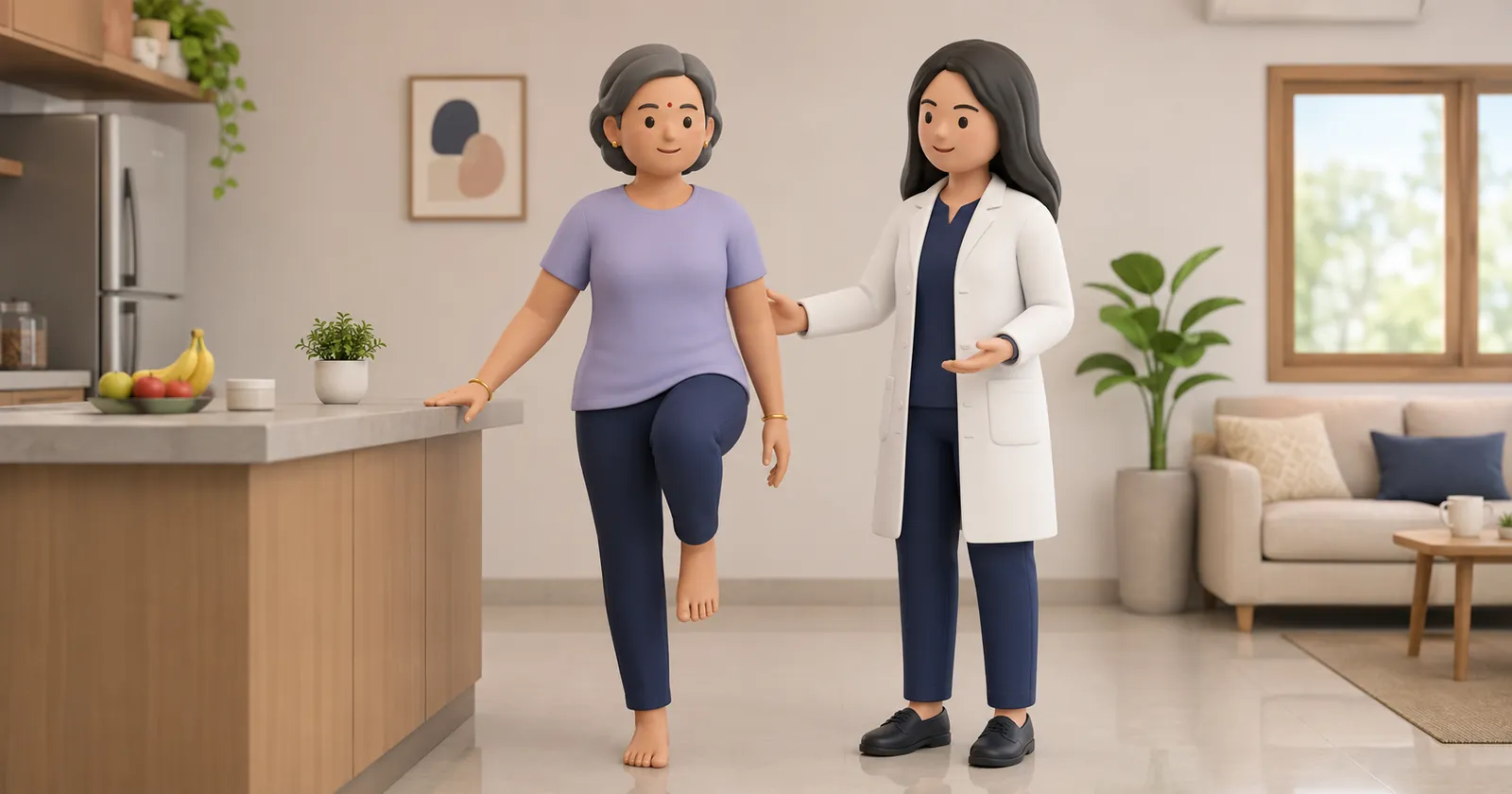
Physiotherapy rehabilitation focuses on strengthening hip extensors, improving ankle plantarflexor endurance, and training cervical proprioception. Patients also learn the adapted seated prayer transition, allowing respectful worship from a firm chair without risking floor collapse.
Supported Calf Raise and Gaze-Upward Balance Drill
Objective: Strengthen calf stabilizers and desensitize cervical extension during overhead prayer reaching
- 1Stand tall facing a sturdy wall, holding firmly onto a wall-mounted rail with both hands.
- 2Gently raise both heels off the floor five centimetres, supporting weight on the balls of your feet.
- 3While holding the heel raise, tilt your head backward fifteen degrees to look gently upward toward the ceiling.
- 4Hold this position for three seconds while breathing steadily, verifying your head feels completely clear.
- 5Lower your heels smoothly to the floor and return your head to a neutral forward gaze.
| Ritual Component | Traditional Practice Hazard | Adapted Senior Safety Modification |
|---|---|---|
| Overhead Brass Bell | High mounting forces senior onto tiptoes with neck hyperextension | Lower bell chain to shoulder height (140 cm) or switch to a handheld bell |
| Floor Pranama (Bowing) | Full prostration onto hard floor; severe transfer collapse risk | Perform standing or seated bowed-head pranama (anjali mudra) from a sturdy chair |
| Floor Seating (Chowki / Asana) | Sitting on low 10 cm wooden chowki causes joint entrapment | Install a cushioned wooden armchair with firm armrests at 48 cm seat height |
| Marble Floor Slickness | Water, milk, ghee, and flower petals create severe slip zones | Place secure rubber-backed washable non-skid runners across prayer walkways |
Red Flags and Emergency Post-Fall Escalation
Falls occurring in pooja rooms carry risks of severe burn trauma if the falling senior strikes oil lamps (diyas) or brass incense burners. If an elder falls in the mandir, check immediately for burn injuries and extinguish any open flames. Assess for hip and pelvic fractures; sharp groin pain upon passive leg movement demands complete immobilization. Do not attempt to force the senior upright; summon emergency medical transport immediately.
Frequently Asked Questions
Is it religiously acceptable for an older Indian to perform prayers seated in a chair?
Traditional Hindu, Jain, and Sikh scriptures explicitly validate seated prayer (asanam) for individuals with physical limitations or advanced age. Respectful devotional intent (bhakti) is paramount; seated prayer preserves spiritual practice while protecting physical safety.
Can physiotherapists help adapt pooja room exercises for elderly parents in India?
Geriatric physiotherapists design customized prayer transfer protocols, recommend bell adjustments, and train safe floor transitions. Under the NCAHP Act 2021, Indian patients enjoy direct access to registered physiotherapists. BookPhysio.in connects you with verified physiotherapists for home consultations with direct session payments.
Related recovery guides & articles
BookPhysio.in Editorial Team
The BookPhysio.in editorial team writes and maintains this content, checking it against reliable clinical sources. Content follows our medical review policy: general information only, and no page claims a clinical review until a named registered physiotherapist has signed it off.
Read our medical review policy