
Postpartum Coccydynia: Tailbone Pain Relief, Hard Floor Sitting Adaptations, and Coccyx Cushions in India
In short
Severe pain at the tip of the tailbone after childbirth makes sitting down excruciating. Learn how to offload the coccyx, adapt floor sitting for pooja, and restore pelvic floor balance.
In this guide (6 sections)
Postpartum coccydynia, localised, sharp pain at the sacrococcygeal joint or the tip of the tailbone, is a distressing musculoskeletal complication following vaginal childbirth. During the second stage of labour, the fetal head pushes the coccyx posteriorly by up to 2 centimetres to expand the pelvic outlet. In cases involving rapid delivery, instrumental assistance (forceps or vacuum), or a narrow sub-pubic arch, the sacrococcygeal joint can be sprained, subluxated, or hypermobilised. In India, where daily family life involves sitting on hard tiled or marble floors for prayers, dining, or cradling an infant, coccydynia severely impairs daily functioning. Structured pelvic physiotherapy and proper ergonomic offloading provide rapid, lasting relief.
1. Functional Biomechanics: Sacrococcygeal Joint Hypermobility and Muscular Attachments
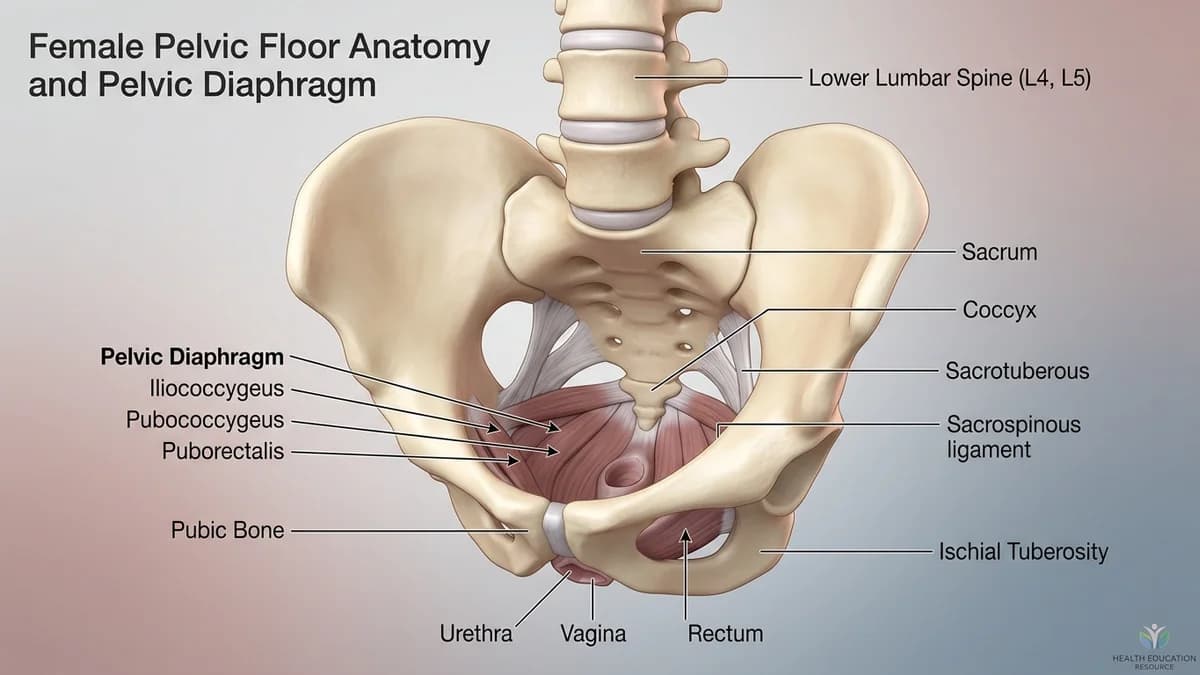
The coccyx serves as an essential biomechanical weight-bearing tripod anchor along with the bilateral ischial tuberosities. It serves as the distal insertion site for key pelvic structures: the pubococcygeus, iliococcygeus, and coccygeus muscles anteriorly, the gluteus maximus posteriorly, and the sacrotuberous and sacrospinous ligaments laterally. When the sacrococcygeal joint is traumatised during delivery, these attached muscular fibres develop protective spasm, pulling the mobile coccyx anteriorly into rigid flexion or lateral deviation. Sitting on a flat surface presses directly against this hypermobile, inflamed bony segment, triggering sharp periosteal pain.
2. Domestic Indian Context: Daily Chores, Ergonomics, and Privacy
Traditional Indian lifestyle habits directly exacerbate coccydynia. Resting on firm wooden diwans, sitting cross-legged on marble floors during pooja, and leaning backward on soft mattresses while breastfeeding place the entire torso weight directly upon the coccyx. In addition, mothers often lean backward while feeding their baby on the bed, adopting a slouched 'sacral sitting' posture. Practical solutions include using a specialised U-shaped or wedge coccyx cushion with a posterior cutout, sitting upright on the ischial sit bones with a lumbar roll, and avoiding soft, sagging sofas that force the pelvis into posterior tilt.
3. Clinical Special Tests and Physical Examination
Clinical assessment involves external palpation of the sacrococcygeal joint line, lateral coccygeal borders, and the sacrotuberous ligaments to reproduce familiar pain. The sit-to-stand provocation test assesses whether transitioning from sitting to standing provokes sharp catching pain. When clinically indicated, an internal pelvic digital palpation assesses coccygeal hypermobility, resting spasm of the pubococcygeus and coccygeus muscles, and evaluates for trigger points.
| Sitting Surface | Pelvic Position | Coccyx Pressure Level | Clinical Recommendation |
|---|---|---|---|
| Hard Floor (Marble / Tiles) | Direct posterior pelvic contact | Maximum focal bone compression | Strictly avoid; use thick mat or chair |
| Soft Sagging Sofa or Bed | Excessive posterior sacral tilting | High sustained shear on ligaments | Avoid; place firm board or sit upright |
| Firm Chair with Lumbar Roll | Anterior pelvic tilt on sit bones | Minimal direct tailbone contact | Recommended for meals and desk work |
| U-Shaped Cutout Cushion | Weight distributed on ischial bones | Zero contact (coccyx suspended in air) | Gold standard for feeding and travel |
4. Stage-by-Stage Functional Physiotherapy Protocol
Rehabilitation centres on immediate mechanical offloading, myofascial release of attached levator ani and gluteal fibres, and restoring pelvic tilt motor control.
Phase 1: Proper Ischial Weight-Bearing and Coccyx Cushion Fitting
Objective: Eliminate mechanical contact on the inflamed tailbone during all daytime sitting.
- 1Place a firm foam wedge cushion with a rear U-shaped cutout on your chair or car seat. Position the cutout toward the back.
- 2Sit down so your two ischial tuberosities (sit bones) rest firmly on the solid foam wings.
- 3Verify that your tailbone hovers freely over the open cutout without touching the chair base.
- 4Place a small rolled towel behind your lower back to maintain a slight forward pelvic tilt, keeping weight forward on your thighs.
- 5Never use a hollow doughnut ring, as doughnut cushions compress the surrounding pelvic floor muscles inward and worsen local tension.
Phase 2: Gentle Piriformis and Gluteal Myofascial Release
Objective: Release tension in the gluteus maximus and lateral rotators that pull asymmetrically on the coccyx.
- 1Lie comfortably on your back with both knees bent and feet flat on the floor.
- 2Cross your right ankle over your left knee in a 'figure-4' position.
- 3Gently reach your hands around the back of your left thigh and draw your left knee toward your chest.
- 4Feel a deep, comfortable stretch in your right outer buttock without provoking tailbone pain.
- 5Hold for 30 seconds while taking slow, relaxed breaths, then switch smoothly to the left side.
Phase 3: Deep Squat Coccyx Decompression (Malasana Modification)
Objective: Gently stretch and elongate the levator ani and anococcygeal ligament under relaxed diaphragmatic breathing.
- 1Stand with your feet wider than shoulder-width apart, holding onto a sturdy kitchen counter or door frame for balance.
- 2Lower your hips into a comfortable supported squat, keeping your heels flat or resting them on a folded towel.
- 3Allow your pelvic floor to relax and widen completely toward the floor.
- 4Take 5 to 6 deep diaphragmatic breaths, feeling your tailbone gently move backward and unclamp with each exhalation.
- 5Press through your hands and feet to stand up smoothly without straining.
Seek immediate medical consultation if you experience: severe pain accompanied by a visible swelling or draining sinus near the natal cleft (indicating an infected pilonidal abscess), numbness in your saddle area, unexplained bowel incontinence, or severe bone pain that wakes you from sleep and is unrelated to sitting.
5. Clinic Consultation, Home Visits, and Transparent Fee Benchmarks
In India, under the National Commission for Allied and Healthcare Professions (NCAHP) Act 2021, patients can consult a registered physiotherapist directly without an upfront referral, though BookPhysio.in does not ask for one. Pelvic health physiotherapists perform internal and external sacrococcygeal mobilisation to gently realign a subluxated coccyx. Clinic consultations in major Indian cities range between ₹500 and ₹1,500, with home visits ranging from ₹700 to ₹2,000 for mothers unable to sit comfortably during travel. Patients pay their physiotherapist directly at each appointment, with no platform commission.
6. Frequently Asked Questions
Why did my doctor say not to use a round doughnut cushion for tailbone pain?
While circular doughnut cushions remove direct contact from the centre, they concentrate all body weight onto the surrounding pelvic floor muscles and ischiorectal fossa. This inward squeezing increases resting tension in the levator ani and pudendal nerve branches, frequently worsening coccydynia. A wedge cushion with an open posterior U-shaped cutout is far superior because it supports the thighs and sit bones while leaving the coccyx completely free.
How long does postpartum tailbone pain take to resolve in India?
With proper ergonomic offloading using a cutout cushion and targeted pelvic floor physiotherapy, acute postpartum coccydynia typically improves noticeably within 3 to 6 weeks. Chronic cases where the tailbone was pulled into anterior spasm may require 8 to 12 weeks of gentle manual therapy and postural correction.
Related recovery guides & articles
BookPhysio.in Editorial Team
The BookPhysio.in editorial team writes and maintains this content, checking it against reliable clinical sources. Content follows our medical review policy: general information only, and no page claims a clinical review until a named registered physiotherapist has signed it off.
Read our medical review policy