
Postpartum Urinary Retention: Catheter Weaning, Bladder Sensory Re-Education, and Recovery in India
In short
Being unable to urinate after giving birth is frightening and painful. Discover how post-void residual checks, catheter weaning, and pelvic floor relaxation restore bladder control.
In this guide (6 sections)
Postpartum urinary retention (PUR), the inability to spontaneously void within 6 hours of vaginal delivery or catheter removal following caesarean section, or voiding only small amounts with high residual volumes, affects up to 14 percent of new mothers in India. Factors like prolonged second-stage labour, epidural analgesia, perineal tears, instrumental delivery, or severe periurethral edema can temporarily silence bladder sensation. When a new mother cannot pass urine, the bladder can rapidly overfill to over 1,000 millilitres, stretching the detrusor muscle fibres and risking permanent detrusor atony. Early identification, safe catheter management, and pelvic floor sensory re-education are essential to restore normal voiding reflexes.
1. Functional Biomechanics: Detrusor Atony and Pudendal Neuropraxia
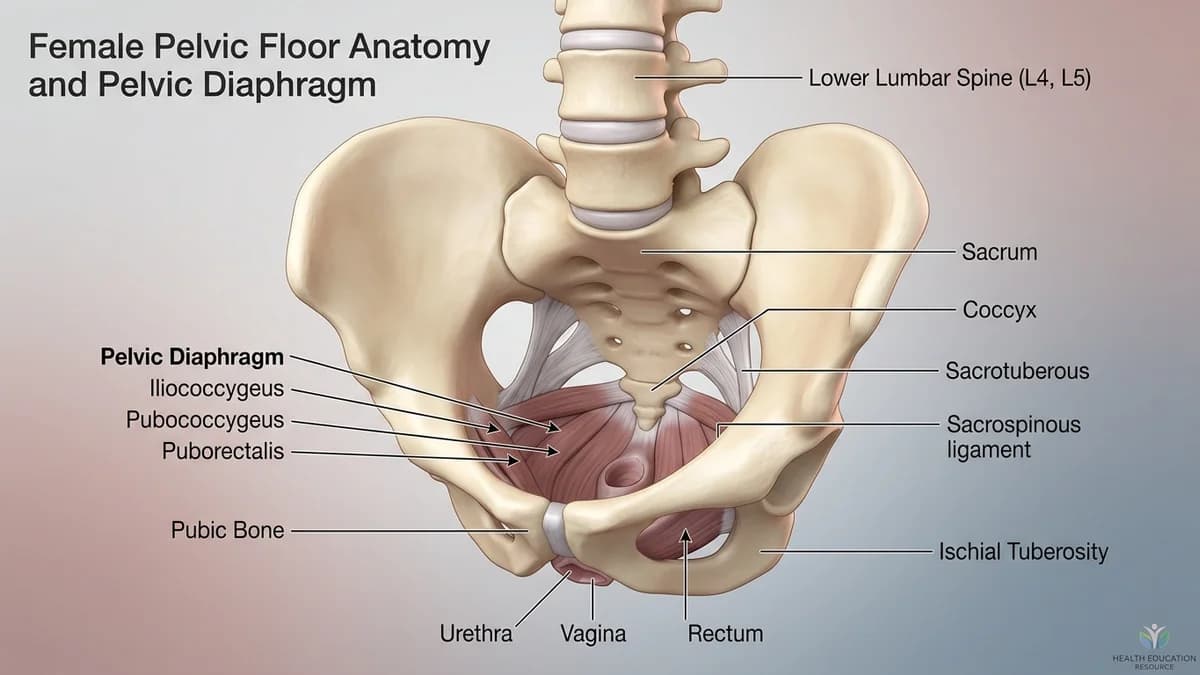
Voiding is regulated by the micturition reflex: sensory stretch receptors in the detrusor wall transmit signals via pelvic parasympathetic nerves (S2-S4) to the sacral cord and pontine micturition centre. During prolonged labor or instrumental delivery, compression of the fetal head against the maternal pelvis can cause transient neuropraxia of the pudendal and pelvic splanchnic nerves. In addition, epidural local anaesthetics temporarily block autonomic bladder stretch sensation. If the bladder over-distends, the myofilaments within detrusor smooth muscle cells are stretched beyond their physiological cross-bridge overlap, temporarily paralyzing the bladder's ability to contract forcefully.
2. Domestic Indian Context: Daily Chores, Ergonomics, and Privacy
In Indian maternity wards and home recovery environments, new mothers are often overwhelmed by visitors, infant feeding demands, and perineal pain. Modesty surrounding shared family bathrooms or fear of stinging over an episiotomy stitch often leads mothers to resist urinating. Sitting tensely on high western commodes with knees clamped shuts off the pelvic floor relaxation reflex. Physiotherapists intervene by demystifying bladder recovery, teaching pain-free voiding postures using warm water rinses, and establishing structured voiding schedules to prevent silent bladder over-distension.
3. Clinical Special Tests and Physical Examination
Assessment begins by categorizing PUR as overt (complete inability to void) or covert (spontaneous voiding occurs, but post-void residual urine volume exceeds 150 millilitres). Post-void residual (PVR) is measured non-invasively using a portable bladder ultrasound scanner or via in-and-out catheterization immediately after voiding. Physical examination evaluates perineal hematoma, periurethral swelling, and pelvic floor reflex relaxation.
| Clinical Type | Post-Void Residual (PVR) | Patient Presentation | Immediate Clinical Management |
|---|---|---|---|
| Overt PUR (Acute) | Unable to void; bladder holds >500 ml | Painful distended lower abdomen, fullness | Immediate catheter decompression for 24-48 hrs |
| Covert PUR (Silent) | Voids small volumes, PVR > 150 ml | Frequent dribbling, incomplete sensation | PVR monitoring, timed double voiding, physio |
| Recovering Phase | PVR between 50 and 150 ml | Improving sensation, steady urine stream | Pelvic down-training, fluid scheduling |
| Fully Resolved | PVR under 50 ml | Normal voluntary voiding and full relief | Standard postpartum pelvic maintenance |
4. Stage-by-Stage Functional Physiotherapy Protocol
Rehabilitation centres on protecting the detrusor muscle from over-stretching, desensitising perineal pain reflexes, and re-establishing the voiding reflex.
Phase 1: Warm Water Sensory Reflex Stimulation Protocol
Objective: Trigger parasympathetic micturition reflexes and relax periurethral sphincter spasm without pushing.
- 1Sit comfortably on the toilet with your feet supported flat on a small stool.
- 2Turn on the bathroom sink tap so the sound of running water provides auditory stimulation.
- 3Fill a peri-bottle with comfortably warm water and pour it gently over your perineum while sitting on the commode.
- 4The warmth relieves stinging over stitches and reflexively relaxes the striated urethral sphincter.
- 5Take slow breaths through open lips and wait for the stream to initiate without straining.
Phase 2: Timed Voiding and Double-Voiding Technique
Objective: Prevent bladder overfilling and ensure complete evacuation of residual urine.
- 1Set an alarm to visit the bathroom every 2 to 3 hours, regardless of whether you feel an urge.
- 2Sit and allow urine to flow freely until the stream finishes naturally.
- 3Stand up from the toilet, take 5 slow steps around the bathroom, and sit back down on the seat.
- 4Lean slightly further forward, rest your forearms on your knees, and exhale softly.
- 5Allow any remaining residual urine to empty completely without bearing down.
Phase 3: Deep Diaphragmatic Pelvic Drop and Sphincter Release
Objective: Overcome fear-induced pelvic floor guarding that obstructs the urethral lumen.
- 1Lie on your back with knees bent and feet flat on the floor, placing a hand on your lower belly.
- 2Inhale deeply through your nose, expanding your lower abdomen and pelvic bowl.
- 3Consciously focus on releasing all tension around your urethra, vagina, and anus.
- 4Imagine a tight fist gently opening and softening completely.
- 5Exhale softly, maintaining this open, relaxed pelvic state.
Seek emergency medical care immediately if you notice: complete inability to pass urine for over 6 hours, severe lower abdominal distension and agonizing pain, high fever with chills and back pain (suggesting ascending kidney infection), or sudden continuous urine leakage without awareness (overflow incontinence).
5. Clinic Consultation, Home Visits, and Transparent Fee Benchmarks
Under the National Commission for Allied and Healthcare Professions (NCAHP) Act 2021, patients in India can consult a registered pelvic health physiotherapist directly without an upfront referral, though BookPhysio.in does not ask for one. Pelvic physiotherapists work collaboratively with obstetricians, utilizing portable bladder ultrasound to monitor post-void residual recovery. Clinic consultations in Indian cities range between ₹500 and ₹1,500, with home visits ranging from ₹700 to ₹2,000 where available. Patients pay their physiotherapist directly at each consultation, with zero platform commission.
6. Frequently Asked Questions
Will having a catheter after delivery cause permanent bladder weakness?
No. In fact, a temporary urinary catheter protects your bladder. By keeping the bladder decompressed while nerves and muscles recover from birth trauma, the catheter prevents irreversible over-stretching of the detrusor muscle. Most women successfully wean off the catheter within 24 to 72 hours with proper physiotherapy support.
Should I push hard with my abdominal muscles to force urine out?
Never forcefully strain or push to pass urine. Pushing raises intra-abdominal pressure, which can cause the pelvic floor to reflexively tighten and clamp the urethra shut. Urination should be a passive process driven by detrusor contraction and pelvic floor relaxation. Lean forward, relax your jaw, and let the urine flow naturally.
Related recovery guides & articles
BookPhysio.in Editorial Team
The BookPhysio.in editorial team writes and maintains this content, checking it against reliable clinical sources. Content follows our medical review policy: general information only, and no page claims a clinical review until a named registered physiotherapist has signed it off.
Read our medical review policy