
Power Cuts and Load Shedding: Motion-Sensor Night Lighting for Geriatric Fall Safety
In short
Sudden nocturnal darkness caused by power cuts and load shedding triggers severe disorientation and falls in seniors. Discover how plug-in motion lighting protects night-time mobility.
In this guide (6 sections)
Environmental illumination directly dictates postural stability in older adults. As sensory organs age, the visual system undergoes significant physiological degradation, characterized by pupillary miosis, reduced crystalline lens transparency, and decreased retinal rod photoreceptor sensitivity. Consequently, older adults require three to four times more ambient illumination than younger individuals to achieve equivalent visual acuity. When sudden nocturnal darkness occurs due to electrical grid failures or unlit corridors, seniors lose their primary sensory anchor, precipitating disorientation, balance loss, and high-impact falls.
Domestic and Cultural Indian Realities
In many Indian cities, suburban areas, and tier-2 towns, periodic power cuts, voltage fluctuations, and scheduled load shedding are frequent occurrences. While urban apartment complexes often possess central diesel generator backup, there is frequently a twenty to sixty-second latency before backup power engages. In individual homes and standalone bungalows, inverters may power primary room ceiling fans while leaving hallways and secondary bathrooms in pitch darkness. Seniors who awaken abruptly during the night to urinate (nocturia) frequently attempt to navigate dark corridors without turning on lights, either because they fear disturbing family members or because wall switches are awkwardly located behind doors. In the pitch black, seniors bump into low furniture, miss door frames, or trip over pets.
Clinical Biomechanics and Postural Control Decay
Postural orientation relies heavily on visual information to calibrate vestibular and somatosensory inputs. In low-light environments, visual cues such as door jambs, wall corners, and floor transitions vanish. In seniors with age-related dark adaptation impairment, eyes can take up to ten minutes to adjust to low ambient light, compared to less than two minutes in young adults. Deprived of vision, the central nervous system must rely exclusively on compromised proprioceptive signals from arthritic lower limbs. If the senior also experiences postural blood pressure drops upon standing from bed, this sensory deprivation triggers immediate vestibular mismatch, causing uncontrolled lateral postural sway and falls.
Functional Assessment and Risk Stratification
Clinical screening evaluates visual-vestibular balance integration using the Modified Clinical Test of Sensory Interaction in Balance (mCTSIB). In this assessment, patient balance is tested under four sensory conditions: eyes open on firm ground, eyes closed on firm ground, eyes open on compliant foam, and eyes closed on compliant foam. Seniors who exhibit marked instability or fall during condition two (eyes closed on firm ground) are heavily dependent on visual input. For these individuals, any reduction in night-time illumination dramatically elevates fall risk, necessitating automated lighting solutions.
Targeted Strength and Balance Exercises
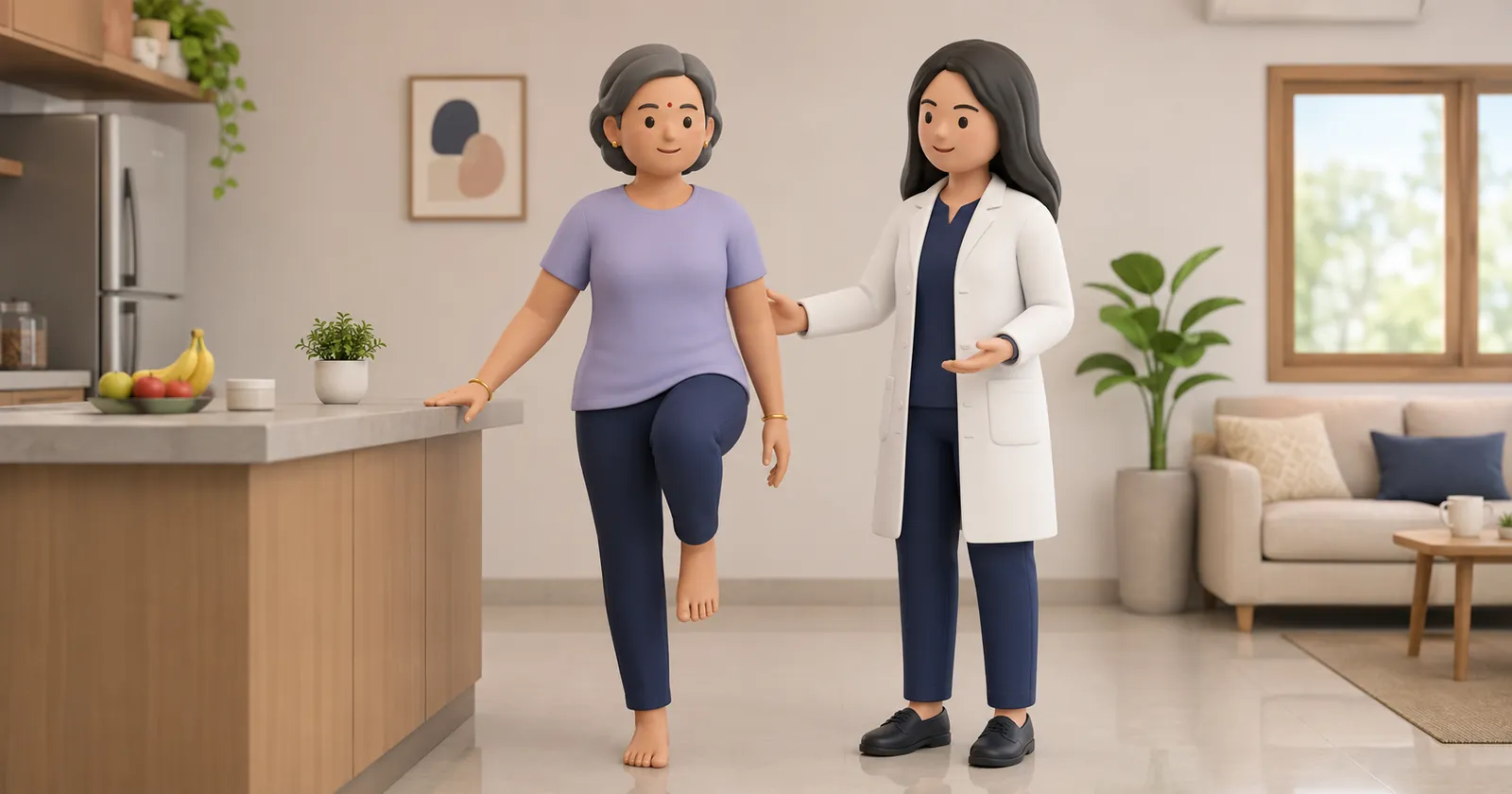
Physiotherapy rehabilitation trains non-visual sensory systems by improving somatosensory acuity and vestibular compensation. Balance exercises performed in safe, corner-supported settings with gradual reductions in visual input help the brain re-weight its reliance toward plantar pressure cues and inner-ear vestibular signals.
Corner-Supported Balance with Gradual Visual Occlusion
Objective: Train somatosensory and vestibular reliance for safer navigation during low-light conditions
- 1Stand in the corner of a room with your back facing the intersection, standing thirty centimetres away from the walls.
- 2Place a sturdy dining chair directly in front of you so your hands can touch the backrest instantly if needed.
- 3Stand tall with feet spaced hip-width apart and establish stable, steady balance with your eyes open.
- 4Gently close your eyes while keeping your fingertips hovering two centimetres above the chair back.
- 5Focus on the pressure sensations under your feet and maintain stable upright balance for twenty seconds.
| Lighting Location | Recommended Hardware Specification | Clinical Safety Objective |
|---|---|---|
| Bedside to Bedroom Doorway | Rechargeable plug-in motion-sensor LED light (warm amber, 2700K) | Illuminates floor upon feet swinging out of bed without disrupting circadian sleep |
| Corridor and Hallway Transition | Battery-backed automatic motion-activated wall path lights (50 lux at floor) | Highlights high door thresholds and turns during sudden electrical power outages |
| Bathroom Entrance and Interior | Continuous low-wattage emergency LED night light with 4-hour battery backup | Ensures continuous visibility of wet tiles, commode rim, and wall grab bars |
| Emergency Power Cut Kit | Glow-in-the-dark luminescent tape along baseboards and lightweight bedside torch | Provides fail-safe visual reference points during extended inverter battery exhaustion |
Red Flags and Emergency Post-Fall Escalation
Nocturnal falls in the dark carry high risks of severe cranial trauma, as fallen seniors often remain stranded on cold floors for hours before family discovery (long lie syndrome). Hypothermia, pressure sores, and rhabdomyolysis can develop rapidly. If a senior is found on the floor following a night-time fall, check mental alertness immediately. Confusion, slurred speech, or vomiting suggests a subdural haematoma. Inspect the hips and shoulders for acute fractures before attempting repositioning.
Frequently Asked Questions
What type of night light is best for older adults: bright white or warm amber?
Warm amber or soft red lighting (2700K or lower) is clinically preferred for nocturnal pathways. Bright blue-white light inhibits melatonin secretion, disrupting sleep architecture and worsening morning drowsiness, whereas warm amber provides adequate pathway contrast without blinding dark-adapted eyes.
Can physiotherapists evaluate an older adult's home for lighting and sensory fall risks?
Geriatric physiotherapists assess sensory integration and evaluate home environmental lighting to recommend optimal fixture placements. Under the NCAHP Act 2021, patients in India can consult registered physiotherapists directly. BookPhysio.in connects you with verified physiotherapists for home consultations with direct per-session payments.
Related recovery guides & articles
BookPhysio.in Editorial Team
The BookPhysio.in editorial team writes and maintains this content, checking it against reliable clinical sources. Content follows our medical review policy: general information only, and no page claims a clinical review until a named registered physiotherapist has signed it off.
Read our medical review policy