
Pudendal Neuralgia: Alcock Canal Compression, Seated Burning Pain, and Nerve Gliding in India
In short
Severe burning, electric shock pain in the perineum that worsens with sitting is often pudendal neuralgia. Learn how Alcock canal decompression and nerve gliding restore comfort.
In this guide (6 sections)
Pudendal neuralgia is a debilitating neuropathic pain condition caused by irritation, entrapment, or compression of the pudendal nerve along its pelvic course. Patients in India, both men and women, frequently describe an excruciating burning, electric shock, or foreign-body sensation in the perineum, rectum, clitoris, or penis. The hallmark of pudendal neuralgia is that pain is severely aggravated by sitting on hard surfaces and relieved almost immediately by standing or lying flat. Because the condition is often under-recognised, patients frequently spend months consulting multiple specialists and undergoing unhelpful procedures. Specialized pelvic physiotherapy provides conservative decompression, nerve gliding, and targeted ergonomic adaptation.
1. Functional Biomechanics: The Course of the Pudendal Nerve and Entrapment Zones
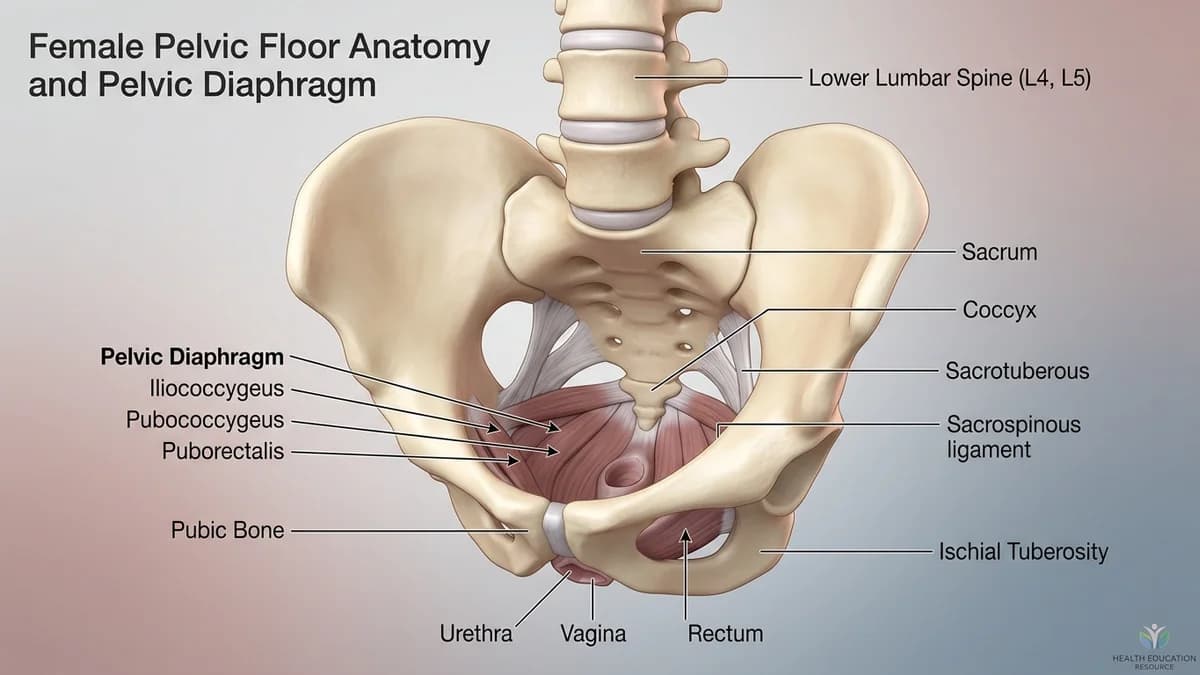
The pudendal nerve originates from the sacral nerve roots S2, S3, and S4. It exits the pelvis through the greater sciatic foramen, hooks around the ischial spine between the sacrospinous and sacrotuberous ligaments (the 'inter-ligamentous clamp'), and enters the pudendal (Alcock) canal, a specialized tunnel within the obturator internus fascia on the lateral pelvic wall. Entrapment can occur at the inter-ligamentous clamp, within Alcock canal due to obturator internus muscle spasm, or at the falciform process. When an entrapped nerve is compressed by sitting, compromised endoneurial microcirculation causes ischemia, triggering intense paroxysmal burning pain along its sensory distribution.
2. Domestic Indian Context: Daily Chores, Ergonomics, and Privacy
Indian domestic and professional routines frequently present major challenges for individuals with pudendal neuralgia. Sitting on hard wooden chairs, driving or commuting on autorickshaws over uneven roads, and sitting cross-legged on marble floors during family prayers or dining severely compress the nerve. Patients often struggle to work at office desks, resorting to standing all day. Practical interventions include using a split or U-shaped coccyx cushion with central relief, modifying desk setups to sit-stand arrangements, and learning gentle nerve gliding movements to restore neural axoplasmic flow.
3. Clinical Special Tests and Physical Examination
Diagnosis adheres to the validated Nantes Criteria: (1) pain in the anatomical territory of the pudendal nerve, (2) pain predominantly aggravated by sitting, (3) pain does not wake the patient at night, (4) no objective clinical sensory loss on examination, and (5) positive pain relief following diagnostic pudendal nerve block. Physical examination reproduces familiar pain by palpating the ischial spine and Alcock canal internally or externally.
| Nantes Criterion | Clinical Presentation Requirement | Diagnostic Verification | Physiotherapy Relevance |
|---|---|---|---|
| 1. Pain Territory | From clitoris/penis to anus (perineum) | Dermatomal S2-S4 sensory distribution | Confirm boundaries of pain map |
| 2. Aggravation by Sitting | Pain dramatically increases when seated | Relieved by standing or sitting on toilet | Implement central-channel cushion immediately |
| 3. Night-Time Sleep | Pain does not wake the patient at night | Absence of nocturnal rest pain | Reassures against malignant involvement |
| 4. Sensory Exam | No dense sensory motor deficit | Intact sensation to pinprick and touch | Rules out destructive sacral plexus lesion |
4. Stage-by-Stage Functional Physiotherapy Protocol
Rehabilitation centres on immediate mechanical nerve offloading, releasing the obturator internus muscle, and performing gentle neurodynamic mobilisations.
Phase 1: Central Perineal Offloading Cushion Positioning
Objective: Eliminate direct mechanical compression on Alcock canal and the inter-ligamentous space during sitting.
- 1Select a firm therapeutic cushion with a complete central cut-out channel running from front to back.
- 2Place the cushion on a flat, supportive chair.
- 3Sit down so that your ischial tuberosities (sit bones) rest firmly on the supportive lateral foam sections.
- 4Ensure your perineum, tailbone, and genital structures suspend freely over the open central gap without any contact.
- 5Never sit directly on hard unpadded surfaces while the nerve is inflamed.
Phase 2: Gentle Pudendal Neurodynamic Mobilisation (Flossing)
Objective: Restore physiological gliding of the pudendal nerve through Alcock canal and reduce perineal neural tethering.
- 1Sit upright on your cut-out cushion or on the edge of a bed.
- 2Slowly extend your affected leg straight out in front of you, resting your heel on the floor.
- 3As you gently tilt your head backward (looking toward the ceiling), pull your foot back toward your shin.
- 4Then, as you lower your chin gently toward your chest, point your toes forward away from you.
- 5Move smoothly between these two positions in a rhythmic motion so you feel only a gentle nerve stretch without sharp burning.
Phase 3: Side-Lying Clamshell with Neutral Sacral Alignment
Objective: Strengthen the deep external hip rotators to stabilize the pelvic ring without compressing Alcock canal.
- 1Lie on your unaffected side with knees bent at 45 degrees and feet stacked together.
- 2Keep your pelvis perpendicular to the floor without allowing your top hip to roll backward.
- 3Inhale to prepare. As you exhale, slowly elevate your top knee while keeping your heels touching.
- 4Hold at the top for 2 seconds without twisting your lower back, then lower smoothly over 3 seconds.
- 5Perform on both sides to balance bilateral pelvic stability.
Seek immediate emergency neurosurgical evaluation if you develop: sudden bilateral foot drop or progressive leg weakness, loss of bowel or bladder sphincter control, saddle anaesthesia (total loss of sensation when wiping), or severe night pain accompanied by fever and unexplained weight loss.
5. Clinic Consultation, Home Visits, and Transparent Fee Benchmarks
Under the National Commission for Allied and Healthcare Professions (NCAHP) Act 2021, patients in India can consult a registered pelvic health physiotherapist directly without an upfront referral, though BookPhysio.in does not ask for one. Specialized physiotherapists perform internal and external obturator internus releases and neural mobilisations in dedicated private rooms. Clinic sessions across Indian cities range between ₹500 and ₹1,500, with home visits ranging from ₹700 to ₹2,000 for patients who cannot travel seated. Patients pay their physiotherapist directly at each consultation, with no platform commission.
6. Frequently Asked Questions
Can pudendal neuralgia resolve without surgery in India?
Yes. Conservative physiotherapy, postural ergonomics, central cut-out cushions, and stress management successfully relieve symptoms in over 70 to 80 percent of patients with pudendal neuralgia. Surgical decompression of Alcock canal is reserved only for refractory cases that fail conservative care after 6 to 12 months.
Why does my perineal pain feel better when I sit on a toilet seat?
A standard toilet seat has an open centre that allows the perineum and pudendal nerve pathway to suspend freely without any contact pressure, while your body weight is supported entirely by your thighs and sit bones. This classic relief on a toilet seat is a strong clinical indicator of pudendal nerve entrapment.
Related recovery guides & articles
BookPhysio.in Editorial Team
The BookPhysio.in editorial team writes and maintains this content, checking it against reliable clinical sources. Content follows our medical review policy: general information only, and no page claims a clinical review until a named registered physiotherapist has signed it off.
Read our medical review policy