
Scaphoid Non-Union & Herbert Screw: Wrist Mobilization
In short
Scaphoid non-union risks avascular necrosis. Rigid Herbert screw fixation followed by dart-thrower plane mobilization restores pain-free wrist biomechanics.
In this guide (5 sections)
The scaphoid bone plays a central stabilizing role across the proximal carpal row, linking carpal kinematics between the radius and distal carpal bones. Due to its retrograde arterial blood supply through distal branches of the radial artery, waist and proximal pole fractures are uniquely vulnerable to delayed union, fibrous non-union, and avascular necrosis (AVN). Surgical stabilization using a headless compression screw (Herbert screw): frequently combined with vascularized bone grafting: provides rigid internal compression, which facilitates targeted postoperative wrist rehabilitation.
Domestic and Cultural Indian Realities
In India, scaphoid fractures are commonly misdiagnosed as simple sprains following falls from two-wheelers or sporting accidents. Young working adults often carry a chronic non-union for months while continuing manual labour or computer work. Following surgical fixation, patients must balance necessary wrist protection against the demands of daily tasks, such as turning doorknobs, lifting water buckets, and operating motorcycle accelerator grips.
Surgical Pathoanatomy and Biomechanical Principles
The Herbert screw features variable thread pitches at its proximal and distal ends, drawing the fracture fragments together under compression while sinking beneath articular cartilage. Dart-thrower motion (DTM): moving the wrist from radial extension to ulnar flexion: occurs primarily at the midcarpal joint, generating minimal shear stress or rotation across the healing scaphoid-lunate articulation. Hand therapists prioritize DTM to preserve functional carpal mobility while osseous trabeculae consolidate.
Postoperative Rehabilitation Phases and Splinting Protocols
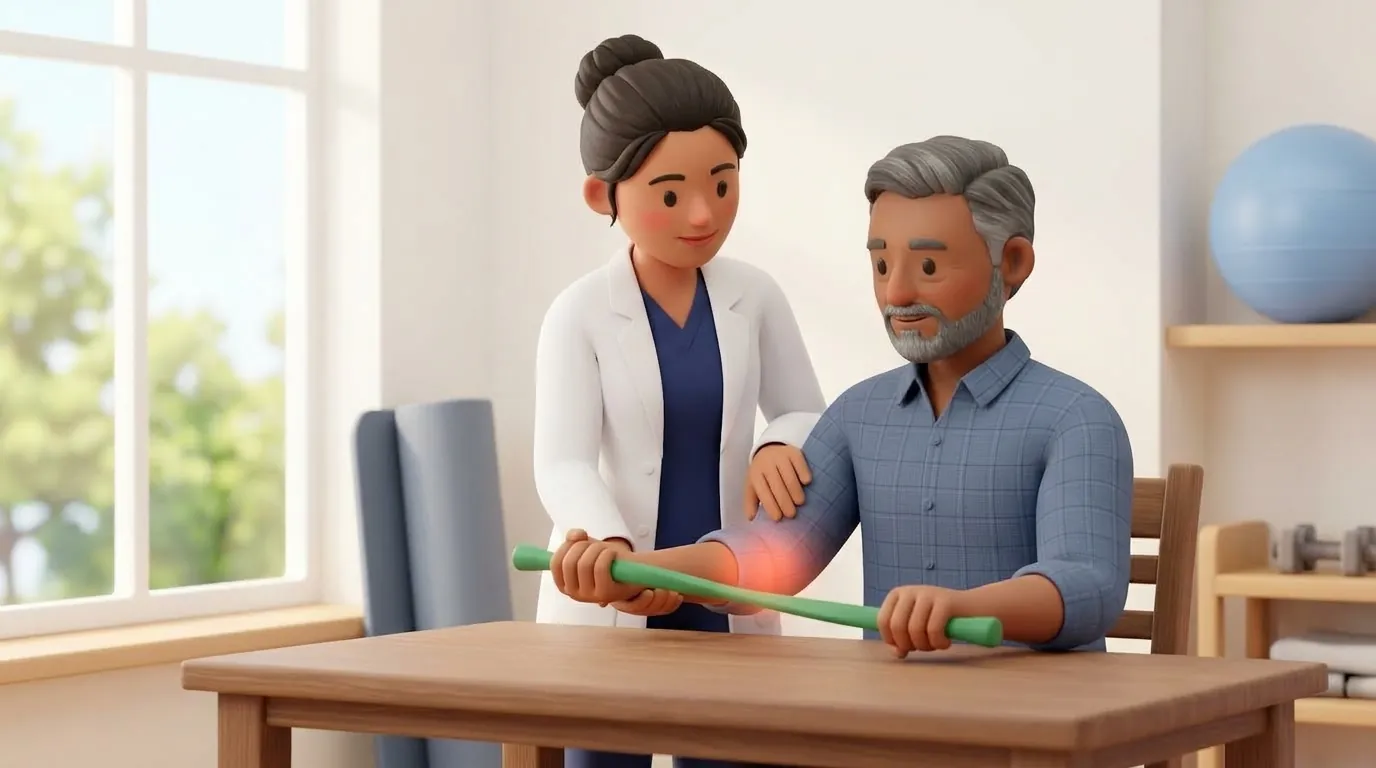
Post-surgical management begins with a thermoplastic thumb spica splint for 4 to 6 weeks, depending on graft integration and bone quality. Active finger, thumb IP, and forearm pronation-supination exercises start immediately. Once rigid radiographic union is confirmed, the splint is transitioned to functional wear, and isolated dart-thrower movements commence, progressing to circumduction and light grip strengthening by week 8 to 10.
Calibrated Dart-Thrower Motion (DTM) Excursion
Objective: Mobilize the midcarpal joint without imposing rotational shear stress on the healing scaphoid
- 1Rest your forearm on a flat surface with your wrist positioned just over the table edge in neutral.
- 2Move your wrist diagonally upward and outward into radial extension (as if preparing to throw a dart).
- 3Hold this cocked diagonal position for 2 seconds without forcing pain at the anatomical snuffbox.
- 4Slowly move your wrist diagonally downward and inward into ulnar flexion (as if releasing the dart).
- 5Repeat this smooth diagonal arc, avoiding pure forward-and-backward wrist bending.
| Recovery Stage | Orthotic Protection | Permitted Kinematic Arc |
|---|---|---|
| Weeks 1 to 4 (Consolidation) | Forearm thumb spica orthosis worn full-time | Active finger fist closure, thumb IP flexion, elbow mobility |
| Weeks 5 to 6 (Midcarpal Stage) | Removable thumb spica for hygiene and exercise | Initiate plane of dart-thrower motion; avoid axial loading |
| Weeks 7 to 8 (Union Confirmed) | Wean splint to night wear and high-risk activities | Gentle wrist flexion-extension, isometric grip re-education |
| Weeks 9 to 12 (Functional Loading) | Splint discharged for all standard daily tasks | Progressive resistance putty, functional household lifting |
Red Flags and Specialist Escalation
Severe, unremitting pain localized to the anatomical snuffbox during axial thumb loading, progressive carpal collapse (scaphoid non-union advanced collapse: SNAC wrist), or hardware prominence on follow-up radiographs requires immediate orthopaedic reassessment.
Frequently Asked Questions
Why is diagonal dart-throwing motion safer for a healing scaphoid bone?
Moving the wrist diagonally from high-radial to low-ulnar angles uses the midcarpal joint and places very little shear stress on the scaphoid bone, allowing you to regain wrist movement without risking fracture disruption.
Do I need a doctor referral to start scaphoid rehabilitation on BookPhysio.in?
BookPhysio.in does not ask for a doctor referral. Direct access is protected under the NCAHP Act 2021. You book verified physiotherapists directly and pay per session with complete fee transparency.
Related recovery guides & articles
BookPhysio.in Editorial Team
The BookPhysio.in editorial team writes and maintains this content, checking it against reliable clinical sources. Content follows our medical review policy: general information only, and no page claims a clinical review until a named registered physiotherapist has signed it off.
Read our medical review policy