
High Door Thresholds (Chaukhat): Transition Hazards and Step Modifications for Seniors
In short
Raised wooden door thresholds (chaukhats) in traditional Indian homes are classic architectural trip hazards. Learn how to modify doorway transitions and train stepping mechanics.
In this guide (6 sections)
Architectural transitions between interior living spaces represent common sites of domestic trip falls in older populations. Among these, raised door thresholds, known in Indian vernacular architecture as chaukhats or umbarthas, present significant environmental barriers. Originally designed in traditional homes to prevent rainwater ingress, keep out insects, and support heavy wooden door frames, these wooden, stone, or marble ledges raise the doorway base by three to ten centimetres above floor level. For seniors with reduced joint mobility and blunted lower-limb proprioception, negotiating these raised ledges multiple times daily creates a constant trip hazard.
Domestic and Cultural Indian Realities
In traditional Indian bungalows, ancestral havelis, and older apartment complexes, high chaukhats are situated at nearly every internal doorway, particularly separating bedrooms, kitchens, and pooja rooms. In Hindu cultural tradition, the threshold is considered auspicious; family members are traditionally instructed never to step directly on the chaukhat, but always to step over it. While this custom is simple for agile youths, it forces frail older adults into a prolonged single-leg stance with elevated hip flexion. If an elderly grandmother carrying a brass prayer thali or laundry basket attempts to step over a high chaukhat while wearing a long saree, the trailing edge of the fabric or her rear toe frequently catches the raised ledge, precipitating a violent forward fall into the adjoining room.
Clinical Biomechanics and Postural Control Decay
Stepping over a raised obstacle requires coordinated anticipatory postural adjustments (APAs). Before initiating the step, the body shifts its centre of mass laterally onto the stance limb. The swing leg then executes combined hip flexion, knee flexion, and ankle dorsiflexion to lift the foot safely above the obstacle height. In older adults, age-related psoas and rectus femoris weakness reduces peak hip flexion height. Simultaneously, impaired hip abductor (gluteus medius) endurance causes the pelvis to drop on the swing side (Trendelenburg sign), effectively lowering the foot closer to the threshold. If the trailing foot's toe clearance is misjudged by just ten millimetres, the toe clips the chaukhat, halting forward swing and causing an unrecoverable forward fall.
Functional Assessment and Risk Stratification
Clinical assessment of threshold navigation utilizes the Step-Over Obstacle Test and the Dynamic Gait Index item for obstacle crossing. The clinician evaluates whether the senior clears five-centimetre and ten-centimetre hurdles with sufficient foot margins, whether the trailing foot makes contact, and whether the patient requires hand contact against door frames. Seniors who display marked trunk swaying, hesitation, or scuffing of the trailing foot are at high risk of threshold-related falls and require specific stepping therapy and threshold ramp adaptations.
Targeted Strength and Balance Exercises
Physiotherapy rehabilitation focuses on strengthening hip flexors, building single-leg stance stability, and training dynamic obstacle clearance. Stepping drills with visual markers retrain the central nervous system to allocate adequate margin of safety during domestic doorway transitions.
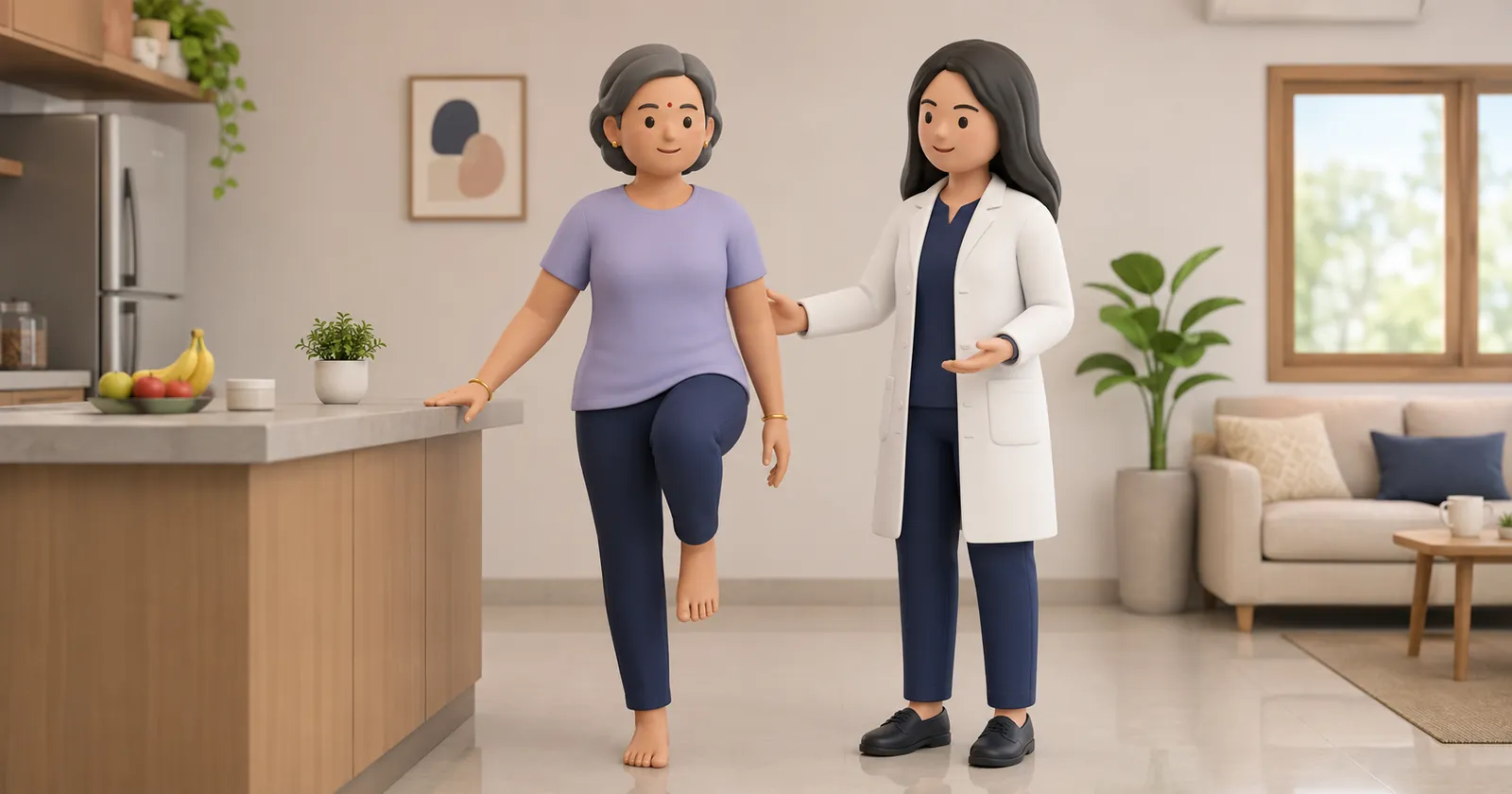
Threshold Step-Over Drill with Bilateral Doorframe Support
Objective: Train safe hip elevation and controlled trailing leg clearance during doorway transitions
- 1Stand directly in front of a raised threshold, placing your hands firmly against both sides of the doorframe for support.
- 2Shift your body weight steadily onto your left foot, pressing firmly through your left heel.
- 3Lift your right knee high, consciously flexing your hip until your right foot clears the threshold by at least five centimetres.
- 4Plant your right foot securely on the floor on the opposite side of the threshold, shifting weight forward.
- 5Carefully lift your trailing left foot high and forward over the threshold without allowing the toe to drag or clip the ledge.
| Threshold Scenario | Architectural Modification | Clinical Functional Rationale |
|---|---|---|
| High Wooden Chaukhat (5 to 10 cm) | Install dual-sided beveled wooden or rubber threshold transition ramps (1:12 slope) | Converts abrupt vertical trip ledge into smooth, gradual rolling incline |
| Marble or Granite Bathroom Threshold | Apply high-contrast yellow/black adhesive visual warning tape along the top edge | Improves visual edge perception for seniors with reduced contrast sensitivity |
| Narrow Doorway with Raised Base | Install a vertical stainless steel grab rail on the interior and exterior doorframe | Provides a secure handhold to support single-leg balance during the step-over |
| Ancestral Non-Structural Divider | Shave or remove non-loadbearing interior threshold completely flush with flooring | Eliminates the environmental trip hazard entirely from primary walking paths |
Red Flags and Emergency Post-Fall Escalation
A forward trip over a raised threshold frequently propels the falling senior into furniture or door edges. Immediately inspect the patient for facial lacerations, dental trauma, and upper-extremity fractures (such as humeral neck or radial head fractures). If the patient struck their head against a hard doorframe, monitor closely for signs of concussion or intracranial hemorrhage, including unequal pupils, vomiting, confusion, or clear fluid drainage from the nose or ears. In such cases, keep the spine immobilised and summon emergency medical transport immediately.
Frequently Asked Questions
Can threshold ramps be installed without damaging traditional wooden door frames?
Portable, modular rubber or lightweight hardwood threshold ramps can be placed directly adjacent to high chaukhats using removable non-slip adhesives. They require no drilling into historic frames and provide a smooth, gentle transition that eliminates trip hazards.
Do I need a doctor referral to have a physiotherapist assess home fall risks in India?
Under the NCAHP Act 2021, Indian citizens can access registered physiotherapists directly without requiring a doctor referral. On BookPhysio.in, you connect directly with verified geriatric physiotherapy clinicians who conduct detailed home environmental and balance audits with pay-per-session pricing and zero platform commissions.
Related recovery guides & articles
BookPhysio.in Editorial Team
The BookPhysio.in editorial team writes and maintains this content, checking it against reliable clinical sources. Content follows our medical review policy: general information only, and no page claims a clinical review until a named registered physiotherapist has signed it off.
Read our medical review policy