
Stress Urinary Incontinence: Urethral Closure Mechanics, The Knack Technique, and Pelvic Floor Rehabilitation in India
In short
Leaking urine when coughing, sneezing, or lifting is a treatable mechanical issue, not an inevitable part of ageing or motherhood. Learn how the Knack technique and pelvic floor training restore continence.
In this guide (6 sections)
Stress urinary incontinence (SUI), the involuntary leakage of urine during coughing, sneezing, laughing, jumping, or heavy lifting, affects up to 30 percent of adult women in India. Because of social stigma and modesty in multi-generational homes, many women suffer silently for years, wearing menstrual pads daily and restricting social outings or laughter with relatives. Many mistakenly assume that urinary leaks are a permanent, unavoidable consequence of childbirth or menopause. In reality, SUI is primarily a mechanical deficit in urethral closure pressure that responds reliably to structured pelvic floor rehabilitation.
1. Functional Biomechanics: Urethral Closure Pressure and the Hammock Hypothesis
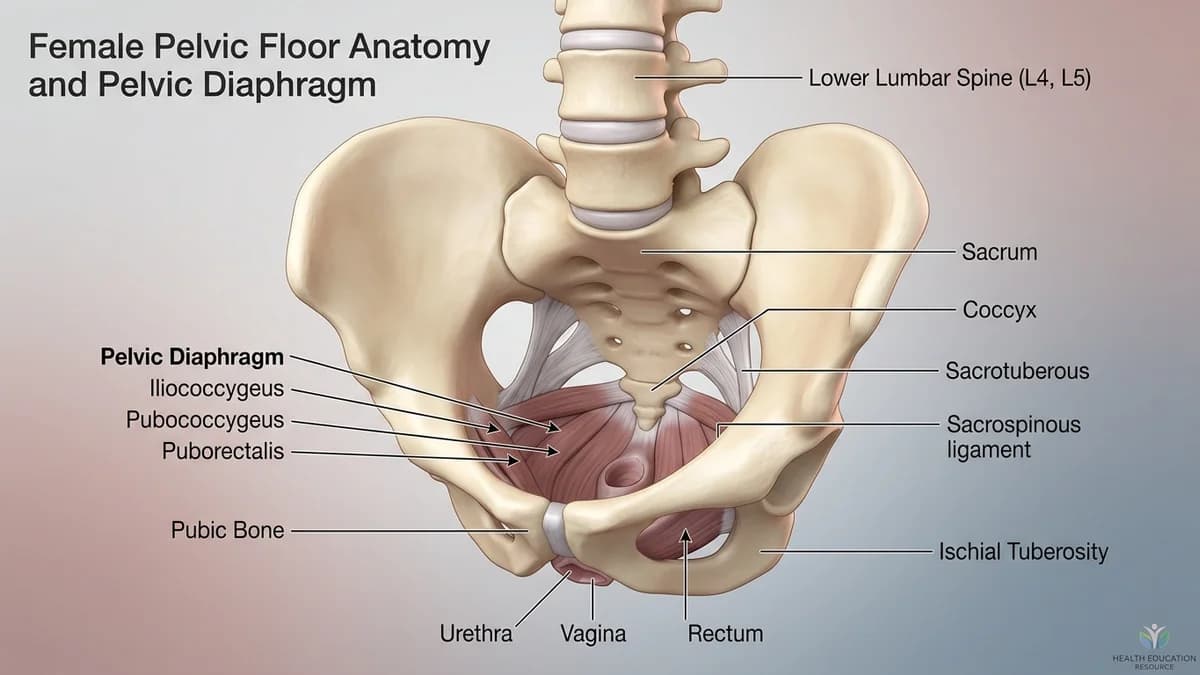
Continence depends on maintaining intra-urethral pressure higher than intra-vesical (bladder) pressure at all times, especially during physical exertion. Under DeLancey's hammock hypothesis, the urethra rests upon a supportive sub-urethral layer composed of the anterior vaginal wall, endopelvic fascia, and the arcus tendineus fasciae pelvis, backed dynamically by the pubococcygeus and puborectalis muscles. When you cough or sneeze, intra-abdominal pressure rises abruptly. A healthy pelvic floor contracts reflexively a fraction of a second before the cough, compressing the urethra against this firm hammock to prevent leaks. In SUI, this timing is disrupted or the muscular support is deconditioned.
2. Domestic Indian Context: Daily Chores, Ergonomics, and Privacy
In Indian homes, daily triggers for stress leaks include vigorous coughing during spice tempering (tadka in hot mustard or ghee), seasonal allergies in dusty urban environments, laughing during family gatherings, and lifting heavy metal buckets or grocery bags. Managing wet clothing or disposable pads without drawing unwanted attention from extended family members causes substantial psychological distress. Learning 'The Knack', a well-timed voluntary pelvic floor pre-contraction before a cough, empowers women to prevent leaks instantly during daily household tasks.
3. Clinical Special Tests and Physical Examination
Clinical diagnosis involves a Cough Stress Test, where the patient coughs with a comfortably full bladder while the clinician observes for immediate leakage. Pelvic floor muscle strength and endurance are quantified via digital palpation using the Modified Oxford Scale (grades 0 to 5). Electromyographic biofeedback or perineometry may be employed to assess contraction velocity and motor unit recruitment.
| Muscle Grade | Physical Exam Finding | Functional Continence Status | Physiotherapy Target |
|---|---|---|---|
| Grade 0-1 (Trace) | No palpable contraction or slight flicker | Severe leaks with light coughing/walking | Sensory re-education and biofeedback |
| Grade 2 (Weak) | Faint squeeze without inward elevation | Frequent leaks with sneezing and lifting | Assisted contractions in gravity-eliminated postures |
| Grade 3 (Moderate) | Definite squeeze and inward lift | Intermittent leaks during heavy coughing | Endurance holds and fast-twitch training |
| Grade 4-5 (Good to Strong) | Strong squeeze, firm lift against resistance | Continent or rare minor leak under extreme load | Functional integration into impact and sport |
4. Stage-by-Stage Functional Physiotherapy Protocol
The rehabilitation protocol combines fast-twitch muscle training with proprioceptive motor planning to automate urethral closure during sudden pressure spikes.
Phase 1: Mastering 'The Knack' Pre-Contraction Maneuver
Objective: Train the anticipatory reflex contraction of the levator ani before intra-abdominal pressure rises.
- 1Sit comfortably on a chair or stand in front of a mirror with your spine upright.
- 2Take a gentle breath in. Just before you clear your throat or initiate a simulated cough, squeeze and lift your pelvic floor firmly.
- 3Perform a single light cough while keeping the pelvic floor squeezed tightly upward.
- 4Notice whether the pelvic floor holds the closure during the cough without giving way.
- 5Release the contraction fully after the cough, rest for 5 seconds, and repeat.
Phase 2: Quick-Flick Contractions for Fast-Twitch Muscle Fibres
Objective: Build explosive motor unit recruitment in the peri-urethral striated sphincter to arrest sudden leaks.
- 1Assume a comfortable seated or crook lying position.
- 2Squeeze your pelvic floor as quickly and firmly as possible, aiming for an instant upward lift.
- 3Hold for only 1 second, then release the muscle completely.
- 4Immediately initiate the next contraction without letting your breathing stop or your abdomen bulge.
- 5Continue for 10 rapid, distinct contractions and relax cleanly between each flick.
Phase 3: Standing Heel Drops with Pelvic Floor Co-Contraction
Objective: Integrate pelvic floor shock absorption during ground impact forces like walking and jumping.
- 1Stand tall with feet hip-width apart and hold onto a sturdy kitchen counter for balance.
- 2Rise up onto the balls of your feet on an inhale.
- 3As you drop your heels firmly back down to the floor, exhale sharply and engage your pelvic floor upward to absorb the impact.
- 4Verify that no urine leaks during the heel strike.
- 5Relax your muscles for 3 seconds before rising for the next repetition.
Consult a urologist or gynaecologist immediately if you experience: blood in your urine (gross hematuria), severe burning pain and fever with urination (suggesting acute urinary tract infection), sudden total loss of urine without exertion, or progressive difficulty passing urine requiring pushing.
5. Clinic Consultation, Home Visits, and Transparent Fee Benchmarks
Under the National Commission for Allied and Healthcare Professions (NCAHP) Act 2021, patients in India can consult a registered pelvic health physiotherapist directly without an upfront referral, though BookPhysio.in does not ask for one. Women can receive personalised care in modern outpatient clinics equipped with biofeedback units or opt for domiciliary home visits for greater privacy. In tier 1 and tier 2 Indian cities, clinic consultations typically cost ₹500 to ₹1,500, while home sessions range from ₹700 to ₹2,000. Patients pay the physiotherapist directly at each appointment, with no platform commission.
6. Frequently Asked Questions
Can Kegel exercises cure stress incontinence if I have had multiple deliveries?
Targeted pelvic floor muscle training aims to resolve or substantially reduce stress leaks in over 70 percent of women with mild to moderate SUI. Success depends on performing contractions with correct lifting mechanics rather than bearing down. A qualified physiotherapist ensures you are recruiting the right muscles without substituting gluteal or abdominal clenching.
Should I stop drinking water to reduce urine leaks during the day?
Restricting water intake is counterproductive. When you drink less water, urine becomes concentrated and acidic, which irritates the bladder lining and triggers secondary bladder spasms and urge leaks. Maintain healthy hydration of 1.5 to 2 litres of water spread evenly across the day, while reducing bladder irritants like strong chai and coffee.
Related recovery guides & articles
BookPhysio.in Editorial Team
The BookPhysio.in editorial team writes and maintains this content, checking it against reliable clinical sources. Content follows our medical review policy: general information only, and no page claims a clinical review until a named registered physiotherapist has signed it off.
Read our medical review policy