
T7 to T12 Paraplegia Mobility: Lower Abdominal Activation and KAFO Calipers
In short
Individuals with lower thoracic paraplegia utilize active abdominal control and bilateral KAFO calipers to achieve therapeutic standing and household ambulation.
In this guide (6 sections)
Spinal cord lesions between the T7 and T12 thoracic segments spare the upper, middle, and lower abdominal wall musculature in a descending, segment-specific pattern. The rectus abdominis, internal and external obliques, and transversus abdominis receive segmental innervation from T7 (upper rectus) down to T12 (lower rectus and pyramidalis). With intact abdominal control and stable trunk balance, individuals with lower thoracic paraplegia possess robust core stability. When fitted with bilateral Knee-Ankle-Foot Orthoses (KAFOs, historically termed calipers in India), these individuals can achieve independent standing, parallel bar walking, and swing-to or swing-through ambulation using bilateral elbow crutches.
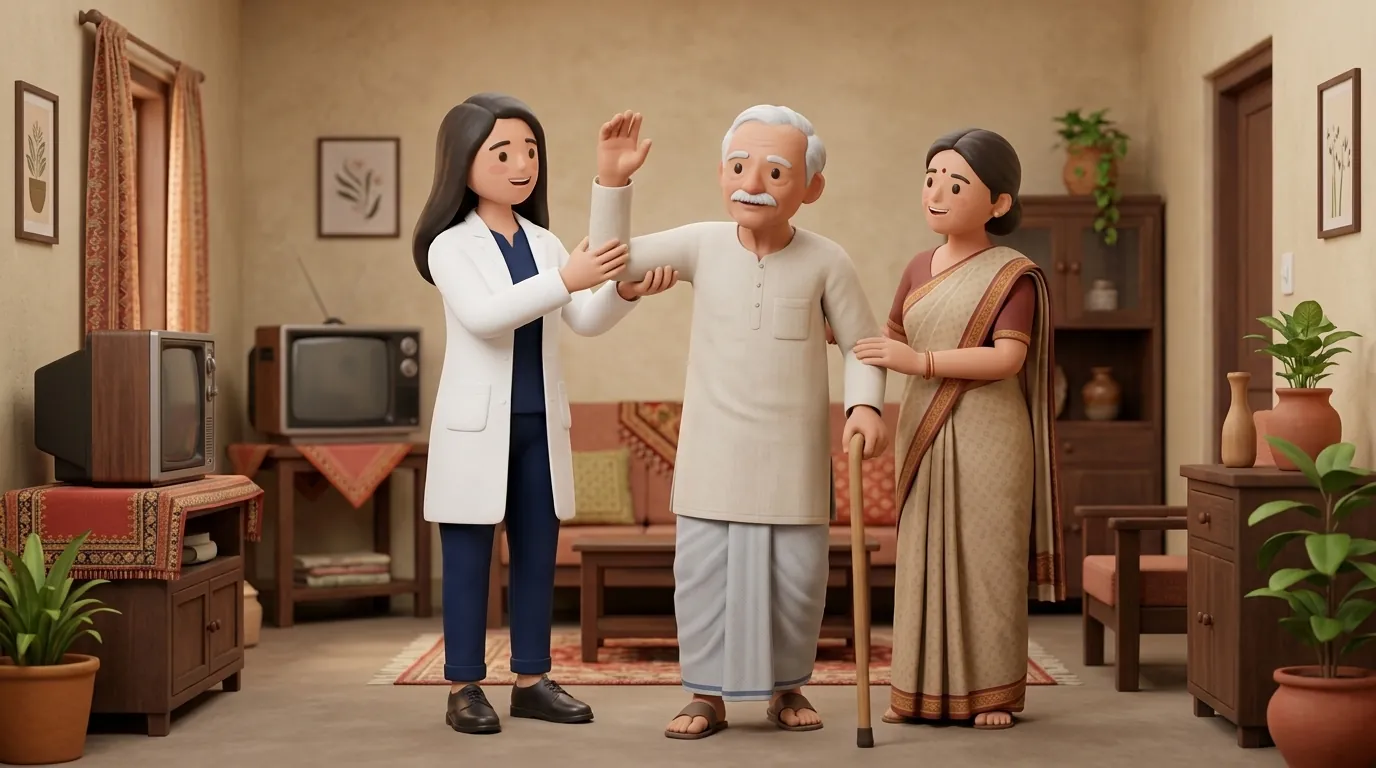
Domestic and Cultural Indian Realities
In Indian rehabilitation practice, bilateral metal-and-leather or lightweight polypropylene KAFO calipers have long served as primary orthotic prescriptions. Standing upright in calipers provides significant psychological and physiological benefits: it facilitates participation in family prayer rituals, allows reaching high domestic kitchen shelves, and slows disuse osteoporosis. However, community ambulation in calipers across broken pavements and crowded markets imposes extreme metabolic energy expenditure. Physiotherapy provides an honest, balanced perspective: training calipers for therapeutic daily standing and household exercise, while utilizing an active lightweight manual wheelchair for efficient community commuting.
Clinical Biomechanics and Neurological Recovery
Ambulation in bilateral KAFOs relies on passive biomechanical skeletal locking. Because active hip and knee extensors are denervated, the orthosis locks the knee joints in full extension with drop-ring or bail locks, while rigid ankle uprights maintain 90 degrees of neutral dorsiflexion. To achieve stable standing without collapsing into hip flexion, the patient extends the hips by hanging on the dense anterior iliofemoral ligaments (the Y-ligaments of Bigelow). By pushing the pelvis forward and leaning the upper torso slightly backward, the ground reaction force line passes posterior to the hip joints, mechanically locking the hips into hyperextension without requiring active muscular effort.
Functional Movement Analysis and Clinical Assessment
Candidate assessment begins with testing abdominal muscle innervation using the Beevor sign: observing whether the umbilicus moves upward when the patient attempts a partial sit-up (indicating preserved T7-T9 upper abdominals with denervated T10-T12 lower abdominals). Hip extension range of motion must demonstrate zero hip flexion contractures: any contracture greater than 5 to 10 degrees prevents the patient from hanging on the Y-ligaments, causing forward collapse. Upper extremity strength must be grade 5/5 in triceps, latissimus dorsi, and shoulder depressors to support body weight during swing phases.
Targeted Rehabilitation and Functional Independence Protocol
Rehabilitation progresses systematically. First, the patient masters donning and doffing the bilateral KAFOs independently in long-sitting on the bed. Second, sit-to-stand transitions are practiced inside parallel bars: locking the caliper knee joints before standing, placing hands forward on the bars, and pushing upward while thrusting the pelvis forward into the locked ligamentous stance. Third, ambulation begins with a swing-to gait, progressing to a reciprocal swing-through gait using bilateral elbow crutches. Cardiovascular interval training is integrated to manage the substantial aerobic demands of caliper walking.
Parallel Bar Pelvic Forward-Thrust and Ligamentous Lock Drill
Objective: Master passive hip locking on the Y-ligaments during caliper standing
- 1Stand inside parallel bars with bilateral KAFO knee drop-locks securely engaged.
- 2Grasp the parallel bars 6 inches ahead of your hips with hands firm and wrists stable.
- 3Push downward through your arms while consciously thrusting your pelvis forward and upward.
- 4Allow your upper torso and shoulders to relax slightly backward until you feel your anterior hips tighten.
- 5Momentarily release one hand from the bar to verify that your hips remain mechanically locked.
- 6Hold the stable upright posture for 30 seconds before shifting weight back to hands.
| Functional Factor | Manual Wheelchair Propulsion | Bilateral KAFO Caliper Walking |
|---|---|---|
| Metabolic Energy Expenditure | Low to moderate; roughly 10-20% above normal walking | Extremely high; 5 to 6 times higher than normal gait |
| Travel Velocity | Fast; 3 to 5 km/h easily sustained over long distances | Slow; 0.5 to 1.5 km/h; restricted to short household distances |
| Primary Clinical Value | Functional community travel, work, and social mobility | Therapeutic weight-bearing, bone health, and spasticity relief |
| Surface Versatility | Overcomes ramps and curbs with wheelies | Requires smooth, level flooring; dangerous on outdoor uneven terrain |
Red Flags and Emergency Escalation
Inspect the skin beneath all caliper thigh cuffs, knee pads, and ankle uprights immediately after every standing session. Focal redness over the fibular head (peroneal nerve compression), patella, or medial malleolus that persists beyond 20 minutes indicates improper orthotic alignment requiring immediate caliper adjustment to prevent deep ulcers. Furthermore, because caliper walking induces rapid heart rate spikes exceeding 140 to 160 beats per minute, cease walking immediately if chest tightness, extreme shortness of breath, or dizziness occurs.
Frequently Asked Questions
Can caliper walking replace my wheelchair for daily work and outdoor travel?
For most individuals with complete lower thoracic paraplegia, caliper walking is primarily a therapeutic exercise rather than a practical replacement for a wheelchair. Walking with KAFOs requires immense arm effort and consumes up to six times more energy than normal walking. Most individuals use calipers for daily home standing and use lightweight wheelchairs for efficient outdoor commuting.
How do I arrange in-home caliper fitting and gait training with a physiotherapist?
Under the NCAHP Act 2021, registered physiotherapists in India can be engaged directly for orthotic assessment and home gait training. On BookPhysio.in, you can connect with an experienced neuro-physiotherapist who will evaluate your caliper fit, train sit-to-stand transitions, and supervise walking drills. Fees are paid directly to the clinician at your home appointment.
Related recovery guides & articles
BookPhysio.in Editorial Team
The BookPhysio.in editorial team writes and maintains this content, checking it against reliable clinical sources. Content follows our medical review policy: general information only, and no page claims a clinical review until a named registered physiotherapist has signed it off.
Read our medical review policy