
Tai Chi and Balance Training for Fall Prevention in Diabetic Neuropathy
In short
Sensory neuropathy robs diabetic patients of natural footing awareness, leading to frequent stumbling. Discover how gentle Tai Chi and balance training retrain safe movement.
In this guide (6 sections)
Postural instability and falls represent major causes of morbidity and functional decline in older adults living with diabetic peripheral neuropathy. Somatosensory axonal loss impairs joint proprioception and cutaneous plantar sensation, forcing the central nervous system to re-weight balance control toward visual and vestibular systems. Tai Chi, an ancient Chinese mind-body practice characterized by slow, continuous, flowing movements and conscious weight shifting, has emerged as an evidence-based balance rehabilitation intervention. By emphasizing controlled knee flexion, rotational trunk alignment, and deliberate foot placement, Tai Chi retrains dynamic balance, improves neuromuscular reaction times, and significantly reduces fall risk in neuropathic patients.
Domestic and Cultural Indian Realities
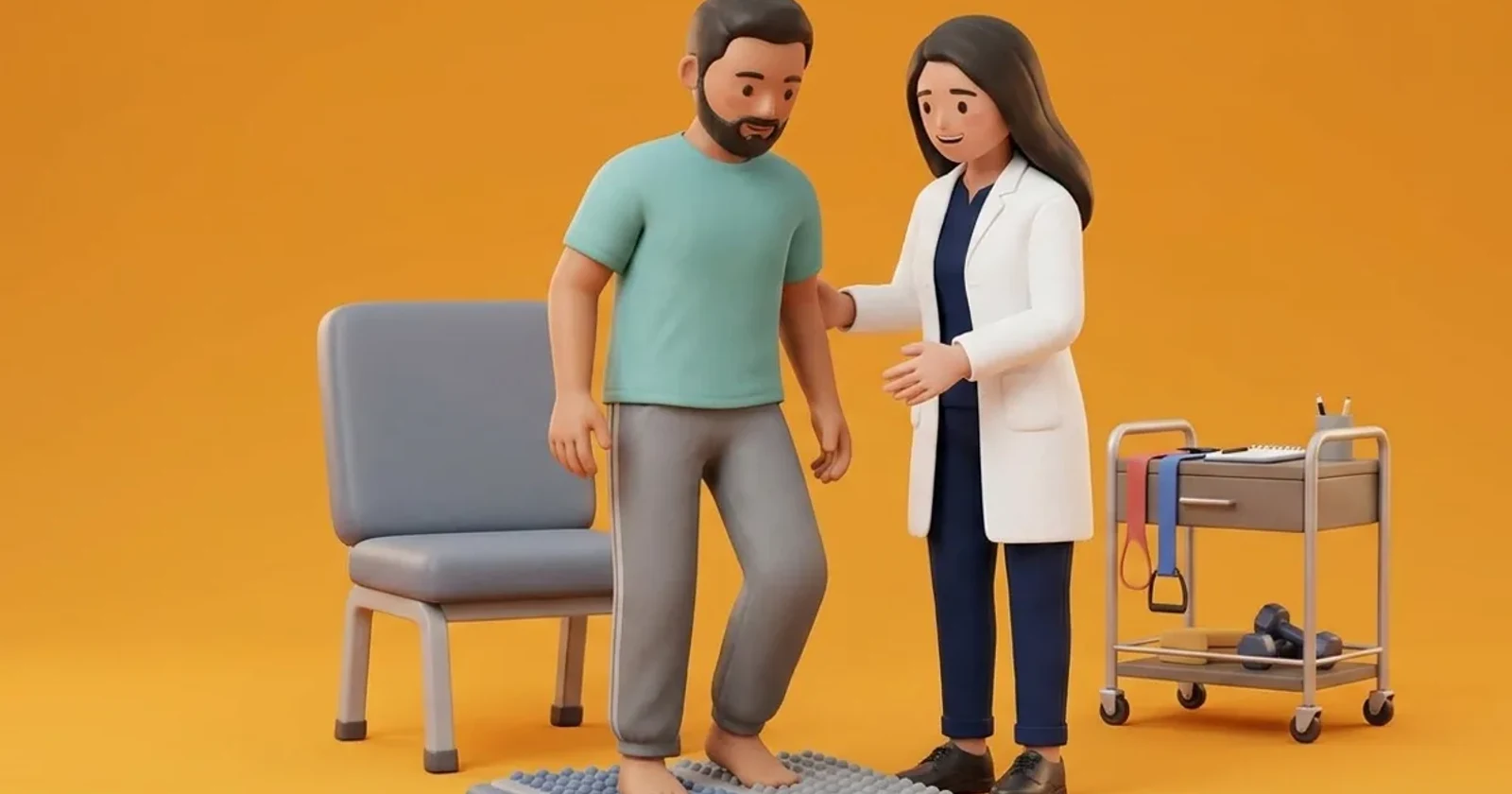
In Indian households, elderly family members often spend their retirement years relatively inactive, sitting for hours watching television or chatting with family. When they attempt to walk outdoors on uneven pavements, navigate crowded bazaars, or step over elevated door thresholds (chaukhat), their sluggish balance reflexes fail to prevent stumbling. Traditional Indian exercises like strenuous yogic postures or deep squats may place excessive torque on arthritic knees or crush insensate feet. Tai Chi provides a gentle, low-impact movement alternative that can be practiced safely inside the living room or on a shaded veranda. Patients can practice while holding onto the back of a sturdy dining chair, making it suitable for frail older adults.
Clinical Biomechanics and Neuropathic Breakdown
Maintaining dynamic balance during walking requires continuous adjustments of the body centre of mass over a shifting base of support. In diabetic neuropathy, delayed nerve conduction slows the activation of ankle stabiliser muscles (tibialis anterior and gastrocnemius), preventing rapid recovery from small balance perturbations. Tai Chi addresses this deficit by training intentional, slow-motion weight transfers: the individual learns to sink their centre of mass by maintaining slight knee flexion (15 to 20 degrees), which lowers the centre of gravity and activates quadriceps and gluteal stabilisers. Furthermore, Tai Chi drills emphasize placing the heel down softly before rolling weight onto the forefoot, which eliminates harsh ground impacts and minimizes plantar shear stress.
Clinical Assessment and Neuropathy Screening
Assessment begins with validated functional mobility and balance tests, including the Berg Balance Scale (BBS), the Timed Up and Go (TUG) test, and the Four-Step Square Test. Dynamic gait analysis observes step width, stride length variability, and postural sway during walking. Sensation is evaluated with 10g monofilaments and 128 Hz tuning forks to establish baseline peripheral nerve involvement. The clinician verifies that the patient wears protective, non-slip footwear during practice rather than practicing barefoot on hard domestic tiles.
Targeted Offloading and Intrinsic Foot Conditioning
The Tai Chi programme incorporates modified classical forms tailored for neuropathic populations, beginning with seated weight shifts before advancing to supported standing. Movements emphasize diagonal stepping, gentle trunk rotation, and coordinated arm sweeps that challenge visual-vestibular integration. Training sessions are held two to three times weekly for 30 to 45 minutes, always concluding with calming diaphragmatic breathing exercises.
Supported Tai Chi Cloud Hands Weight-Shifting Drill
Objective: Improve lateral weight shifting and trunk rotational balance with chair support
- 1Stand tall with feet hip-width apart behind a sturdy dining chair, resting both hands lightly on the backrest.
- 2Slightly soften both knees, sinking your centre of gravity by approximately one inch.
- 3Slowly shift 70 percent of your body weight onto your right leg, feeling your right hip and thigh engage.
- 4Hold the right-sided stance for 3 seconds while gently turning your torso slightly to the right.
- 5Smoothly shift your weight across to the left leg over 4 seconds, turning your torso gently to the left.
- 6Maintain steady, relaxed breathing without holding your breath throughout the flowing movement.
| Training Phase | Movement Complexity & Posture | Targeted Balance Mechanism |
|---|---|---|
| Phase 1: Seated Postural Forms | Seated trunk rotations, arm reaches, ankle tapping on floor | Core stability; vestibular visual tracking without fall risk |
| Phase 2: Supported Static Stance | Bilateral chair support; lateral weight shifts; narrow base | Lower extremity eccentric muscle activation; ankle proprioception |
| Phase 3: Supported Stepping Forms | Forward-backward diagonal stepping with light fingertip support | Dynamic single-limb stance stability; deliberate heel-to-toe roll |
| Phase 4: Free-Standing Flow Forms | Continuous stepping sequences without hand support; open space | Complete sensorimotor balance integration; community fall resilience |
Red Flags and Urgent Diabetic Foot Escalation
Immediate medical escalation is necessary if a patient experiences true rotational vertigo, chest tightness, palpitations, sudden shortness of breath, or lightheadedness during practice. Inspect feet thoroughly after every session; any blister, redness, or skin irritation caused by shoe friction requires immediate offloading and podiatric evaluation.
Frequently Asked Questions
Is Tai Chi suitable for an older adult who has never done martial arts?
Yes. Therapeutic Tai Chi for balance is a gentle, slow-motion exercise programme, completely unlike combat martial arts. Movements are smooth, calm, and easily modified for beginners, including those with joint arthritis or frailty. Exercises can even be performed while holding onto a chair or sitting.
Should I practice Tai Chi barefoot at home like traditional practitioners?
No. Individuals with diabetic peripheral neuropathy must never practice Tai Chi barefoot. Walking barefoot on hard domestic floors removes essential shock absorption and exposes insensate skin to pressure ulcers. Always wear well-cushioned diabetic shoes with non-skid rubber soles during practice.
Related recovery guides & articles
BookPhysio.in Editorial Team
The BookPhysio.in editorial team writes and maintains this content, checking it against reliable clinical sources. Content follows our medical review policy: general information only, and no page claims a clinical review until a named registered physiotherapist has signed it off.
Read our medical review policy