
Radial Nerve Palsy Tendon Transfer: Pronator Teres Rehab
In short
Irreversible radial nerve injury requires tendon transfer to restore wrist extension. Pronator teres re-education restores tenodesis and active power grasp.
In this guide (5 sections)
When high radial nerve laceration or avulsion fails to recover after primary nerve reconstruction or presents beyond the critical 12 to 18 month re-innervation window, tendon transfer offers a reliable reconstructive solution. The standard triple transfer utilizes the median-innervated pronator teres (PT) transferred to the extensor carpi radialis brevis (ECRB) for wrist extension, the flexor carpi radialis (FCR) or flexor carpi ulnaris (FCU) to the extensor digitorum communis (EDC) for finger extension, and the palmaris longus (PL) to the extensor pollicis longus (EPL) for thumb extension.
Domestic and Cultural Indian Realities
In Indian occupational settings, patients with chronic radial palsy: such as factory press operators or carpenters: lose the ability to grip heavy tools or sustain manual labour. Postoperative tendon transfer therapy requires patient concentration to retrain donor muscle actions: teaching the brain that an intention to pronate the forearm now produces strong, functional wrist extension.
Surgical Pathoanatomy and Biomechanical Principles
Successful tendon transfer adheres to Boyes and Brand biomechanical criteria: the donor muscle must possess adequate excursion, sufficient work capacity, a straight line of pull, and synergistic neural timing. The pronator teres is harvested with a periosteal strip from the radial shaft to ensure robust mechanical purchase into the ECRB tendon. Because forearm pronation and wrist extension are natural biomechanical synergies, cerebral re-education of the PT-to-ECRB transfer proceeds smoothly.
Postoperative Rehabilitation Phases and Splinting Protocols
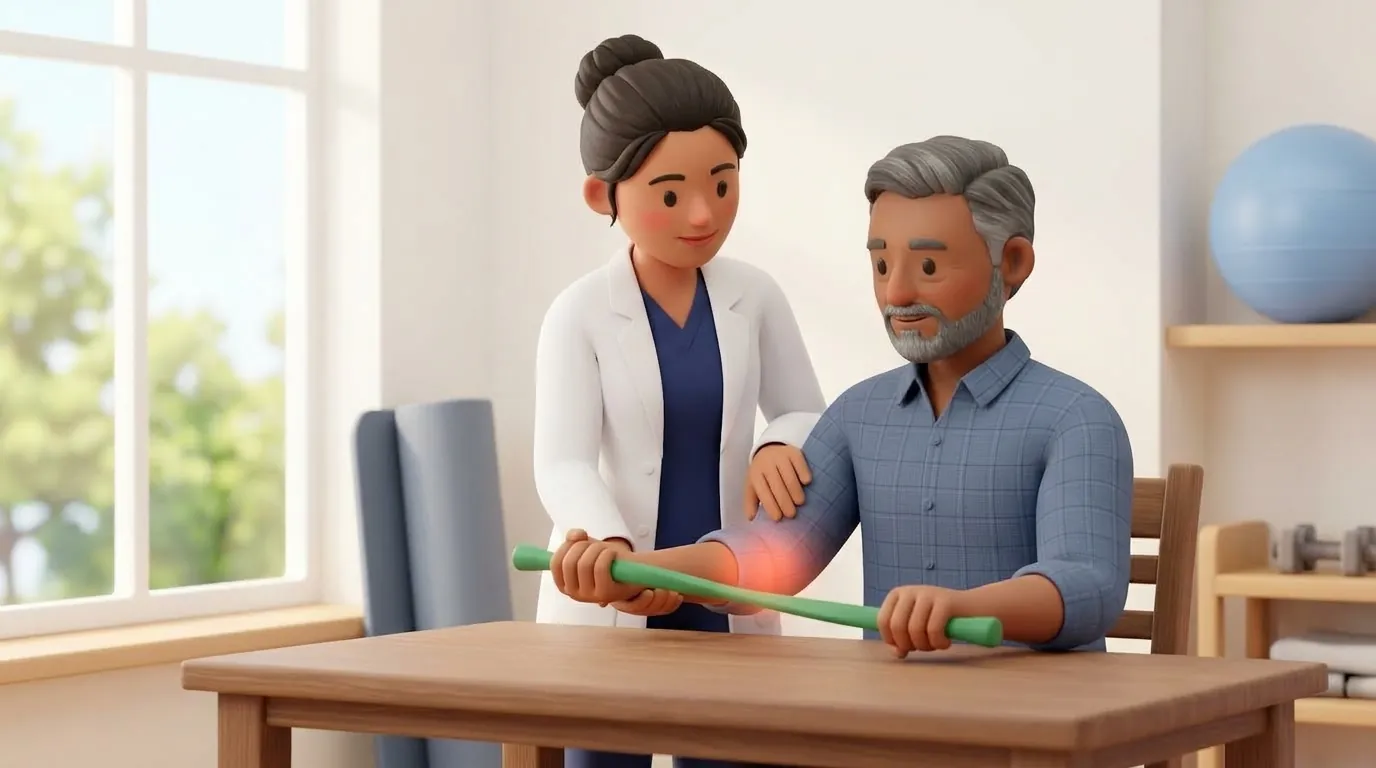
The arm is immobilized in a long-arm plaster cast for 4 weeks with the elbow at 90 degrees, forearm in 30 degrees of pronation, wrist in 40 degrees of extension, and MCP joints in neutral. At week 4, the cast is exchanged for a custom thermoplastic splint. Biofeedback and donor activation begin immediately: the patient gently pronates the forearm against manual resistance, visualizing and feeling the wrist lift into active extension.
Pronation-Facilitated Active Wrist Extension Drill
Objective: Re-educate the transferred Pronator Teres to function as an active wrist extensor
- 1Rest your forearm on a table with your wrist supported just beyond the table edge in neutral.
- 2Place your opposite hand under your wrist for light support.
- 3Intentionally initiate a forearm pronation movement (turning your palm toward the floor).
- 4While initiating pronation, mentally command your wrist to lift backward toward the ceiling.
- 5Hold the active wrist extension for 3 seconds, feeling the transferred pronator tendon pull on the dorsal wrist.
| Donor Muscle | Recipient Tendon | Restored Functional Movement |
|---|---|---|
| Pronator Teres (PT) | Extensor Carpi Radialis Brevis (ECRB) | Active wrist extension; restores synergistic tenodesis |
| Flexor Carpi Radialis (FCR) | Extensor Digitorum Communis (EDC) | Active extension of index, middle, ring, and little finger MCPs |
| Palmaris Longus (PL) | Extensor Pollicis Longus (EPL) | Thumb retropulsion, extension, and hand clearance |
| Post-Op Splint Position | Elbow 90 deg, Forearm 30 deg pronation, Wrist 40 deg extension | Protects healing tenodesis repairs from tensile distraction |
Red Flags and Specialist Escalation
A sudden, painless loss of active wrist extension during early movement suggests mechanical pull-out of the PT tendon from the ECRB insertion. Development of severe wrist flexion contracture or persistent clawing requires prompt surgical review.
Frequently Asked Questions
How does a muscle that used to turn my palm down now lift my wrist up?
Surgeons detached the pronator muscle from the forearm bone and stitched it into the tendon that lifts your wrist. With guided exercises, your brain quickly learns to use this muscle to raise your wrist instead.
Do I need a doctor referral for post-tendon transfer therapy on BookPhysio.in?
BookPhysio.in does not ask for a doctor referral. Direct access is protected under the NCAHP Act 2021. You consult licensed physiotherapists directly and pay per session with complete fee transparency.
Related recovery guides & articles
BookPhysio.in Editorial Team
The BookPhysio.in editorial team writes and maintains this content, checking it against reliable clinical sources. Content follows our medical review policy: general information only, and no page claims a clinical review until a named registered physiotherapist has signed it off.
Read our medical review policy