
Ulnar Clawing Tendon Transfer: Fowler and Stiles-Bunnell Rehab
In short
Irreversible ulnar clawing impairs power grip. Stiles-Bunnell and Fowler tendon transfers restore active MCP flexion and complete digital extension.
In this guide (5 sections)
Chronic, irreversible ulnar nerve paralysis produces intrinsic minus clawing of the ring and little fingers due to paralysis of the third and fourth lumbricals and all interossei. The loss of active metacarpophalangeal (MCP) flexion torque allows extrinsic extensors to hyperextend the MCP joints, resulting in functional collapse of the hand during power grasp. Tendon transfer procedures: such as the Stiles-Bunnell transfer or Fowler tenodesis: restore active MCP flexion, redirecting extrinsic extensor pull to extend the IP joints.
Domestic and Cultural Indian Realities
In Indian society, untreated ulnar claw hand creates both functional disability and severe social stigma. Patients struggle to hold tools, grip two-wheeler handles, eat meals without dropping food, or participate in social handshakes. Successful tendon transfer restores an aesthetically normal resting hand cascade and functional power grip, facilitating community reintegration and economic self-reliance.
Surgical Pathoanatomy and Biomechanical Principles
In the Stiles-Bunnell procedure, the flexor digitorum superficialis (FDS) of the middle or ring finger is harvested, split into slips, routed through the lumbrical canals volar to the deep transverse metacarpal ligament, and sutured into the radial lateral bands of the extensor hood. This reconstruction recreates the exact anatomical line of pull of the paralyzed lumbrical muscles, flexing the MCP joint and extending the PIP and DIP joints simultaneously.
Postoperative Rehabilitation Phases and Splinting Protocols
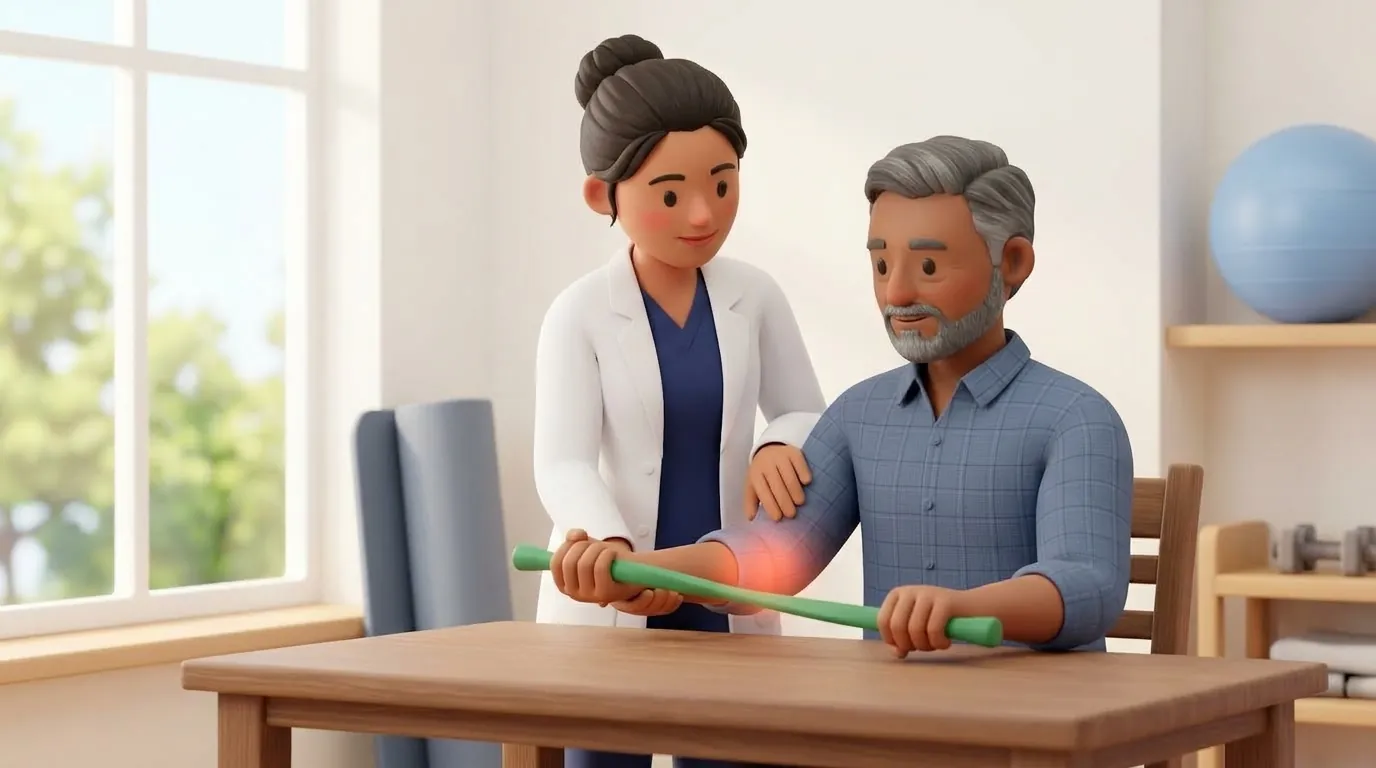
The hand is protected in an intrinsic-plus thermoplastic dorsal blocking splint (wrist 20 degrees flexion, MCPs 60 to 70 degrees flexion, IP joints straight) for 4 weeks. Active place-and-hold exercises commence at week 4: the patient gently contracts the transferred FDS to maintain isolated MCP flexion while actively extending the fingers. Power grip strengthening and functional object manipulation begin at week 8.
Transferred Lumbrical Table-Top Active Hold
Objective: Train the transferred FDS tendon to fire as a primary MCP flexor while keeping IP joints extended
- 1Wear your protective dorsal blocking splint or support your wrist in slight neutral flexion on a table.
- 2Keep your middle and end finger joints (PIP and DIP) completely straight.
- 3Actively bend only your large knuckles (MCP joints) downward to a 90-degree table-top position.
- 4Hold this intrinsic-plus posture for 4 seconds, feeling the transferred muscle activate in the palm.
- 5Slowly return the knuckles back to neutral extension in a smooth, controlled rhythm.
| Surgical Technique | Donor Motor Unit | Biomechanical Insertion and Action |
|---|---|---|
| Stiles-Bunnell Transfer | FDS of middle or ring finger split into 2 slips | Routed through lumbrical canals to radial lateral bands; strong active flexion |
| Fowler Transfer | Extensor Indicis Proprius (EIP) or ECRL with graft | Routed through intermetacarpal spaces; excellent for flexible clawing |
| Zancolli Lasso Procedure | FDS looped around A1/A2 pulleys and sutured to itself | Creates dynamic MCP flexion block without disturbing extensor apparatus |
| Post-Op Splint Protection | Dorsal blocking splint with MCPs in 60-70 deg flexion | Worn continuously for 4 weeks to prevent suture dehiscence |
Red Flags and Specialist Escalation
Sudden recurrence of clawing during exercise indicates suture detachment at the lateral band insertion. Development of a swan neck deformity (PIP hyperextension) suggests excessive tension on the transferred slip, requiring prompt surgical evaluation.
Frequently Asked Questions
Will this tendon transfer stop my fingers from curling into a claw?
Yes. The transferred tendon takes over the job of the paralyzed muscles by bending your main knuckles forward. This allows your natural straightening tendons to fully open your fingertips, resolving the claw posture.
Do I need a doctor referral for ulnar tendon transfer rehab on BookPhysio.in?
BookPhysio.in does not ask for a doctor referral. Direct access is protected under the NCAHP Act 2021. You book registered physiotherapists directly and pay per session with complete fee transparency.
Related recovery guides & articles
BookPhysio.in Editorial Team
The BookPhysio.in editorial team writes and maintains this content, checking it against reliable clinical sources. Content follows our medical review policy: general information only, and no page claims a clinical review until a named registered physiotherapist has signed it off.
Read our medical review policy