
Thoracolumbar Extension in Early Spondylitis: The Prone Lying Sphinx Routine
In short
Combat progressive thoracic kyphosis and maintain lumbar lordosis in early ankylosing spondylitis. Master the clinical progression of prone lying and supported sphinx extension to preserve sagittal spinal balance.
In this guide (6 sections)
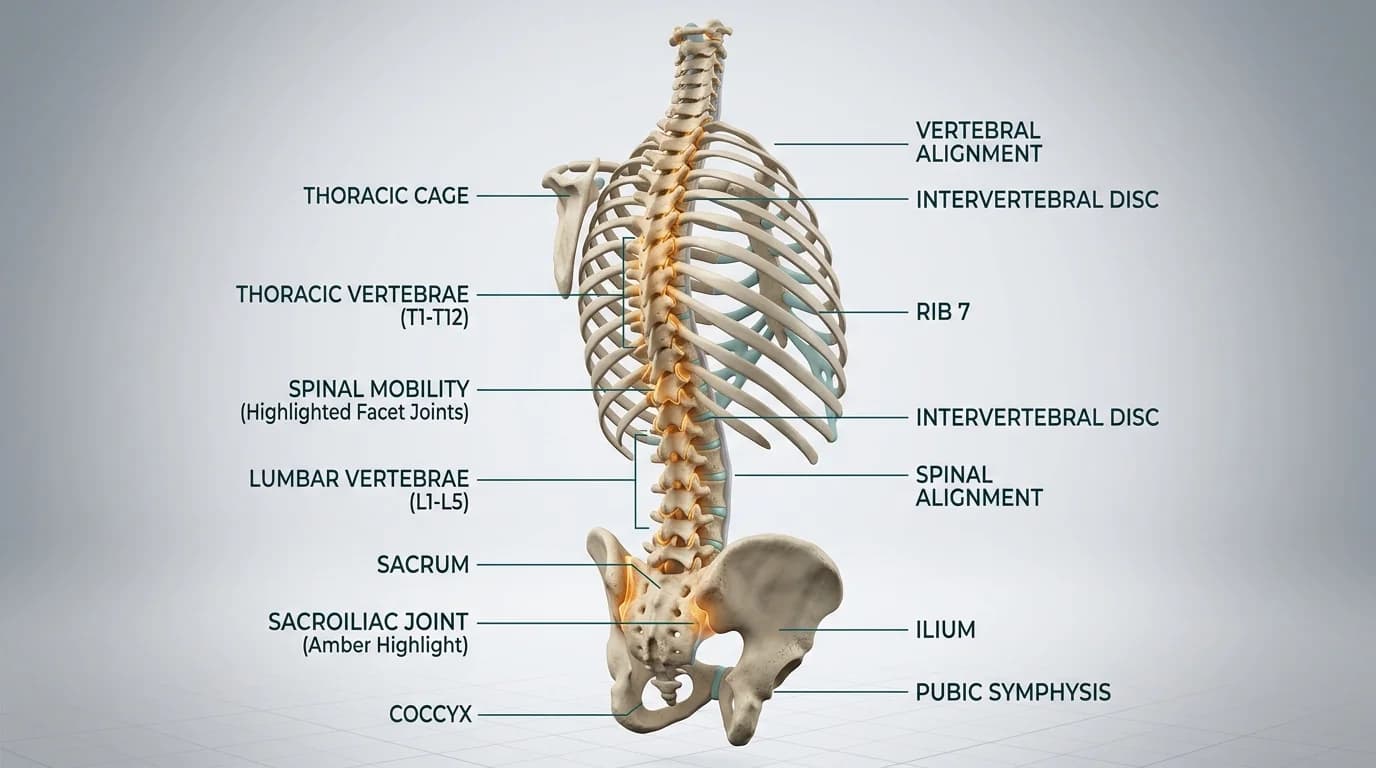
In early ankylosing spondylitis, inflammatory enthesopathy targets the thoracolumbar junction and sacroiliac joints, sparking continuous reparative bone formation along the anterior longitudinal ligament and outer annulus fibrosus. Because modern human life is predominantly lived in forward flexion (working at computers, dining, driving, and relaxing), gravity continuously biases this remodeling process toward thoracic kyphosis and loss of lumbar lordosis. The prone lying sphinx position, an adapted low-load supported extension posture, provides an indispensable biomechanical counter-measure. By using the forearms as a stable tripod base, the sphinx position gently elongates anterior soft tissue restraints and unloads vertebral bodies without creating destructive posterior facet joint jamming.
Domestic and Cultural Indian Realities
In Indian households, the concept of lying flat on one's stomach on the floor or a firm wooden cot is often overlooked in favour of resting in soft chairs or sagging rope charpoys. When an individual with early spondylitis relaxes on a soft sofa, the lumbar spine completely collapses into flexion, accelerating the consolidation of anterior syndesmophytes. Practicing the sphinx routine daily requires designating a clean, firm mat area on the floor or a dedicated firm wooden cot. Patients can integrate this routine into their evening spiritual contemplation or reading time, using a firm bolster under the chest if initial stiffness prevents propping directly onto elbows.
Clinical Biomechanics and Inflammatory Pathology
The anterior longitudinal ligament is a thick, fibrous band adhering to the anterior margins of all vertebral bodies. In spondyloarthritis, enthesitis at these insertions stimulates chondrocyte metaplasia and alkaline phosphatase activity. When the spine remains in prolonged flexion, the anterior disc spaces are compressed while the posterior elements are distracted. This mechanical environment promotes anterior syndesmophyte bridging across disc margins. By assuming the prone sphinx position, the anterior longitudinal ligament is placed under low-load, sustained viscoelastic elongation. This sustained stretch stimulates mechanoreceptors, inhibits pain-spasm cycles in the erector spinae, and ensures that ossification, if it occurs, consolidates in functional upright extension.
Clinical Assessment and Functional Staging
Clinical assessment evaluates sagittal spinal mobility using the modified Schober test and thoracolumbar lateral flexion. Passive prone extension tolerance is evaluated: patients unable to tolerate prone lying flat due to severe hip or abdominal tightness require a supportive pillow beneath the pelvis. Thoracic kyphosis angle is measured using a manual inclinometer or Debrunner kyphometer. The Bath Ankylosing Spondylitis Metrology Index (BASMI) provides an overall composite score of spinal mobility.
Targeted Mobility and Joint Preservation Exercises
The sphinx exercise must be introduced progressively: starting with flat prone lying, advancing to propping on forearms, and maintaining steady diaphragmatic breathing throughout.
Supported Prone Sphinx Postural Hold with Scapular Retraction
Objective: Promote continuous, passive-assisted thoracolumbar extension and open the anterior chest wall safely
- 1Lie face down on a firm exercise mat, with legs straight, feet hip-width apart, and toes relaxed.
- 2Prop your upper body onto your forearms, placing your elbows directly beneath your shoulders with palms flat on the mat.
- 3Gently pull your shoulders downward away from your ears while lifting your chest forward and upward like a sphinx.
- 4Keep your neck lengthened and gaze directed softly at the floor 2 feet in front of your hands, avoiding backward neck hyperextension.
| Progression Level | Positioning Technique | Clinical Objective & Duration |
|---|---|---|
| Level 1: Prone Flat | Lying completely flat on stomach with thin pillow under hips and head turned to side | Gradual relaxation of anterior hip flexors and lumbar settling for 10 minutes |
| Level 2: Supported Sphinx | Propping onto forearms with a soft cushion placed beneath lower ribcage for support | Gentle mid-thoracic extension and anterior ligament elongation for 2 to 3 minutes |
| Level 3: Full Sphinx | Elbows directly under shoulders, chest lifted forward, neck long, no pelvic pillow | Active scapular retraction and sustained sagittal extension for 5 continuous minutes |
| Contraindicated Motion | Pushing up into full cobra pose (Bhujangasana) with locked elbows and arching lower back | Avoids extreme lumbar facet jamming and sharp shearing stress across sacroiliac joints |
Red Flags and Immediate Rheumatology Escalation
If assuming the prone position triggers sharp, radiating pain shooting down the back of the leg below the knee, or numbness in the foot, the patient may have an acute lumbar disc herniation or spinal stenosis exacerbated by extension, requiring urgent clinical evaluation. Severe anterior chest pain accompanied by breathlessness warrants immediate medical review to exclude pleuritis or cardiac involvement.
Frequently Asked Questions
Can the sphinx position reverse established bamboo spine fusion?
No. The sphinx position cannot dissolve or reverse mature bony syndesmophytes once adjacent vertebrae have fused together. However, in early and non-radiographic stages, practicing the sphinx posture daily helps manage morning stiffness, elongates tight anterior ligaments, and prevents the spine from fusing in a forward hunched posture.
How do I book a qualified home physiotherapist to guide spinal extension via BookPhysio.in?
Under the National Commission for Allied and Healthcare Professions (NCAHP) Act 2021, Indian patients enjoy direct access to registered physiotherapists without an obligatory doctor referral. On BookPhysio.in, you schedule an appointment with a verified clinician in your city. Payment is made directly to the therapist at your home appointment via cash or UPI; BookPhysio.in does not process booking fees online.
Related recovery guides & articles
BookPhysio.in Editorial Team
The BookPhysio.in editorial team writes and maintains this content, checking it against reliable clinical sources. Content follows our medical review policy: general information only, and no page claims a clinical review until a named registered physiotherapist has signed it off.
Read our medical review policy