
Toe Clawing and Hammer Toes in Diabetes: Lumbrical Strengthening and Silicone Spacers
In short
Digital deformities like hammer toes and claw toes concentrate intense pressure on toe apices and knuckles in diabetic feet. Learn clinical management using silicone orthoses and exercises.
In this guide (6 sections)
Digital deformities such as claw toes, hammer toes, and mallet toes are common structural complications of diabetic motor neuropathy. Intrinsic muscle denervation selectively weakens the lumbricals and interossei, allowing the long extrinsic toe extensors and flexors to act unopposed. In a claw toe deformity, the metatarsophalangeal (MTP) joint hyperextends while both interphalangeal joints flex tightly. In a hammer toe, the proximal interphalangeal (PIP) joint flexes while the distal joint extends. These joint misalignments create two prominent high-pressure areas: the dorsal aspect of the contracted knuckles (which rub against shoe uppers) and the very tips (apices) of the toes (which dig directly into the ground). Managing these deformities through lumbrical strengthening, medical-grade silicone spacers, and extra-depth footwear prevents recurrent ulceration.
Domestic and Cultural Indian Realities
In Indian households, individuals with clawed or hammer toes face severe hazards from both barefoot walking and narrow traditional footwear. When walking barefoot across hard mosaic, tile, or marble floors, the clawed toe tips bear concentrated vertical body weight, resulting in painful apical calluses that rapidly ulcerate into the distal phalangeal bone. Furthermore, traditional Kolhapuri chappals and leather juttis have shallow, non-yielding toe boxes that press directly against the prominent dorsal PIP knuckles. Over the course of a single day, this constant friction rubs off the epidermis, producing deep dorsal ulcers directly over the extensor tendon and joint capsule. Patients must use soft silicone toe crests to cushion the tips and switch to footwear with generous vertical depth.
Clinical Biomechanics and Neuropathic Breakdown
The lumbrical muscles originate from the tendons of the flexor digitorum longus and insert into the extensor expansion, functioning biomechanically to flex the MTP joints while extending the interphalangeal joints. When motor neuropathy denervates the lumbricals, the extensor digitorum longus hyperextends the proximal phalanx, displacing the plantar fat pad distally away from the metatarsal head. Concurrently, the flexor digitorum longus curls the middle and distal phalanges downward. This clawing quadruples peak pressure beneath the metatarsal heads and shifts ground contact from the broad plantar toe pads to the tiny, unpadded distal nail margins. Without sensory nociception to trigger offloading, continuous walking causes subcutaneous necrosis at both sites.
Clinical Assessment and Neuropathy Screening
Assessment begins by evaluating the passive flexibility of each deformed digit. The clinician attempts to passively reduce the hyperextended MTP joint to neutral while extending the PIP joint; if the digit straightens easily, the deformity is classified as flexible. If contracture prevents manual correction, it is classified as semi-rigid or rigid. The skin is examined for dorsal corns, apical calluses, interdigital soft corns (heloma molle), and subungual hematomas. Sensory testing with 10g monofilaments determines coexisting sensory loss.
Targeted Offloading and Intrinsic Foot Conditioning
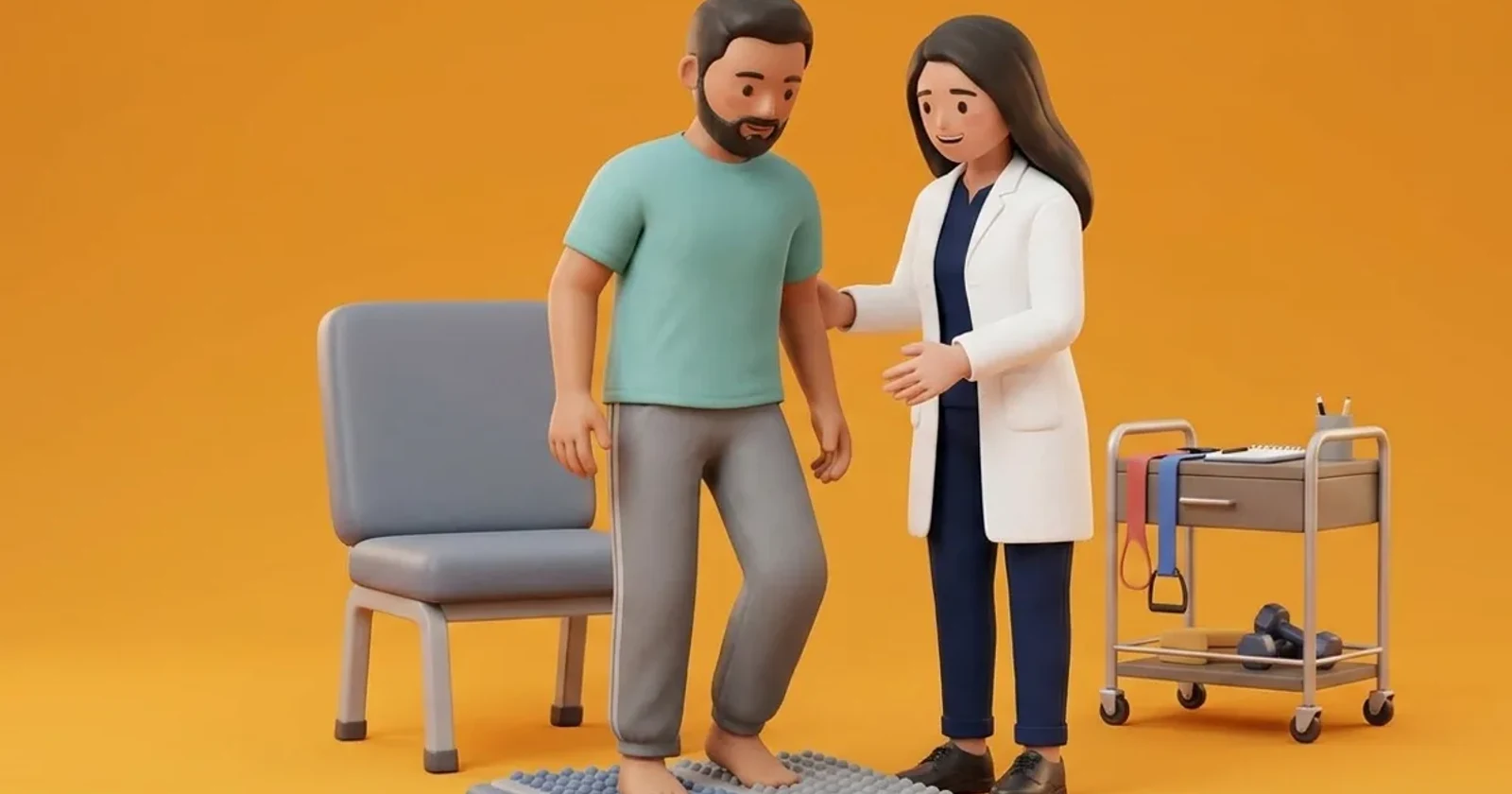
For flexible deformities, physiotherapy emphasizes passive joint stretching and active intrinsic muscle re-education to delay rigid capsular contracture. Medical-grade silicone gel toe crests are fitted beneath the sulcus of the toes, supporting the clawed digits and distributing apical load back onto the plantar pad. Interdigital silicone spacers prevent adjacent toes from rubbing together. Footwear must provide an extra 10 to 12 millimetres of vertical toe box depth to eliminate all dorsal friction.
Seated Passive Toe Extension and Lumbrical Squeeze
Objective: Maintain interphalangeal joint flexibility and stretch tight long flexor tendons
- 1Sit comfortably with one leg crossed over the opposite knee so your foot is within easy reach.
- 2Hold the ball of your foot firmly with one hand to support the metatarsal heads.
- 3Using the fingers of your other hand, gently straighten the curled toes, lifting them into alignment.
- 4Hold the gentle, sustained stretch for 15 seconds without forcing or causing pain.
- 5Slowly release, then actively squeeze your toes downward against your hand for 5 seconds.
- 6Repeat the sequence on each digit, then switch to the other foot.
| Digital Deformity Type | Joint Alignment & High-Pressure Points | Prescribed Orthotic & Footwear Solution |
|---|---|---|
| Claw Toe Deformity | MTP hyperextended; PIP and DIP flexed; pressure on dorsal knuckles and toe tips | Moulded silicone toe crest, metatarsal offloading dome, extra-depth toe box shoe |
| Hammer Toe Deformity | MTP extended; PIP flexed; DIP neutral/extended; pressure over dorsal PIP joint | Silicone sleeve over PIP joint, soft stretchable upper footwear, passive stretching |
| Mallet Toe Deformity | MTP and PIP neutral; DIP flexed; severe pressure on toe tip and nail bed | Silicone toe cap, apical gel pad, proper shoe length with wide rounded toe box |
| Interdigital Soft Corn (Heloma Molle) | Macerated callus between 4th and 5th digits from bony rubbing | Custom interdigital silicone spacer, surgical shoe width expansion |
Red Flags and Urgent Diabetic Foot Escalation
Immediate medical escalation is necessary if a patient discovers an open ulcer over a dorsal toe knuckle or at the tip of a clawed toe. Because the subcutaneous tissue over these joints is extremely thin, ulcers can penetrate directly into the joint capsule or extensor tendon within 48 hours, causing septic arthritis or osteomyelitis. Spreading redness, throbbing swelling, or foul-smelling drainage requires emergency podiatric evaluation.
Frequently Asked Questions
Can silicone toe crests straighten fixed claw toes?
If the claw toe deformity has become rigid with fixed joint contractures, silicone crests cannot physically straighten the bones. However, they perform a vital protective function by filling the empty space under the toes, preventing the toe tips from digging into the ground, and redistributing walking pressure away from vulnerable points.
How do I care for silicone toe spacers and crests at home?
Wash silicone orthoses daily using lukewarm water and mild soap, then allow them to air dry completely. Dust them lightly with plain talcum powder before wearing to prevent skin friction. Inspect the silicone regularly for tears or hardening, and replace them every 3 to 6 months.
Related recovery guides & articles
BookPhysio.in Editorial Team
The BookPhysio.in editorial team writes and maintains this content, checking it against reliable clinical sources. Content follows our medical review policy: general information only, and no page claims a clinical review until a named registered physiotherapist has signed it off.
Read our medical review policy