
Vibration Perception Threshold VPT and Biothesiometry in Diabetic Foot Risk
In short
Biothesiometry provides quantitative measurement of large nerve fibre degeneration in diabetic feet. Learn how vibration perception threshold testing stratifies ulcer risk.
In this guide (6 sections)
The vibration perception threshold (VPT), measured quantitatively using an electronic biothesiometer or neurothesiometer, is one of the most reliable predictors of future neuropathic foot ulceration in patients with diabetes mellitus. Vibratory perception is mediated by Pacinian corpuscles and large myelinated A-beta sensory nerve fibres within the posterior column-medial lemniscal pathway. Because large-diameter sensory axons are vulnerable to metabolic and ischaemic injury from chronic hyperglycaemia, vibratory sensation typically degrades years before superficial pain or thermal awareness is lost. Electronic biothesiometry applies an oscillating 100 Hz electromagnetic probe to specific bony landmarks, delivering a calibrated vibration amplitude measured in volts (0 to 50 volts). A VPT value exceeding 25 volts signifies profound sensory loss and carries a sevenfold increase in ulceration risk.
Domestic and Cultural Indian Realities
In Indian medical practice, screening for diabetic neuropathy is often neglected until a patient arrives at a clinic with an open, infected plantar ulcer. Many patients report that their feet simply feel slightly cold or tingly, which they attribute to normal ageing or poor sleep. Consequently, they continue walking barefoot across stone courtyards, wearing unpadded hawai chappals, and ignoring minor corns. Quantitative biothesiometry provides an objective numerical score that clearly demonstrates sensory loss to patients and their families. Seeing a high voltage score (such as 35 volts) helps family members understand why their loved one must never walk barefoot indoors, wear proper MCR footwear, and conduct daily mirror inspections.
Clinical Biomechanics and Neuropathic Breakdown
Pacinian corpuscles in the deep dermis and subcutaneous tissues respond to rapid mechanical vibrations (100 to 300 Hz), providing essential feedback regarding ground texture, shoe vibrations, and heel contact velocity during gait. In diabetic neuropathy, endoneurial microvascular occlusion and Schwann cell demyelination slow conduction velocities and raise the threshold required to trigger an action potential. When the vibration threshold surpasses 25 volts, protective mechanoreception during the stance phase of walking is abolished. The patient foot lands heavily on the ground without automatic muscular dampening, driving ground reaction forces directly into fragile submetatarsal tissues.
Clinical Assessment and Neuropathy Screening
The biothesiometry examination follows a standardized clinical protocol. Testing is conducted in a quiet, temperature-controlled room with the patient lying comfortably supine with eyes closed. The vibrating probe is first applied to the patient hand (thenar eminence or sternum) so they recognise the sensation. The probe is then placed vertically over the dorsal interphalangeal joint of the hallux, the medial malleolus, the lateral malleolus, and the heel pad. Voltage is increased gradually from zero at a rate of 1 volt per second until the patient indicates the first perception of vibration. Three consecutive readings are averaged for each site.
Targeted Offloading and Intrinsic Foot Conditioning
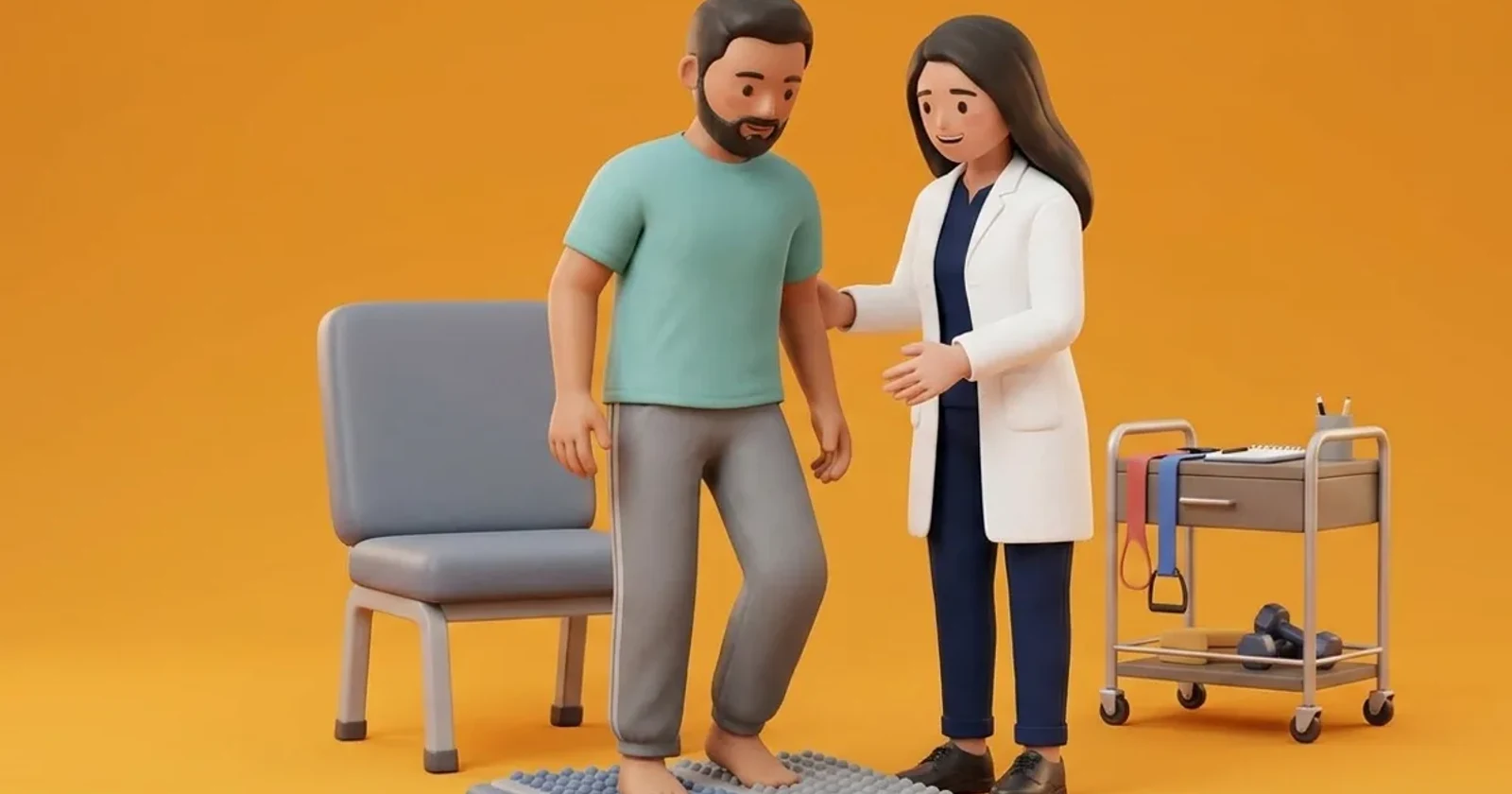
When biothesiometry confirms a VPT above 25 volts, the patient is classified as high-risk, triggering immediate biomechanical interventions. The physiotherapist prescribes custom-moulded multi-density MCR or Plastazote insoles to distribute walking loads evenly across the sole. Footwear with rigid rocker soles is prescribed to reduce metatarsal shear stress. Exercise therapy focuses on visual and vestibular balance compensation alongside gentle seated ankle mobilisation drills.
Seated Active Foot Tapping and Sensory Awareness Drill
Objective: Maintain ankle mobility and stimulate mechanoreceptors safely in a seated position
- 1Sit comfortably in a sturdy chair with feet flat on a textured rubber floor mat.
- 2Keeping your heel on the floor, tap the front of your right foot gently 5 times.
- 3Keeping your toes on the floor, tap your right heel gently 5 times.
- 4Focus your eyes on your foot as it moves, connecting your visual sight with the foot position.
- 5Repeat the 5-tap sequence with your left foot.
- 6Relax your feet in neutral position and breathe steadily.
| VPT Voltage Threshold | Clinical Neuropathic Interpretation | Prescribed Foot Care Action Plan |
|---|---|---|
| < 15 Volts (Normal Perception) | Intact large-fibre sensory function; minimal ulcer risk | Annual clinical screening; standard broad-toe protective footwear |
| 15 to 24 Volts (Mild to Moderate Loss) | Early large-fibre sensory impairment; elevated risk | Biannual foot exams; custom MCR cushioned footwear; strict indoor protection |
| 25 to 50 Volts (Severe Loss / LOPS) | Profound loss of protective sensation; 7x higher ulcer risk | Quarterly podiatric review; custom total contact insoles; rigid rocker shoes |
| > 50 Volts (Complete Loss / Off-Scale) | Complete absence of vibratory perception; extreme ulcer risk | Monthly clinical monitoring; clinical footwear; daily caregiver inspection |
Red Flags and Urgent Diabetic Foot Escalation
Immediate clinical escalation is required if biothesiometry reveals a sudden, asymmetrical spike in vibration threshold on one side accompanied by unilateral foot swelling or warmth, which may indicate acute Charcot neuroarthropathy or nerve root compression. Any open blister, bleeding callus, or purulent drainage demands emergency podiatric care.
Frequently Asked Questions
How is electronic biothesiometry different from a regular tuning fork test?
A standard 128 Hz tuning fork provides a simple yes-or-no check for vibration sense, but it cannot measure how severe the sensory loss is or track subtle changes over time. Electronic biothesiometry delivers an exact numerical voltage score (from 0 to 50 volts), allowing clinicians to measure gradual nerve deterioration and evaluate foot ulcer risk accurately.
Can my vibration score improve if I achieve tight blood sugar control?
Improving blood glucose control, blood pressure, and cholesterol can slow or halt the progression of nerve damage and occasionally produce minor improvements in early sensory scores. However, longstanding nerve fibre loss is permanent, which is why lifelong footwear protection and regular screenings remain necessary.
Related recovery guides & articles
BookPhysio.in Editorial Team
The BookPhysio.in editorial team writes and maintains this content, checking it against reliable clinical sources. Content follows our medical review policy: general information only, and no page claims a clinical review until a named registered physiotherapist has signed it off.
Read our medical review policy