
Wet Bathroom Tile Falls: Anti-Skid Mats, Grab Bars, and Surface Safety Standards
In short
Over seventy percent of severe domestic geriatric falls occur in bathrooms. Learn how soapy water, smooth ceramic tiles, and inadequate support create hazardous environments for seniors.
In this guide (6 sections)
The domestic bathroom represents the most dangerous environmental zone for older adults. Epidemiological data indicates that more than seventy percent of severe in-home fall injuries, including hip fractures and traumatic brain injuries, happen inside wet bathing areas. Bathrooms combine rigid ceramic surfaces, confined architectural layouts, soapy water, and multiple postural transitions such as stepping over shower sills, sitting down, and rising from wet toilet fixtures. Mitigating these hazards through rigorous surface modification, high-grade anti-skid mats, and biomechanically positioned grab bars is an urgent clinical priority for geriatric independence.
Domestic and Cultural Indian Realities
Bathing traditions in Indian households feature specific environmental patterns that heighten slip risks. Many older Indians prefer the traditional 'bucket-and-mug' (balti and mugga) bathing ritual, sitting on a low plastic stool (patla) while repeatedly bending forward to scoop warm water. This process distributes large volumes of soapy water across smooth ceramic or polished granite floor tiles. Furthermore, bathrooms in older Indian apartments often lack separate dry and wet zones, meaning water from bathing spreads across the entire floor leading to the commode and doorway. Seniors attempting to dry their feet on cheap, unanchored coir mats or worn cotton towels placed outside the door often experience sudden mat-displacement slips that cause violent falls against concrete door jambs.
Clinical Biomechanics and Postural Control Decay
Water combined with soap surfactants forms an elastohydrodynamic lubricant film that completely decouples the micro-roughness between footwear soles or human skin and ceramic tiles. This dynamic reduces the available coefficient of friction below 0.10. At the same time, the sensory demands of bathing challenge postural stability: closing one's eyes while washing hair eliminates visual anchoring, leaving the individual dependent on vestibular and somatosensory inputs. In seniors with age-related vestibular decline or peripheral neuropathy, this sudden loss of visual feedback causes immediate postural sway. When coupled with the slippery floor surface, the slightest lateral displacement of the centre of mass precipitates a catastrophic fall.
Functional Assessment and Risk Stratification
A geriatric bathroom safety assessment systematically evaluates both environmental features and patient physical capabilities. Clinicians inspect floor tile slip resistance, lighting levels, threshold step heights, and structural wall integrity for mounting grab bars. On the patient level, therapists assess single-leg stance duration, trunk lateral flexion control, and the ability to step over a fifteen-centimetre obstacle without hand support. Seniors unable to hold a single-leg stance for five seconds or who demonstrate knee instability during shallow squats require immediate environmental modifications and assistive bathing chairs.
Targeted Strength and Balance Exercises
Physiotherapy rehabilitation incorporates functional stepping and multi-planar hip strengthening to prepare seniors for bathroom movements. Training emphasizes controlled single-leg weight bearing, safe pivoting maneuvers, and learning how to push through firm grab bars using upper-limb triceps and latissimus dorsi power rather than pulling backward on weak plumbing fixtures.
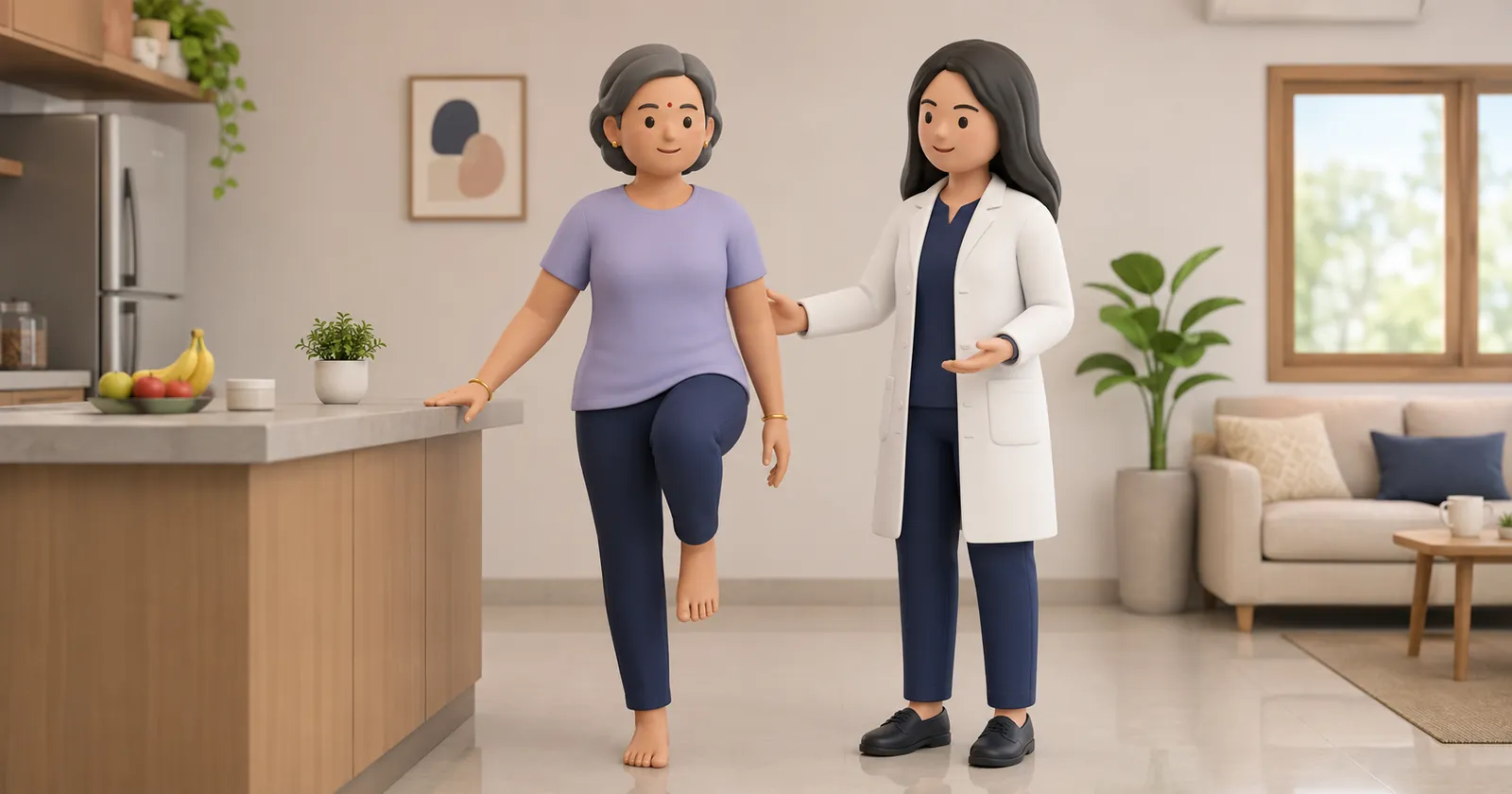
Supported Lateral Step-Over and Weight Transfer
Objective: Improve dynamic hip clearance and single-leg stability when stepping over wet bathroom thresholds
- 1Stand parallel to a sturdy kitchen counter or hallway handrail, holding firmly with both hands.
- 2Place a rolled bathroom towel (ten centimetres high) on the floor beside your outside foot.
- 3Lift your outside foot high, clearing the towel cleanly without touching it, and step laterally.
- 4Shift your full body weight smoothly onto the newly planted foot while keeping your torso upright.
- 5Bring your trailing foot across the towel to join the leading foot, then reverse the sequence.
| Bathroom Zone | Recommended Safety Modification | Clinical Functional Rationale |
|---|---|---|
| Shower and Wet Area Floor | Non-slip textured coating or heavy suction-backed rubber mats | Raises wet dynamic friction coefficient above 0.60 to prevent slips |
| Toilet Transfer Zone | Bilateral 32mm stainless steel grab bars anchored with wall bolts | Provides solid upper-limb lever arms during sit-to-stand transitions |
| Bathing Area Seating | Medical-grade shower chair with drainage holes and rubber tips | Eliminates prolonged standing fatigue and reduces balancing demands |
| Doorway and Exit Zone | Recessed drainage trench and non-skid beveled threshold ramp | Eliminates step-over trip hazards and stops water migration into bedroom |
Red Flags and Emergency Post-Fall Escalation
Bathroom falls frequently involve impact against hard porcelain fixtures or glass partitions. Following a bathroom fall, carefully evaluate the patient for spinal tenderness, cranial lacerations, or rib fractures before moving them. Inability to move the legs or severe radiating neck pain indicates possible cervical spinal cord trauma; do not move the patient's head and immediately contact emergency services. In older adults on antiplatelet or anticoagulant medications, any head impact demands urgent hospital evaluation even if the patient appears alert initially.
Frequently Asked Questions
Are adhesive anti-slip strips effective on wet bathroom floors for elderly safety?
Adhesive non-slip strips provide localized traction when newly applied, but soap scum, warmth, and humidity often degrade their adhesive backing within months. Professional chemical anti-slip surface etching or full-coverage heavy rubber mats with deep drainage channels offer superior, durable slip resistance.
Can a physiotherapist evaluate an older adult's bathroom safety at home in India?
Geriatric physiotherapists conduct thorough home environmental assessments to optimise bathroom ergonomics, grab bar positions, and mobility safety. Under the NCAHP Act 2021, Indian patients enjoy direct access to registered physiotherapists. BookPhysio.in connects you with verified local physiotherapists for home visits with transparent session pricing and no platform fees.
Related recovery guides & articles
BookPhysio.in Editorial Team
The BookPhysio.in editorial team writes and maintains this content, checking it against reliable clinical sources. Content follows our medical review policy: general information only, and no page claims a clinical review until a named registered physiotherapist has signed it off.
Read our medical review policy