
Acromioclavicular (AC) Joint Sprains: Rockwood Classification and Conservative vs Surgical Rehab
In short
A direct fall onto the shoulder tip frequently separates the AC joint. Learn Rockwood Grades I to VI, provocative physical tests, and conservative rehabilitation timelines.

In this guide (5 sections)
Anatomy and Mechanism of AC Joint Disruption
The Acromioclavicular (AC) joint is a diarthrodial joint linking the lateral end of the clavicle to the acromion process of the scapula.
Joint stability is maintained horizontally by the AC capsule and ligaments (superior, inferior, anterior, posterior), and vertically by the potent coracoclavicular (CC) ligaments (trapezoid and conoid ligaments).
AC joint injuries typically result from a direct blow or hard fall onto the lateral point of the shoulder with the arm adducted (e.g., cycling crash, motorcycle fall, cricket dive), driving the acromion downward and medially while the clavicle remains elevated.
The Rockwood Classification System (Grades I to VI)
The Rockwood classification determines clinical management based on ligament disruption and clavicular displacement on bilateral Zanca radiographs.
| Rockwood Grade | Ligament Damage Extent | Clavicular Displacement Pattern | Recommended Management Strategy | |
|---|---|---|---|---|
| Grade I | Sprain of AC ligament; CC ligaments completely intact | Normal radiographic alignment; no joint space widening | Conservative: brief sling for 3-5 days; early pain-free ROM. | |
| Grade II | Complete AC ligament tear; partial CC ligament sprain | Slight vertical elevation (< 25% or < 5mm); AC joint widened | Conservative: sling for 1-2 weeks; progressive strengthening. | |
| Grade III | Complete tear of both AC and CC ligaments | Clavicle elevated 25 to 100% above acromion; visible deformity | Controversial: first-line conservative rehab trial; surgery for elite throwers. | |
| Grade IV | Complete tears with posterior displacement into trapezius | Clavicle buttonholed posteriorly through trapezius muscle | Surgical reconstruction required. | |
| Grade V | Extreme vertical displacement (> 100 to 300% elevation) | Massive tear with wide skin tenting and deltotrapezial detachment | Surgical reconstruction required. | |
| Grade VI | Inferior displacement of clavicle beneath coracoid process | Extremely rare; high neurovascular injury risk | Emergency surgical reduction required. |
Clinical Physical Examination Tests
Physical examination identifies localized tenderness directly over the superior AC joint line and reproduces pain during compressive maneuvers.
- The Paxinos Sign: Examiner places thumb behind posterolateral acromion and index finger over anterosuperior clavicle, compressing them together. Sharp pain localized to the AC joint confirms pathology.
- Cross-Body Adduction Test: Passively elevate arm to 90 degrees flexion and maximally adduct across the chest toward the opposite shoulder, compressing the AC joint.
- Step-Off Deformity Inspection: Inspect the shoulder from the side and front: a prominent superior clavicular bump confirms joint subluxation or dislocation.
- Horizontal Displacement Stability Test: Grasp the distal clavicle between thumb and index finger, assessing anterior-posterior translation relative to the acromion.
Conservative Rehabilitation Protocol (Grades I to III)
Grade I and II injuries, and most Grade III injuries in recreational individuals, heal with excellent functional outcomes without surgery.
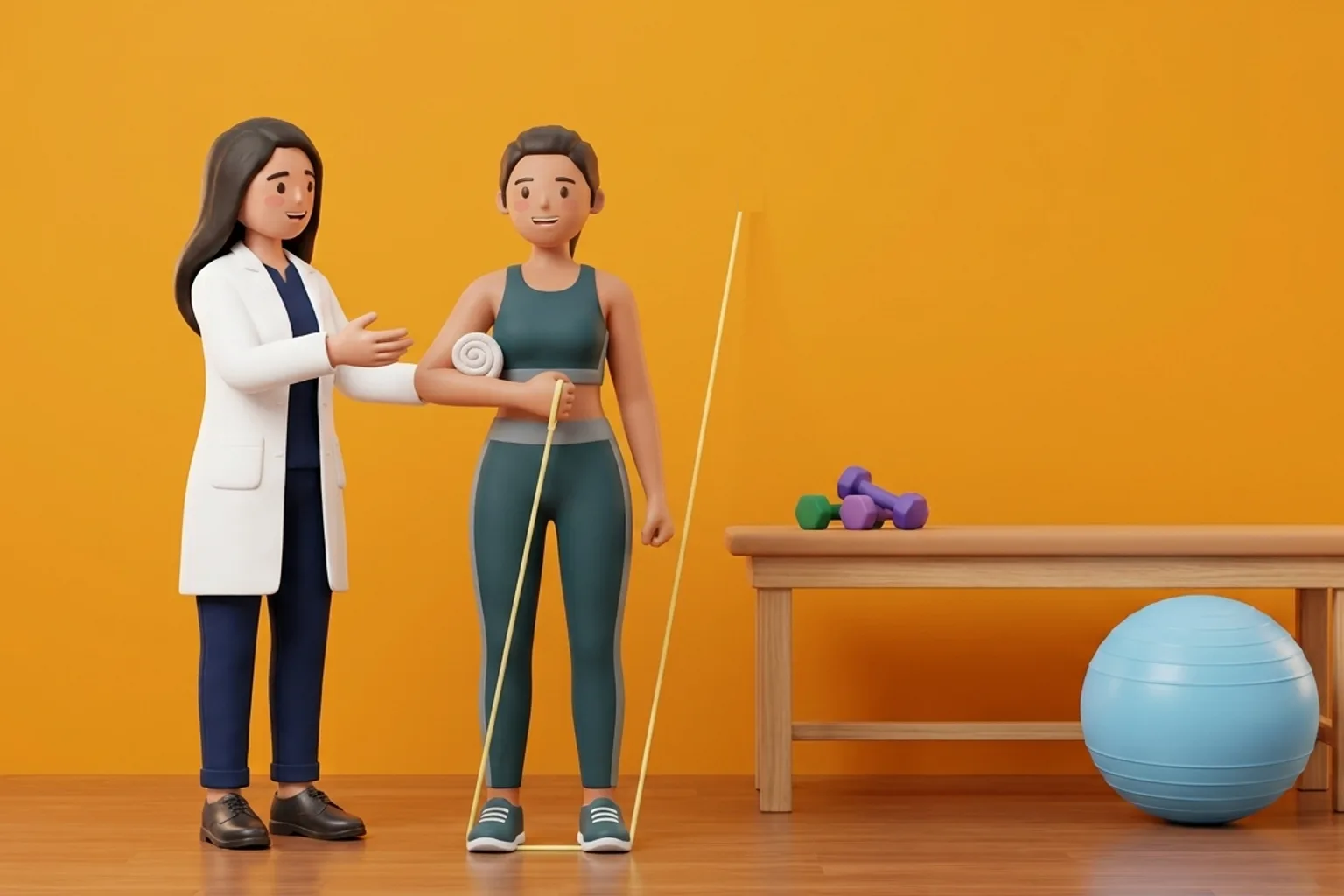
Initial sling immobilization relieves gravitational downward traction on the arm, transitioning to deltoid, trapezius, and periscapular strengthening.
Frequently Asked Questions
Will the 'bump' on my shoulder disappear after an AC joint sprain?
In Grade II and III injuries, the visible bony step-off bump on the collarbone is permanent because torn CC ligaments heal with elongation. However, with physiotherapy, the joint becomes completely pain-free with normal full strength and range of motion.
When can a patient return to sports after a Grade I or II AC sprain?
Grade I sprains typically return to non-contact sports within 1 to 2 weeks. Grade II sprains require 3 to 6 weeks of progressive strengthening before contact sports clearance.
Why is surgical repair debated in Grade III separations?
Extensive clinical trials comparing surgical repair to conservative physiotherapy for Grade III AC joint injuries show identical long-term functional scores, with surgery carrying higher complication and re-operation rates.
Related condition guides

Related recovery guides & articles
BookPhysio.in Editorial Team
The BookPhysio.in editorial team writes and maintains this content, checking it against reliable clinical sources. Content follows our medical review policy: general information only, and no page claims a clinical review until a named registered physiotherapist has signed it off.
Read our medical review policy