
Badminton Lateral Ankle Inversion Sprain and Chronic Instability Rehabilitation
In short
Rapid directional cuts and lateral lunges on high-traction synthetic badminton courts make ankle inversion sprains frequent. Restoring mechanoreceptors prevents chronic instability.
In this guide (7 sections)
Lateral ankle inversion sprains account for over 30% of all acute traumatic injuries in competitive badminton. The injury characteristically occurs during rapid side-to-side shuffling, late cross-court lunges, or awkward landings from jump smashes where the foot touches down in plantarflexion and sudden inversion. The anterior talofibular ligament (ATFL) is the first and most common structure torn, followed by the calcaneofibular ligament (CFL). Without structured rehabilitation, over 40% of players develop Chronic Ankle Instability (CAI), marked by recurrent giving-way episodes, sensorimotor deficits, and early talocrural osteochondral lesions.
Domestic Indian Sports Reality and Field Conditions
In Indian badminton halls, players often compete on specialized PVC or polyurethane courts that feature high friction coefficients. While this high-grip surface aids explosive acceleration, it also prevents the shoe from sliding even marginally during an errant lateral plant. If a player lands off-balance on the lateral border of their footwear, the shoe 'catches' the synthetic surface abruptly, snapping the ankle into violent inversion. Many players tape ankles poorly with non-elastic cotton bandages or return within days of an acute sprain, leading to permanent ligamentous laxity.
Biomechanics and Pathomechanics of Injury
In plantarflexion, the narrower posterior portion of the talus sits within the mortise, rendering the talocrural joint inherently less bony-stable. The ATFL, which runs nearly parallel to the long axis of the foot in plantarflexion, becomes taut and absorbs maximal tensile strain. At inversion velocities exceeding 700 degrees per second, the stretch reflex of the peroneus longus and brevis is too slow (latency 60 to 90 ms) to counteract the inversion moment. Mechanical disruption of ligamentous tissue simultaneously shears articular mechanoreceptors (Ruffini, Pacinian corpuscles), inducing chronic central proprioceptive deficits.
Clinical Assessment and Provocative Special Tests
- Anterior Drawer Test: With the ankle in 10 to 15 degrees plantarflexion, the examiner translates the talus anteriorly while stabilizing the tibia. Increased anterior translation (>3 mm compared to contralateral) or a soft end-feel confirms ATFL disruption.
- Talar Tilt (Inversion Stress) Test: With the ankle in neutral, inversion force is applied to the hindfoot. Excessive tilt (>10 degrees compared to unaffected side) indicates combined ATFL and CFL structural compromise.
- Ottawa Ankle Rules: Direct bone tenderness along the posterior 6 cm of the lateral or medial malleolus, or inability to bear weight for 4 steps, indicates the need for plain radiographs to rule out fractures.
Stage-by-Stage Functional Return Protocol
- Phase 1: Protection and Swelling Resolution (Days 0 to 7): Implement POLICE principles with semi-rigid lace-up ankle bracing. Perform active ankle pumps, alphabet drawing, and non-weight-bearing isometric peroneal contractions. Maintain cardiovascular fitness with arm ergonometry.
- Phase 2: Full Weight Bearing and Neuromuscular Control (Weeks 1 to 3): Normalize gait pattern without limping. Progress to double-leg calf raises, single-leg static balance, and banded eversion strengthening against progressive resistance.
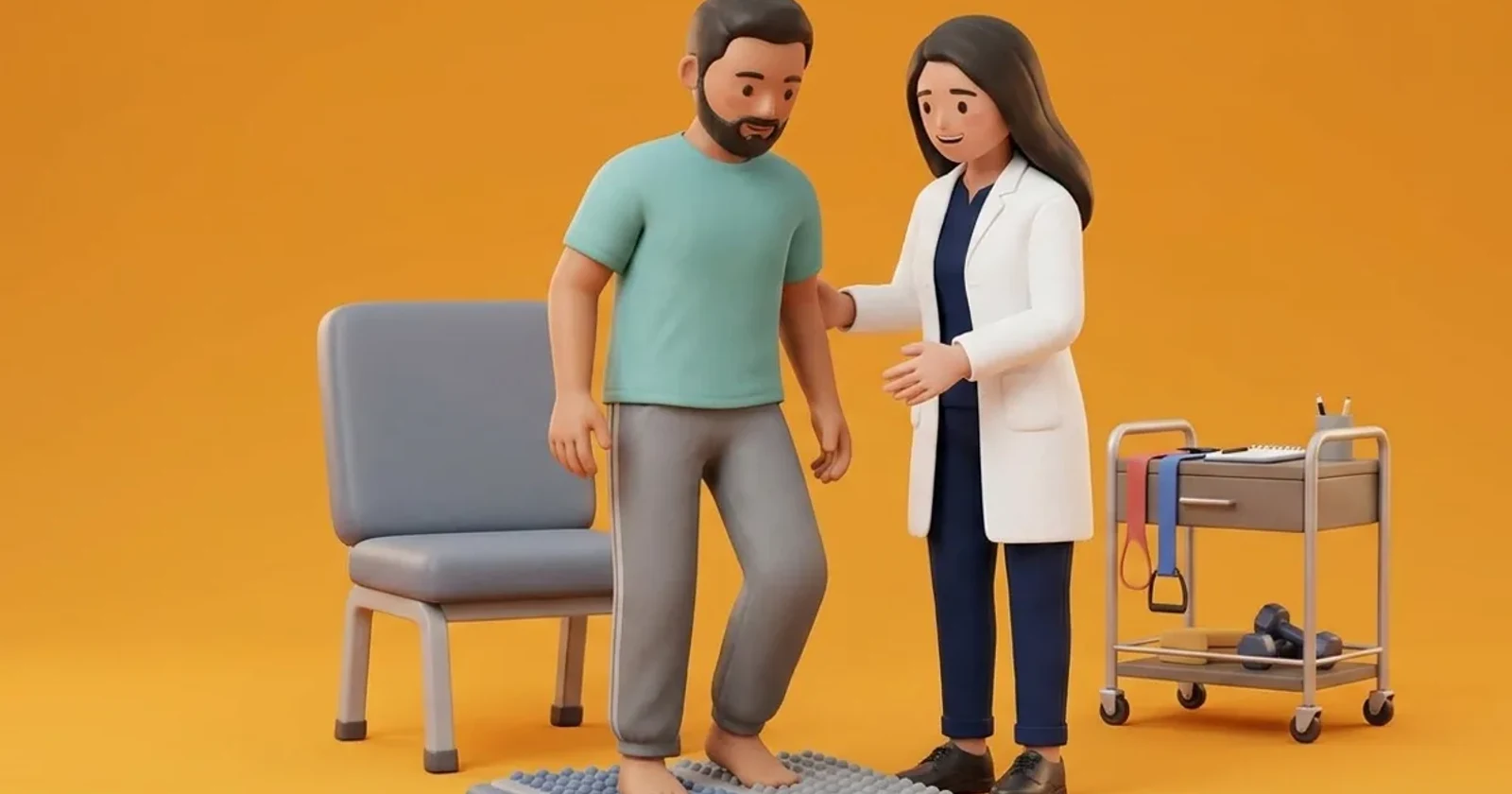
- Phase 3: Perturbation and Multi-Planar Reactive Agility (Weeks 3 to 6): Advance to dynamic balance training on wobble boards or foam pads. Introduce lateral hurdle hops, side shuffles, and forward deceleration stick landings.
- Phase 4: Badminton-Specific Court Footwork and Match Re-entry (Weeks 6 to 8): Execute 6-corner corner shadow footwork drills with unanticipated directional callouts. Use functional semi-rigid bracing for match play during the first 6 months post-injury to prevent recurrence.
Single-Leg Dynamic Clock Reach on Balance Pad
Objective: Restores dynamic lateral stability, subtalar joint proprioception, and eccentric peroneal reaction time.
- 1Stand barefoot on one leg in the center of a dense foam pad or folded towel, with the knee slightly unlocked (15 degrees flexion).
- 2Keep your hands on your hips and torso upright.
- 3Slowly reach the non-supporting foot out to tap points on a virtual clock on the floor (12 o'clock forward, 3 o'clock lateral, 6 o'clock backward).
- 4Return to center without shifting weight onto the tapping foot.
- 5Resist any tendency for the stance ankle to collapse outward into inversion.
Ankle Ligament Sprain Grading and Functional Markers
| Grade | Pathological Injury | Mechanical Stability | Return to Badminton Timeframe | |
|---|---|---|---|---|
| Grade I (Mild) | Microscopic ATFL stretch, minimal swelling | Stable, negative anterior drawer | 7 to 14 days (with taping) | |
| Grade II (Moderate) | Partial ATFL tear, localized ecchymosis | Mild laxity with clear end-feel | 3 to 5 weeks (with semi-rigid brace) | |
| Grade III (Severe) | Complete rupture of ATFL and CFL | Gross laxity, absent mechanical end-feel | 8 to 12 weeks (structured neuromuscular rehab) |
Red Flag Signs Requiring Immediate Medical Referral
Inability to bear any weight immediately following injury, focal bone tenderness over the base of the fifth metatarsal (Jones fracture) or navicular bone, or persistent severe ankle swelling accompanied by paresthesias in the foot requires urgent orthopaedic imaging and specialist assessment.
Frequently Asked Questions
Does wearing an ankle brace weaken the leg muscles over time?
Extensive sports medicine research shows that functional lace-up or semi-rigid ankle braces do not weaken the peroneal muscles. Instead, they provide vital mechanical restriction and tactile proprioceptive input that prevents catastrophic inversion without hindering court performance.
Why do ankle sprains keep happening after the first injury in badminton?
A sprain tears not only ligament fibers but also the sensory nerve endings (mechanoreceptors) embedded within them. Without dedicated proprioceptive and balance rehabilitation, the brain cannot sense ankle positioning fast enough to prevent subsequent inversion roll-overs.
Related condition guides



Related recovery guides & articles
BookPhysio.in Editorial Team
The BookPhysio.in editorial team writes and maintains this content, checking it against reliable clinical sources. Content follows our medical review policy: general information only, and no page claims a clinical review until a named registered physiotherapist has signed it off.
Read our medical review policy