
Bakody Sign (Shoulder Abduction Test): Diagnostic Accuracy, Biomechanics, and Clinical Utility
In short
Understand how the Bakody sign relieves radiating arm pain through brachial plexus offloading, and learn to distinguish C5-C6 radiculopathy from shoulder pathology.
In this guide (4 sections)
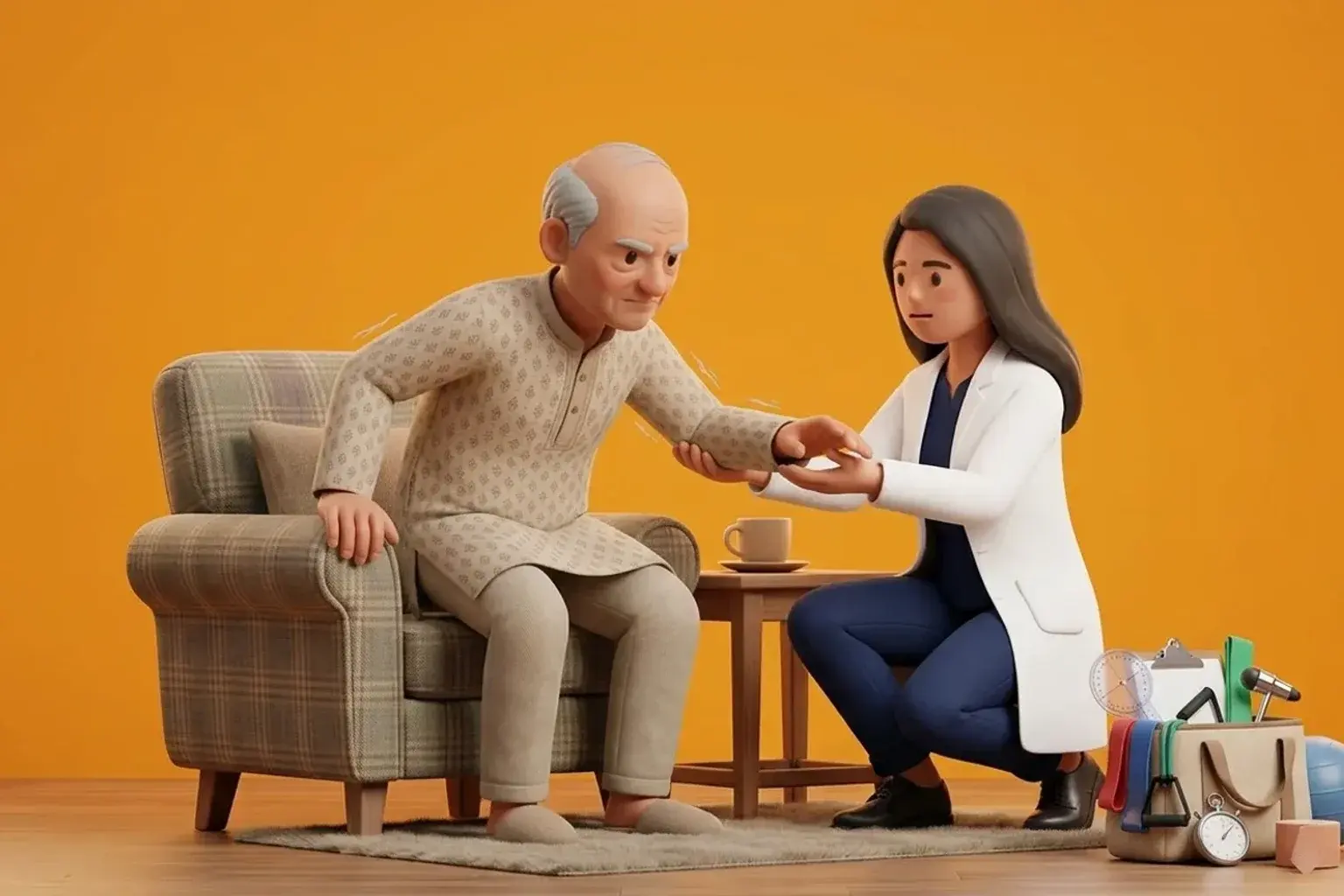
The Bakody sign, historically described by neurosurgeon George Bakody and widely known as the shoulder abduction relief test, is an invaluable clinical sign for diagnosing cervical radiculopathy. The test is elicited by having the patient actively elevate the symptomatic arm through the scapular plane and rest the palm or forearm on the crown of their head. A positive Bakody sign occurs when this arm elevation produces immediate relief or marked reduction of radicular pain radiating down the arm. Displaying high diagnostic specificity ranging between 80 and 90 percent, a positive Bakody sign strongly points to cervical nerve root involvement, most commonly at the C5 or C6 levels, while assisting clinicians in differentiating cervical radiculopathy from local shoulder pathologies such as rotator cuff tendinopathy and subacromial impingement.
Train Overhead Strap Hanging, Resting Arm on Head at Desks, and Night Relief
In Indian metropolitan settings, patients frequently display the Bakody sign spontaneously during daily life. Commuters standing on crowded Mumbai local trains, Delhi Metro coaches, or city buses often grasp high overhead handrails or luggage racks, suddenly realizing that their persistent, gnawing arm pain subsides while their arm remains elevated above shoulder level. Similarly, corporate desk workers and programmers sitting through exhausting video conferences are often observed unconsciously resting their painful arm on top of their head or draping it over an office chair headrest to escape radiating forearm burning. When resting at home, individuals with acute C5 or C6 root compression instinctively sleep with their symptomatic arm propped up on a stack of pillows beside their ear, adopting Bakody posture as their sole defense against sleep-disrupting radicular pain.
Neuro-Biomechanical Mechanism: Slackening the Brachial Plexus and Decongesting Foramina
The pathophysiological mechanism underlying Bakody sign involves profound changes in the biomechanical tension of the cervical nerve roots and brachial plexus. When the arm hangs dependently at the side, gravity exerts a downward traction vector on the lower trunks and cords of the brachial plexus, pulling the exiting C5 and C6 nerve roots taut against the inferior pedicle and uncinate osteophytes of the intervertebral neural foramen. By actively elevating the humerus into abduction and resting the hand on the vertex of the head, the physical distance between the cervical neuroforamen and the axillary entrance is substantially shortened. This positional slackening decreases intraneural tension, lowers endoneurial fluid pressure, and alleviates venous congestion within the epidural space, immediately restoring microvascular capillary perfusion to the ischemic nerve fibers.
Positional Offloading Protocols, Scapular Elevation Taping, and Gradual Lowering
Identifying a positive Bakody sign provides the treating physiotherapist with an immediate, validated posture for clinical offloading. In acute, highly sensitive stages, patients are instructed to utilize supported abduction positioning using arm slings, desktop armrests, or contoured pillows during sedentary work to minimize continuous neural traction. Rigid or elastic kinesiology taping applied to support scapular elevation and upward rotation assists in maintaining a slackened brachial plexus during upright mobility. As acute radicular inflammation responds to manual therapy and anti-inflammatory management, rehabilitation shifts toward progressive neural loading. The physiotherapist introduces gradual arm lowering protocols combined with neurodynamic sliders, ensuring the nerve root adapts to full dependent hanging without symptom recurrence.
Supported Scapular Abduction Offloading Rest Position
Objective: Utilize the biomechanics of Bakody sign to decompress acute C5 or C6 nerve root inflammation during desk work
- 1Sit comfortably in a supportive desk chair with your back resting firmly against the backrest.
- 2Elevate your symptomatic arm and rest your palm gently on the crown of your head, keeping your elbow pointed outward.
- 3Position a high pillow or an adjustable desk armrest directly beneath your elbow so your shoulder muscles can relax completely.
- 4Remain in this supported position for three to five minutes, allowing the tension in your neck and radiating arm to subside.
- 5When lowering your arm, use your opposite healthy hand to support and lower your elbow slowly to avoid abrupt stretch.
| Clinical Characteristic | C5/C6 Cervical Radiculopathy | Subacromial Impingement Syndrome | Thoracic Outlet Syndrome (TOS) |
|---|---|---|---|
| Response to Arm Elevation | Immediate relief of radiating arm pain and paresthesia (Positive Bakody) | Aggravation of anterolateral shoulder pain between 60° and 120° (Painful Arc) | Aggravation of symptoms or paresthesia reproduced during elevated arm stress test (Roos) |
| Primary Pain Location | Neck, scapula, lateral shoulder, radiating into radial forearm and thumb | Localized strictly to the anterolateral deltoid; does not radiate below elbow | Diffuse aching across neck, chest wall, medial arm, and fourth/fifth digits |
| Spurling Test Response | Positive: Reproduces familiar shooting pain down the arm | Negative: Neck compression produces no shoulder or arm symptoms | Negative: Unaffected by axial cervical compression |
In rare clinical presentations, actively abducting the arm and placing the hand on the head sharply worsens radiating pain instead of relieving it. This phenomenon, known as a reverse Bakody sign, typically signifies an interscalene compressive mass, severe thoracic outlet entrapment, or an anomalous cervical rib compressing the lower trunk of the brachial plexus. A reverse Bakody sign warrants immediate diagnostic ultrasound or MRI evaluation of the supraclavicular fossa.
Frequently Asked Questions
If resting my hand on my head relieves my pain, does that mean my shoulder is completely healthy?
A positive Bakody sign indicates that the source of your radiating pain is cervical nerve root compression rather than primary shoulder joint pathology. However, it does not guarantee that your shoulder is completely devoid of minor tendinopathy. A comprehensive physiotherapy assessment evaluates both the cervical spine and the shoulder rotator cuff complex to rule out secondary subacromial stiffness or double-crush phenomena.
Do I need a doctor referral to treat cervical radiculopathy on BookPhysio.in?
BookPhysio.in does not require a doctor referral. Under the National Commission for Allied and Healthcare Professions (NCAHP) Act 2021, patients across India enjoy direct access to autonomous registered physiotherapists. Through BookPhysio.in, you connect directly with verified clinicians and pay per session with transparent fees, completely free from advance package commitments, commission markups, or platform subscription charges.
Related condition guides


Related recovery guides & articles
BookPhysio.in Editorial Team
The BookPhysio.in editorial team writes and maintains this content, checking it against reliable clinical sources. Content follows our medical review policy: general information only, and no page claims a clinical review until a named registered physiotherapist has signed it off.
Read our medical review policy