
Critical Illness Cachexia: Nutritional Protein and Exercise Synergy
In short
Reverse critical illness cachexia. Combine high-protein nutrition with progressive resistance exercise to restore lean muscle mass in India.
In this guide (2 sections)
Critical illness cachexia is a severe metabolic syndrome characterized by progressive, involuntary loss of skeletal muscle mass and adipose reserves driven by sustained systemic inflammation, hypermetabolism, and massive proteolysis. Unlike simple starvation, cachectic muscle wasting cannot be reversed by nutritional intake alone. True muscular restoration mandates a powerful synergy between high-biological-value protein feeding and progressive mechanical resistance exercise.
The Anabolic Resistance Phenomenon in Sarcopenic Critical Illness
Critically ill patients exhibit profound anabolic resistance: skeletal muscle tissue loses its normal sensitivity to hyperaminoacidemia and hyperinsulinemia. Circulating tumor necrosis factor-alpha (TNF-alpha), interleukin-6 (IL-6), and elevated cortisol levels suppress mammalian target of rapamycin (mTOR) signaling. Providing high dietary protein without mechanical loading simply results in hepatic amino acid oxidation rather than muscle protein synthesis. Applying mechanical tension via resistance exercise re-sensitizes muscle cells, activating the mTOR pathway and directing dietary amino acids into myofibrillar resynthesis.
| Clinical Component | Recommended Prescription | Biological Mechanism | Rehabilitation Objective | |
|---|---|---|---|---|
| Protein Intake Target | 1.5 to 2.0 grams / kg body weight / day | Provides essential amino acid building blocks (especially leucine) | Overcomes anabolic threshold to initiate muscle resynthesis | |
| Exercise Timing Synergy | 20 to 30 grams protein consumed within 45 min of exercise | Mechanical tension primes mTOR phosphorylation window | Maximizes muscle protein synthesis efficiency | |
| Mechanical Resistance Mode | Progressive resistance bands, weighted cuffs, bodyweight squats | Induces intramuscular mechanotransduction and tensile stress | Stimulates myofiber hypertrophy and satellite cell activation | |
| Caloric Energy Density | 30 to 35 kcal / kg body weight / day | Prevents dietary protein from being diverted to gluconeogenesis | Maintains positive nitrogen balance and energy equilibrium |
Integrated Nutrition-Mobility Schedule and Protocol
The physiotherapist collaborates closely with the clinical dietitian to coordinate the daily schedule. Resistance exercise is timed precisely one hour after breakfast or mid-afternoon snack, followed immediately by a high-protein supplement or meal. Exercise prescription emphasizes major postural and locomotive muscle groups: quadriceps, gluteals, latissimus dorsi, and deltoids, utilizing slow, controlled contractions across three sets of eight to ten repetitions.
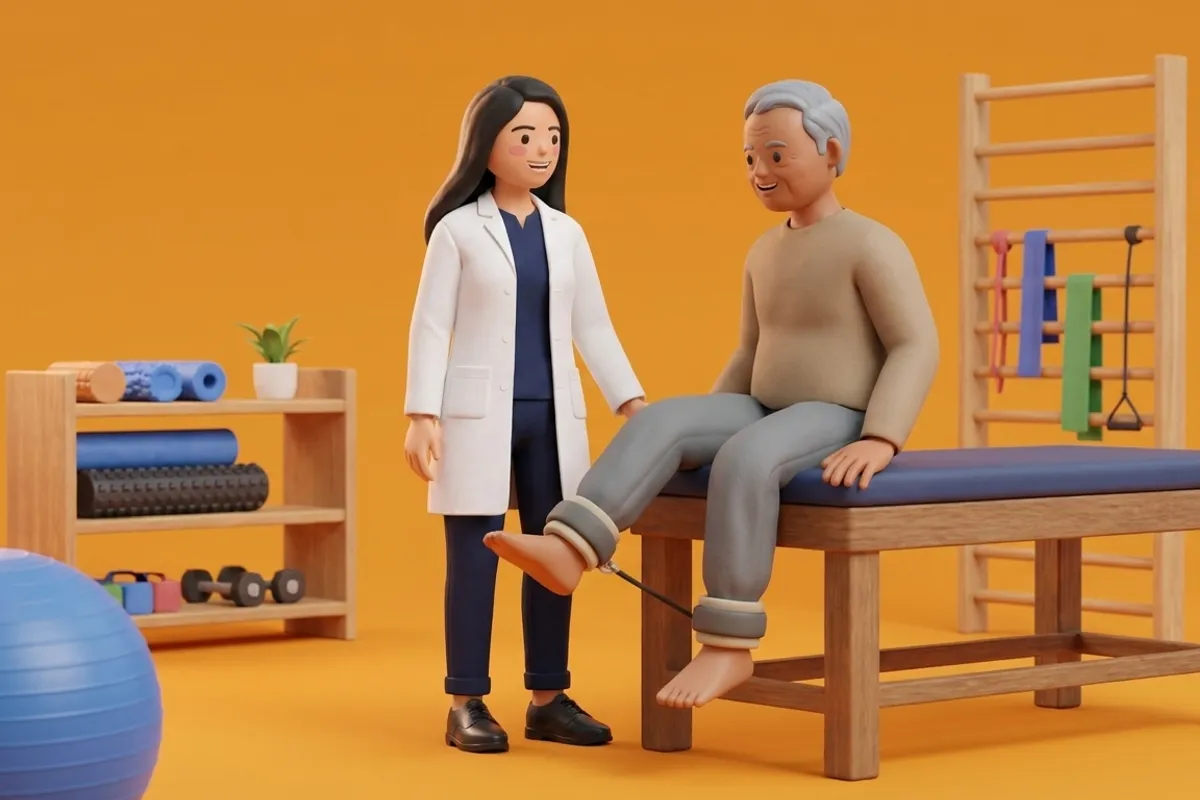
Supported Seated Knee Extension with Elastic Band Resistance
Objective: Apply mechanical tensile load to the quadriceps to stimulate muscle protein synthesis.
- 1Sit upright in a sturdy chair with an elastic resistance band looped securely around the ankle and anchored to the chair leg.
- 2Slowly extend the knee forward against the elastic resistance over a three-second count.
- 3Hold the fully extended knee position for two seconds, feeling the anterior thigh muscle contract firmly.
- 4Lower the foot back down slowly over a four-second eccentric count to maximize mechanotransductive signaling.
- 5Rest for thirty seconds between sets, drinking water as needed.
Domestic Recovery in India and Multigenerational Support
In Indian households, cachectic post-ICU patients are frequently offered light, watery diets such as plain dal water or thin rice khichdi, which provide negligible protein and calories. Visiting physiotherapists guide families to enrich traditional meals: adding paneer cubes to khichdi, mixing roasted sattu flour into buttermilk, incorporating curd, sprouted pulses, and prescribed whey protein supplements to meet the necessary daily protein targets.
Long-Term Trajectory and Lean Mass Accretion
Reversing critical illness cachexia requires four to six months of dedicated nutrition-exercise synergy. Patients consistently gain lean muscle mass, improve muscle density on ultrasound, and regain functional stamina, achieving full restoration of independence in domestic and community life.
Verify renal function before initiating high-protein nutrition. In patients with residual acute kidney injury or chronic kidney disease without hemodialysis, protein intake must be calibrated by a nephrologist to prevent hyperazotemia.
Why is walking alone insufficient to reverse critical illness cachexia?
Low-intensity walking provides cardiovascular stimulation but lacks the mechanical peak torque required to overcome anabolic resistance and activate the mTOR protein resynthesis cascade. Progressive resistance training is mandatory to stimulate myofibrillar hypertrophy.
Do I need a doctor referral to consult a home physiotherapist in India?
Under the National Commission for Allied and Healthcare Professions (NCAHP) Act 2021, patients in India enjoy direct access to registered physiotherapists without requiring a mandatory doctor referral. At BookPhysio.in, you consult verified physiotherapists and pay directly per session without hidden fees or platform commissions.
Related condition guides
Related recovery guides & articles
BookPhysio.in Editorial Team
The BookPhysio.in editorial team writes and maintains this content, checking it against reliable clinical sources. Content follows our medical review policy: general information only, and no page claims a clinical review until a named registered physiotherapist has signed it off.
Read our medical review policy