
Cervical Collar Use: Evidence Critique, Muscular Atrophy, and Weaning Protocols
In short
Understand the hidden hazards of prolonged cervical collar use: rapid muscular atrophy, loss of proprioception, and evidence-based weaning protocols.
In this guide (4 sections)
Soft foam cervical collars remain among the most commonly prescribed and self-purchased orthopedic devices for acute neck pain and cervical radiculopathy across India. Marketed to provide immediate rest and mechanical support to the aching spine, collars are frequently adopted by patients as a primary management strategy. However, contemporary orthopedic and physiotherapy clinical guidelines present a robust critique of routine cervical collar usage. While rigid collars serve an indispensable, life-saving role in stabilizing acute traumatic fractures and ligamentous disruptions, the prolonged use of soft collars in non-traumatic cervical spondylosis and radiculopathy is strongly discouraged. Research demonstrates that immobilizing the cervical spine for more than forty-eight to seventy-two hours triggers rapid disuse atrophy of stabilizing muscles, degrades proprioceptive acuity, and fosters debilitating psychological dependence.
Over-the-Counter Pharmacy Purchases, 24/7 Collar Wearing, and Travel Fear
In Indian healthcare realities, patients frequently purchase soft cervical collars over-the-counter from neighborhood medical stores without professional medical evaluation. Convinced that neck pain signifies an inherently fragile spine that must be protected from all motion, individuals frequently wear collars twenty-four hours a day, including while eating, watching television, and sleeping. When preparing to travel by bus, train, or auto-rickshaw, anxious commuters strap on their collars out of fear that normal road bumps will sever their spinal cord. Within two to three weeks of continuous immobilization, the deep cervical stabilizing muscles undergo profound fatty infiltration, while the neck joints become stiff and painful. When the patient eventually attempts to remove the collar, their neck muscles are too weak to support the head, convincing them they need the collar forever.
Pathophysiology of Immobilization: Muscle Cross-Sectional Atrophy and Proprioceptive Loss
The pathophysiological consequences of cervical immobilization occur with alarming rapidity. Skeletal muscle biopsy and advanced magnetic resonance imaging demonstrate that within one week of cervical collar immobilization, the cross-sectional area of the longus colli, longus capitis, and multifidus muscles decreases by up to fifteen percent, accompanied by accelerated Type I to Type II muscle fiber transition. Furthermore, the cervical spine possesses an extraordinarily dense network of mechanoreceptors and muscle spindles within its deep facet capsules and suboccipital muscles. Depriving these sensory receptors of normal movement input degrades proprioceptive signaling to the vestibular and visual systems, resulting in chronic postural instability, unsteadiness, and kinesiophobia (fear of movement) upon collar removal.
Evidence-Based Collar Weaning Protocols and Active Functional Restoration
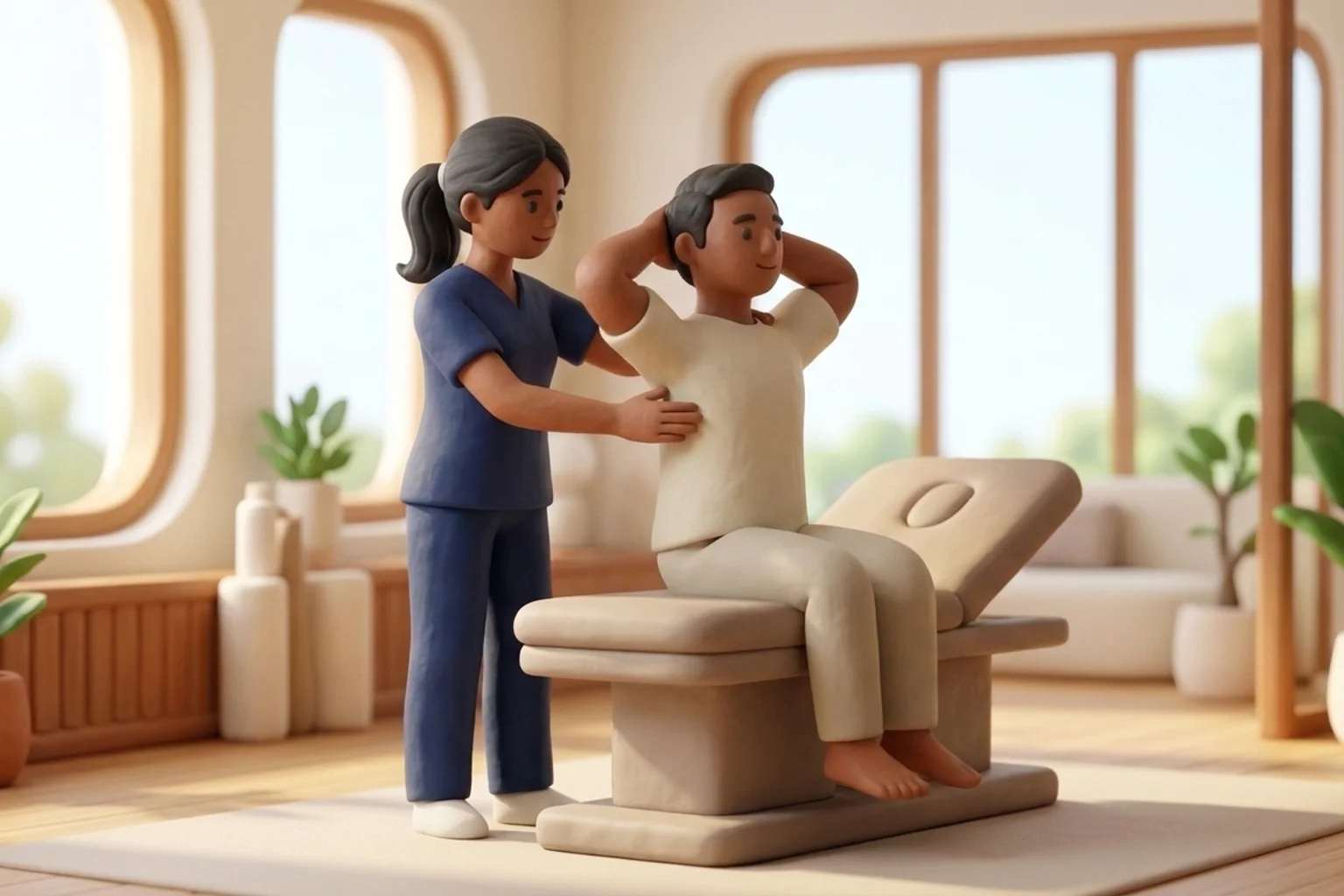
When a patient presents with established collar dependence, physiotherapy guides a safe, systematic weaning protocol. Collars are never abruptly discarded, as sudden gravitational loading on atrophied muscles can provoke severe rebound muscle spasms. Instead, weaning is executed incrementally over seven to ten days: first removing the collar during quiet rest at home, then during sedentary desk tasks, next during outdoor walking, and finally during nighttime sleep. Concurrently, active isometric cervical strengthening is initiated while the patient is still wearing the collar, pressing gently against the foam to awaken dormant motor units. Progressive deep neck flexor nods, scapular stabilization, and gentle active range of motion restore muscular strength and rebuild the patient's confidence in their spine's natural structural strength.
Collar-Weaning Multi-Angle Isometric Stabilization
Objective: Re-awaken atrophied cervical stabilizers and rebuild muscular support during gradual collar removal
- 1Sit comfortably upright in a sturdy chair with your back supported and your neck in neutral alignment without your collar.
- 2Place your right palm flat against the right side of your head just above your ear.
- 3Gently press your head sideways into your palm while resisting with equal force using your hand, keeping your head completely still.
- 4Maintain this gentle, pain-free isometric hold for five seconds while breathing smoothly, then slowly release.
- 5Repeat the same gentle hold on your left temple, then on your forehead, and finally against your palms interlaced behind your head.
| Clinical Parameter | Prolonged Soft Collar Use (>2 Weeks) | Early Active Physiotherapy Protocol | Clinical Outcome Evidence |
|---|---|---|---|
| Deep Muscle Cross-Sectional Area | Rapid disuse atrophy and fatty infiltration of longus colli and multifidus | Maintained muscle volume and enhanced tonic postural motor recruitment | Active exercise preserves muscle architecture and accelerates clinical recovery |
| Joint Mobility and Stiffness | Capsular contractures, zygapophyseal hypomobility, severe morning stiffness | Preserved physiological synovial lubrication and full functional range of motion | Immobilization increases long-term chronic pain risk; movement restores tissue health |
| Psychological Dependence | High kinesiophobia; patient believes spine is unstable without external foam | Rebuilt movement confidence, self-efficacy, and independence from orthoses | Patients treated with active movement return to work 14 days earlier on average |
While soft collars for simple spondylosis are discouraged, rigid cervical collars (such as Philadelphia or Aspen collars) are mandatory and life-saving in verified cervical fractures (e.g., dens fractures, teardrop fractures), acute traumatic ligamentous disruptions, post-surgical reconstructions prior to fusion consolidation, or atlantoaxial subluxation. Never wean a collar without verifying that radiological stability has been formally confirmed by an orthopaedic surgeon.
Frequently Asked Questions
My doctor gave me a soft collar for my acute pinched nerve. How many days should I actually wear it?
In acute, severe cervical radiculopathy where every head movement triggers excruciating pain, a soft collar can be useful for temporary pain relief during the first forty-eight to seventy-two hours. However, it should only be worn for short periods during the day when traveling or sitting upright, and removed when resting. After seventy-two hours, you should begin weaning off the collar and initiate gentle physiotherapy exercises to prevent muscle weakness.
Do I need a doctor referral to treat cervical radiculopathy on BookPhysio.in?
BookPhysio.in does not require a doctor referral. Under the National Commission for Allied and Healthcare Professions (NCAHP) Act 2021, patients across India enjoy direct access to autonomous registered physiotherapists. Through BookPhysio.in, you connect directly with verified clinicians and pay per session with transparent fees, completely free from advance package commitments, commission markups, or platform subscription charges.
Related condition guides



Related recovery guides & articles
BookPhysio.in Editorial Team
The BookPhysio.in editorial team writes and maintains this content, checking it against reliable clinical sources. Content follows our medical review policy: general information only, and no page claims a clinical review until a named registered physiotherapist has signed it off.
Read our medical review policy