
Cervical Spine C6 Radiculopathy: The Overlooked Contributor to Chronic Lateral Elbow Pain
In short
Persistent tennis elbow often originates from the neck. Discover how cervical C6 nerve root compression and double crush syndrome create refractory lateral elbow pain.
In this guide (4 sections)
When a patient presents with lateral elbow pain that proves stubbornly resistant to localized rest, ice, massage, and multiple injections, the primary culprit frequently resides not in the elbow, but in the cervical spine. Cervical radiculopathy, specifically involving the C6 nerve root arising from the C5-C6 motion segment, directly innervates the lateral aspect of the elbow, forearm, and thumb. Furthermore, under the established neurological concept of double crush syndrome, subclinical proximal neural compression at the cervical spine impairs axoplasmic flow, rendering distal peripheral nerve branches and their innervated tendinous entheses exceptionally vulnerable to secondary breakdown under minor mechanical strain.
Smartphone Forward Head Posture and Scooter Commutes in India
In urban Indian society, neck and upper extremity complaints have surged dramatically alongside smartphone usage and sedentary office work. Millions of professionals maintain severe forward head posture for six to eight hours daily, projecting their head five to eight centimeters forward of plumb-line alignment. This posture dramatically increases compressive loading on lower cervical intervertebral discs. Coupled with bumpy daily commutes on two-wheelers over poorly maintained roads where repeated axial shock transmits through the spine, C5-C6 disc herniations and foraminal stenosis develop rapidly, manifesting clinically as referred lateral forearm aching.
C6 Dermatomal Mapping, Myotomal Weakness, and Axoplasmic Flow Stasis
The C6 nerve root exits the spine through the C5-C6 neural foramen, providing primary sensory innervation to the lateral elbow, radial forearm, and index-thumb web space, while supplying motor drive to the biceps brachii, brachioradialis, and extensor carpi radialis longus and brevis. When the C6 root is irritated by a posterolateral disc bulge, uncovertebral joint osteophytes, or facet arthrosis, patients experience referred nociceptive pain and hyperalgesia over the lateral epicondyle without necessarily feeling neck pain. Proximal neural compromise disrupts the slow transport of neurotrophic factors and structural proteins down the axon, degrading the metabolic health and healing capacity of the distal ECRB tendon insertion.
Cervical Assessment Battery, Traction Techniques, and Neural Mobilization
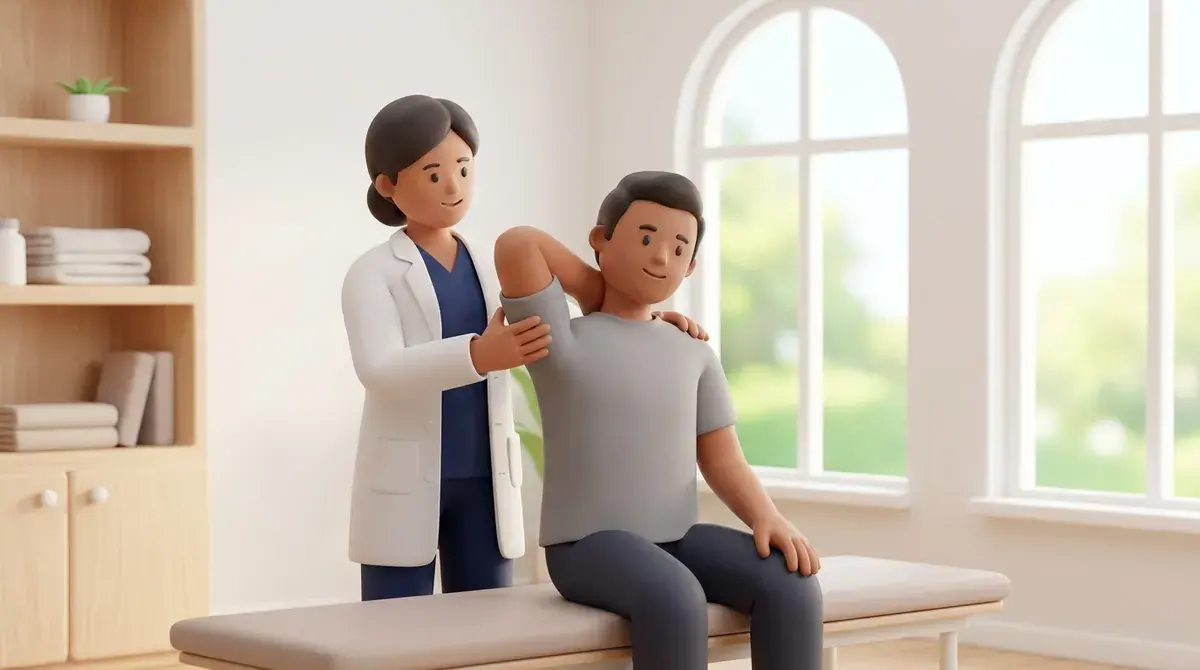
A comprehensive physiotherapy evaluation for chronic lateral elbow pain must systematically screen the cervical spine. Clinicians employ the cervical screening cluster, including Spurling's test, the cervical distraction test, the upper limb neurodynamic test (ULNT1), and ipsilateral cervical rotation of less than sixty degrees. When cervical involvement is identified, treatment shifts from isolated elbow therapy to cervical spine mobilization, manual axial distraction, deep neck flexor re-education, and gentle radial nerve gliding, relieving proximal neural compression and resolving distal elbow recalcitrance.
Seated Cervical Retraction and Chin Tuck Axial Elongation
Objective: Decompress the C5-C6 neural foramen and restore deep cervical stabilizing muscle recruitment
- 1Sit tall in a firm chair with your feet flat on the floor and your shoulders relaxed comfortably downward.
- 2Look straight ahead at eye level, ensuring your chin remains parallel to the floor.
- 3Place two fingers gently against your chin as a tactile guide.
- 4Gently draw your head and chin straight backward horizontally, creating a double chin without tilting your head up or down.
- 5Hold this retracted, elongated posture for 5 seconds, feeling a gentle stretch at the base of your skull, then return to neutral.
| Clinical Assessment Parameter | Primary Lateral Epicondylalgia | Cervical C6 Radiculopathy (Referred Pain) |
|---|---|---|
| Focal Tenderness Location | Exquisite, pinpoint tenderness directly on lateral epicondyle and ECRB tendon footprint | Diffuse, vague aching over lateral elbow and forearm; tenderness is broad and poorly localized |
| Cervical Movement Response | Neck movements (flexion, extension, rotation) produce zero effect on elbow symptoms | Cervical extension and ipsilateral side-bending reproduce or amplify lateral elbow pain |
| Spurling's Compression Test | Completely negative; axial cervical compression elicits no radiating arm pain | Positive; axial downward compression produces sharp shooting pain radiating into lateral forearm |
| Deep Tendon Reflexes | Brachioradialis and biceps tendon reflexes are completely symmetrical and normal | Diminished or absent brachioradialis deep tendon reflex on the affected side |
Progressive motor weakness involving biceps weakness, wrist extensor drop, or loss of sensation over the thumb and index finger warrants urgent cervical magnetic resonance imaging (MRI) and spine specialist evaluation to prevent permanent neurological deficit.
Frequently Asked Questions
Why does my elbow hurt so intensely if the actual medical problem is in my neck?
The nerves that supply sensation to your lateral elbow originate in your cervical spine at the C6 level. When this nerve root is compressed or inflamed in your neck, your brain misinterprets the electrical distress signals as originating from the nerve's terminal destination at your elbow, creating vivid referred pain.
Do I need a doctor referral to see a tennis elbow physiotherapist on BookPhysio.in?
BookPhysio.in does not require a physician prescription. Under the National Commission for Allied and Healthcare Professions (NCAHP) Act 2021, patients across India enjoy direct access to autonomous registered physiotherapists. Through BookPhysio.in, you connect directly with verified clinicians and pay per session with transparent fees, completely free from advance package commitments, commission markups, or platform subscription charges.
Related condition guides



Related recovery guides & articles
BookPhysio.in Editorial Team
The BookPhysio.in editorial team writes and maintains this content, checking it against reliable clinical sources. Content follows our medical review policy: general information only, and no page claims a clinical review until a named registered physiotherapist has signed it off.
Read our medical review policy