
Cervical Spine Differential Evaluation in Post-Concussion Whiplash and Dizziness
In short
Concussion and whiplash occur simultaneously. Learn to differentiate cervicogenic headaches and dizziness from vestibular trauma using clinical tests.
In this guide (4 sections)
Biomechanically, a concussion cannot occur without simultaneously subjecting the cervical spine to violent acceleration and deceleration forces. Research demonstrates that the biomechanical threshold for mild traumatic brain injury is approximately 70 to 120 g of linear acceleration, whereas cervical spine whiplash injuries occur at forces as low as 4.5 g. Consequently, virtually 100 percent of athletic concussions involve concomitant cervical spine soft tissue sprains, suboccipital muscle guarding, and zygapophyseal joint strain. Because upper cervical mechanoreceptors share direct neuroanatomical connections with the vestibular nuclei and superior colliculus, cervical spine injury directly mimics concussive symptoms, including dizziness, headache, visual fatigue, and balance instability.
Indian Contact Sports, Potholed Roads, and Unregulated Cervical Adjustments
In India, athletes sustaining head impacts in kabaddi or football frequently experience severe post-injury neck stiffness. A culturally prevalent and hazardous domestic practice involves seeking roadside "bone setters" or unqualified barbers who perform aggressive, unvetted cervical manipulation ("neck cracking"). Such high-velocity thrusts risk catastrophic vertebral artery dissection or spinal cord injury following acute trauma. Furthermore, traveling in auto-rickshaws over broken road surfaces generates repetitive axial jarring that continually aggravates hypertonic suboccipital musculature, perpetuating chronic cervicogenic headaches.
Cervical Proprioceptive Deafferentation and Cervicogenic Dizziness
The suboccipital muscle complex (rectus capitis posterior major and minor, obliquus capitis superior and inferior) contains the highest density of muscle spindles anywhere in the human body, exceeding 200 spindles per gram of muscle tissue. These deep cervical proprioceptors project directly into the central cervical nucleus (CCN) and vestibular nuclear complex. Trauma to upper cervical facet capsules (C1-C2, C2-C3) and suboccipital spindles distorts cervical proprioceptive feedback. When mismatched against normal vestibular and ocular signals, this abnormal cervical afferent stream produces cervicogenic dizziness, characterized by a vague sense of drunkenness, unsteadiness, and occipital-frontal headaches.
Differential Assessment and Cervical Neuromuscular Rehabilitation
Differentiating cervical pathology from true vestibular trauma requires targeted clinical tests: the Cervical Joint Position Error Test (CJPET) using a head-mounted laser, the Neck Torsion Test (which rotates the body beneath a stabilized head to isolate cervical receptors from the semicircular canals), and manual segmental palpation of C0-C3. Physiotherapy rehabilitation focuses on restoring deep neck flexor motor control (longus colli, longus capitis), gentle manual joint mobilizations (Maitland grades I-III), suboccipital soft tissue release, and laser-guided proprioceptive target relocation retraining.
Craniocervical Flexion Retraining with Towel Biofeedback
Objective: Activate deep cervical flexors (longus colli) and inhibit overactive superficial sternocleidomastoid muscles
- 1Lie supine on a firm plinth with a small rolled towel placed behind the natural hollow of your neck.
- 2Keep your head resting flat, jaw relaxed, tongue on the roof of your mouth, and teeth slightly parted.
- 3Perform a gentle, subtle head nod as if saying "yes", pivoting around an imaginary axis through your ears.
- 4Feel the deep muscles in the front of your neck gently tense without allowing the superficial neck cords to bulge.
- 5Hold the gentle nodded position for 10 seconds while breathing normally, then relax smoothly for 5 seconds.
| Clinical Feature | Cervicogenic Dizziness (Cervical Whiplash) | Central Concussive Vestibular Dysfunction |
|---|---|---|
| Primary Symptom Description | Vague unsteadiness, swimming sensation, floating feeling, neck stiffness, occipital headache radiating to temple | True rotational vertigo, oscillopsia (world jumping during movement), motion sensitivity, profound nausea |
| Symptom Provocation Triggers | Prolonged static neck posture, active neck rotation, manual palpation of upper cervical spine (C1-C3) | Rapid head turns at high frequency (VOR), busy visual motion (supermarket aisles), complex moving environments |
| Neck Torsion Test Response | Positive: Nystagmus or dizziness provoked when trunk is rotated beneath a stationary head (isolates neck) | Negative: No change when body rotates under stationary head; provoked only when head rotates in space |
| Primary Physiotherapy Management | Cervical manual mobilization, craniocervical flexor retraining, laser proprioceptive target retraining | Vestibular rehabilitation therapy (VRT), VOR x1/x2 gaze stabilization, optokinetic habituation drills |
Before performing any cervical manual assessment or sustained neck extension, screen thoroughly for vertebrobasilar insufficiency (VBI). If the patient exhibits the "5 Ds and 3 Ns" (dizziness, drop attacks, diplopia, dysarthria, dysphagia; nausea, numbness, nystagmus) during cervical extension and rotation, abort testing immediately and refer for emergency vascular imaging.
Frequently Asked Questions
How does laser-guided cervical proprioceptive testing work?
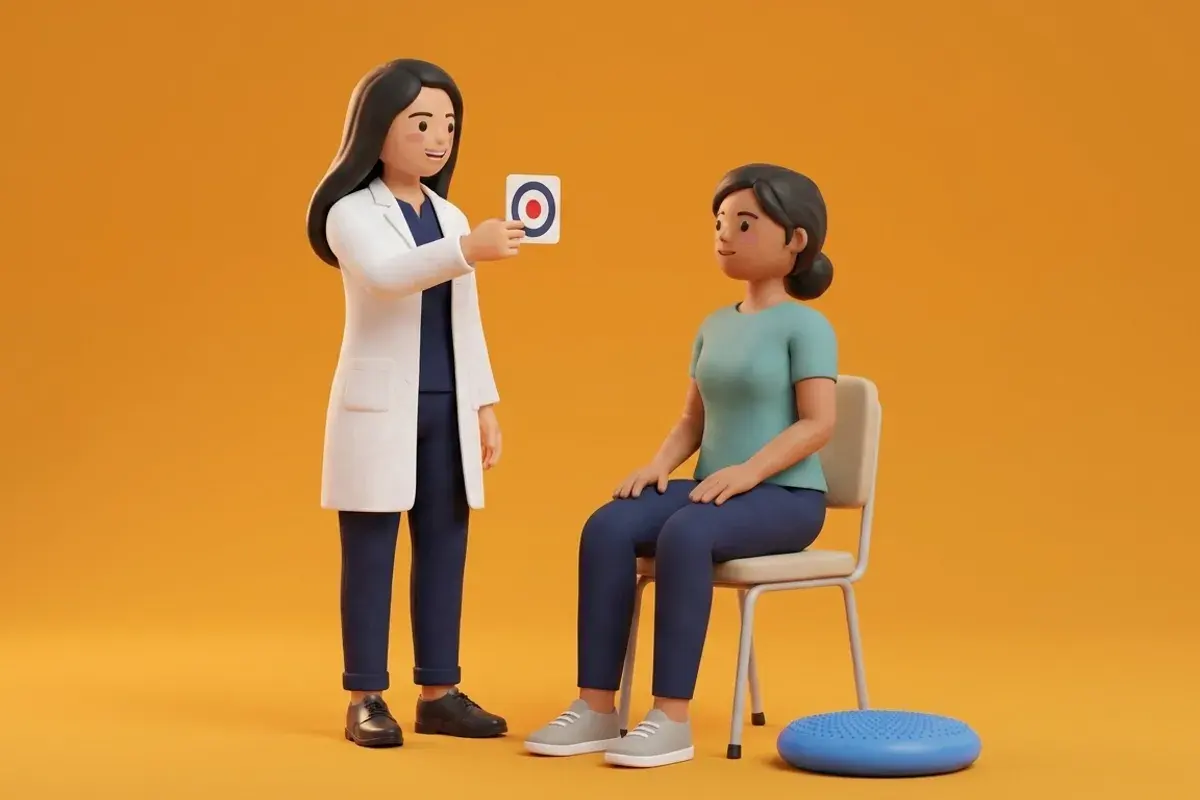
The athlete wears a headband equipped with a small laser pointer and sits exactly 90 cm away from a calibrated bullseye target. With eyes closed, the athlete rotates the head fully to one side and attempts to relocate the exact center of the target upon return. Deviation exceeding 4.5 degrees indicates cervical proprioceptive deficit.
Do I need a doctor referral to see a sports concussion physiotherapist on BookPhysio.in?
BookPhysio.in does not require a physician prescription. Under the National Commission for Allied and Healthcare Professions (NCAHP) Act 2021, patients across India enjoy direct access to autonomous registered physiotherapists. Through BookPhysio.in, you connect with verified clinicians and pay per session with transparent fees, completely free from advance package commitments, commission markups, or platform subscription charges.
Related condition guides

Related recovery guides & articles
BookPhysio.in Editorial Team
The BookPhysio.in editorial team writes and maintains this content, checking it against reliable clinical sources. Content follows our medical review policy: general information only, and no page claims a clinical review until a named registered physiotherapist has signed it off.
Read our medical review policy