
Continuous Passive Motion (CPM) in Post-Lavage Septic Knee: Cartilage Preservation
In short
Continuous passive motion preserves articular cartilage following septic knee joint lavage. Explore Salter principles, setup parameters, and home adaptations in India.
In this guide (5 sections)
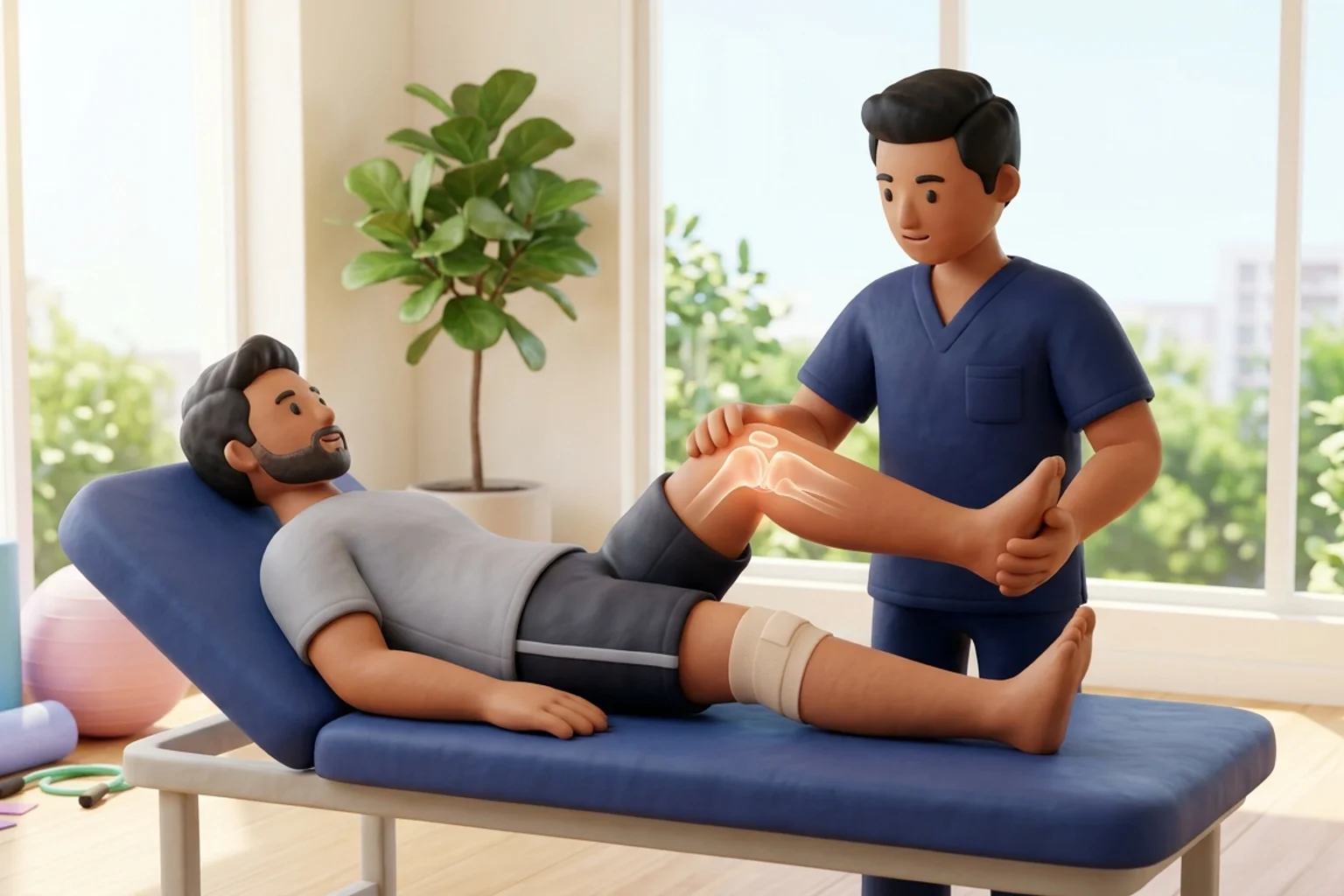
The application of continuous passive motion (CPM) following surgical lavage of the septic knee is grounded in the foundational research of Dr. Robert Salter. Salter demonstrated that sustained, gentle rhythmic passive movement accelerates the clearance of purulent exudate, stimulates chondrocyte metabolic activity, and promotes the regeneration of damaged articular cartilage via neochondrogenesis. In the post-lavage septic knee, where purulent enzymes have depleted synovial mucin and eroded the superficial chondral matrix, CPM offers mechanical motion without active muscle contraction, averting the crushing compressive forces that accelerate cartilage loss.
Domestic and Cultural Indian Realities
In Indian residential environments, utilizing a CPM unit presents logistical considerations that require careful caregiver education. Traditional bedroom furniture may include low wooden cots or soft cotton mattresses (gaddas) that do not support the rigid frame of a mechanical CPM unit. Electrical supply stability is another factor; voltage fluctuations can disrupt motorized programming, necessitating surge protectors. Physiotherapists ensure that the CPM cradle does not rub against fragile surgical incisions or dislodge closed suction drain tubing while family members assist with positioning.
Synovial Fluid Dynamics and Adhesion Prevention
When an infected knee joint remains immobile, fibrinogen within the inflammatory exudate precipitates into dense fibrin networks. These fibrin bands form extensive adhesions between the suprapatellar pouch, femoral condyles, and tibial plateau within 72 hours, resulting in dense fibrous ankylosis. CPM counteracts this adhesion process by maintaining continuous relative motion between synovial surfaces. Furthermore, cyclical flexion and extension generate rhythmic variations in intra-articular pressure, driving nutrient-rich synovial fluid through the porous extracellular matrix of avascular articular cartilage.
Clinical CPM Programming Parameters and Progression
Initial CPM settings typically start with a conservative arc of motion, commonly 0 to 30 degrees of flexion, at a slow cycle rate of one full cycle every two minutes. This ensures that surgical wound tension remains minimal and intra-articular pressure stays within safe physiological boundaries. As drain output diminishes and patient tolerance improves, flexion is increased incrementally by 5 to 10 degrees daily, aiming for 90 degrees by the end of the second postoperative week. Daily duration typically ranges from four to six hours, divided into two-hour sessions separated by rest intervals.
Manual Self-Assisted Knee Bending with Dupatta Cradle
Objective: Complement motorized CPM with active-assisted knee flexion to regain joint proprioception
- 1Sit comfortably on a firm bed with your back supported by pillows and your affected leg extended.
- 2Pass a long soft cotton dupatta or woven scarf beneath the lower calf and heel of your affected limb.
- 3Gently draw both ends of the cloth toward your chest, guiding your heel smoothly along the bed surface into flexion.
- 4Hold the gentle bend for 5 seconds when reaching your comfortable threshold, taking steady breaths.
- 5Slowly ease the cloth tension to allow the leg to glide smoothly back into full extension.
| Recovery Stage | Arc of Motion & Daily Dosage | Clinical Goals and Safety Constraints |
|---|---|---|
| Stage 1: Days 1 to 3 | 0 to 30 degrees flexion; 1 cycle per 2 minutes; 4 hours daily in divided blocks | Synovial fluid diffusion, exudate clearance, prevent suprapatellar pouch adhesions |
| Stage 2: Days 4 to 7 | 0 to 60 degrees flexion; 1 cycle per 90 seconds; 4 to 6 hours daily | Progressive capsular stretch, preserve collateral ligament compliance, support drain removal |
| Stage 3: Days 8 to 14 | 0 to 90 degrees flexion; 1 cycle per minute; 4 hours daily combined with active exercise | Restore functional flexion, transition toward active-assisted heel slides and seated knee swings |
| Stage 4: Post-Week 2 | Discontinue CPM; transition entirely to independent active-assisted and functional movement | Restore independent standing, stationary cycling with high seat, functional gait retraining |
Red Flags and Specialist Escalation
Immediately stop CPM therapy and notify the surgical team if the knee develops sudden sharp pain during the flexion cycle, if dressings become saturated with fresh blood, or if the skin over the incision exhibits blanching or breakdown from cradle pressure. The development of calf pain, cord-like induration, or unilateral lower extremity swelling warrants urgent duplex ultrasonography to rule out deep vein thrombosis.
Frequently Asked Questions
Is a CPM machine mandatory, or can I recover knee movement with manual exercises alone?
While a CPM machine is highly beneficial in the early days after joint lavage because it provides gentle movement without muscle fatigue, it is not mandatory. Structured manual active-assisted exercises, such as towel-assisted heel slides performed diligently under physiotherapist supervision, can achieve excellent range of motion outcomes if a CPM unit is unavailable.
Do I need a doctor referral to consult an orthopaedic physiotherapist on BookPhysio.in?
BookPhysio.in does not require a doctor referral. Under the National Commission for Allied and Healthcare Professions (NCAHP) Act 2021, patients in India have direct access to registered physiotherapists. You pay your clinician directly per session with transparent fees and zero booking commissions or platform subscriptions.
Related condition guides



Related recovery guides & articles
BookPhysio.in Editorial Team
The BookPhysio.in editorial team writes and maintains this content, checking it against reliable clinical sources. Content follows our medical review policy: general information only, and no page claims a clinical review until a named registered physiotherapist has signed it off.
Read our medical review policy