
Deltoid Re-Education and Anterior Recruitment After Reverse Shoulder Replacement
In short
Following reverse shoulder replacement, the deltoid becomes the sole engine of arm elevation. Master the clinical exercises and biofeedback techniques that restore active reach.
In this guide (4 sections)
In a native anatomical shoulder, arm elevation is governed by the coordinated interaction between the rotator cuff, which depresses and stabilizes the humeral head, and the deltoid, which elevates the limb. Following Reverse Total Shoulder Arthroplasty (rTSA), this physiological dynamic is permanently replaced: the deltoid muscle becomes the exclusive motor engine responsible for initiating, stabilizing, and executing forward elevation. Because the semi-constrained glenosphere prosthesis provides intrinsic bony stability, the anterior and middle heads of the deltoid no longer require rotator cuff co-activation. However, decades of chronic pain and disuse frequently leave the deltoid inhibited, atrophied, or uncoordinated. Dedicated deltoid motor re-education is therefore essential to recruit dormant muscle fibers and establish fluid, non-hiking elevation patterns.
Overcoming Compensatory Shoulder Hiking in Indian Household Routines
Patients recovering from rTSA in Indian domestic settings frequently present with persistent upper trapezius substitution, commonly known as shoulder hiking. After years of struggling with a painful torn rotator cuff, the brain instinctively shrugs the entire shoulder girdle upward when attempting to reach for a light switch, lift a cup of tea, or open a screen door. In Indian kitchens, this maladaptive pattern causes rapid neck fatigue, occipital headaches, and poor functional reach toward countertop spices. Furthermore, attempting to carry grandchildren or lift small grocery bags with an uncoordinated deltoid places abnormal stress on the cervical spine. Physiotherapists utilize visual mirror biofeedback and tactile guidance to suppress upper trapezius dominance while activating the anterior deltoid.
Vector Alteration, Length-Tension Relationship, and Neural Plasticity
The surgical alteration of joint architecture profoundly influences deltoid physiology. By shifting the centre of rotation medially by eight to ten millimetres and inferiorly by fifteen to twenty millimetres, rTSA places the anterior deltoid fibers under continuous, pre-tensioned stretch. According to the length-tension curve of skeletal muscle, optimal lengthening increases cross-bridge overlap, increasing passive tension and active force generation. Electromyographic assessments confirm that following rTSA, anterior deltoid activation levels during forward flexion increase by up to forty percent compared to healthy controls. To translate this mechanical advantage into functional movement, cortical motor retraining must take place. The patient must learn to fire the clavicular head of the deltoid independently while keeping the periscapular stabilizers depressed and retracted.
Neuromuscular Facilitation Protocols: From Gravity-Minimised to Upright Reaching
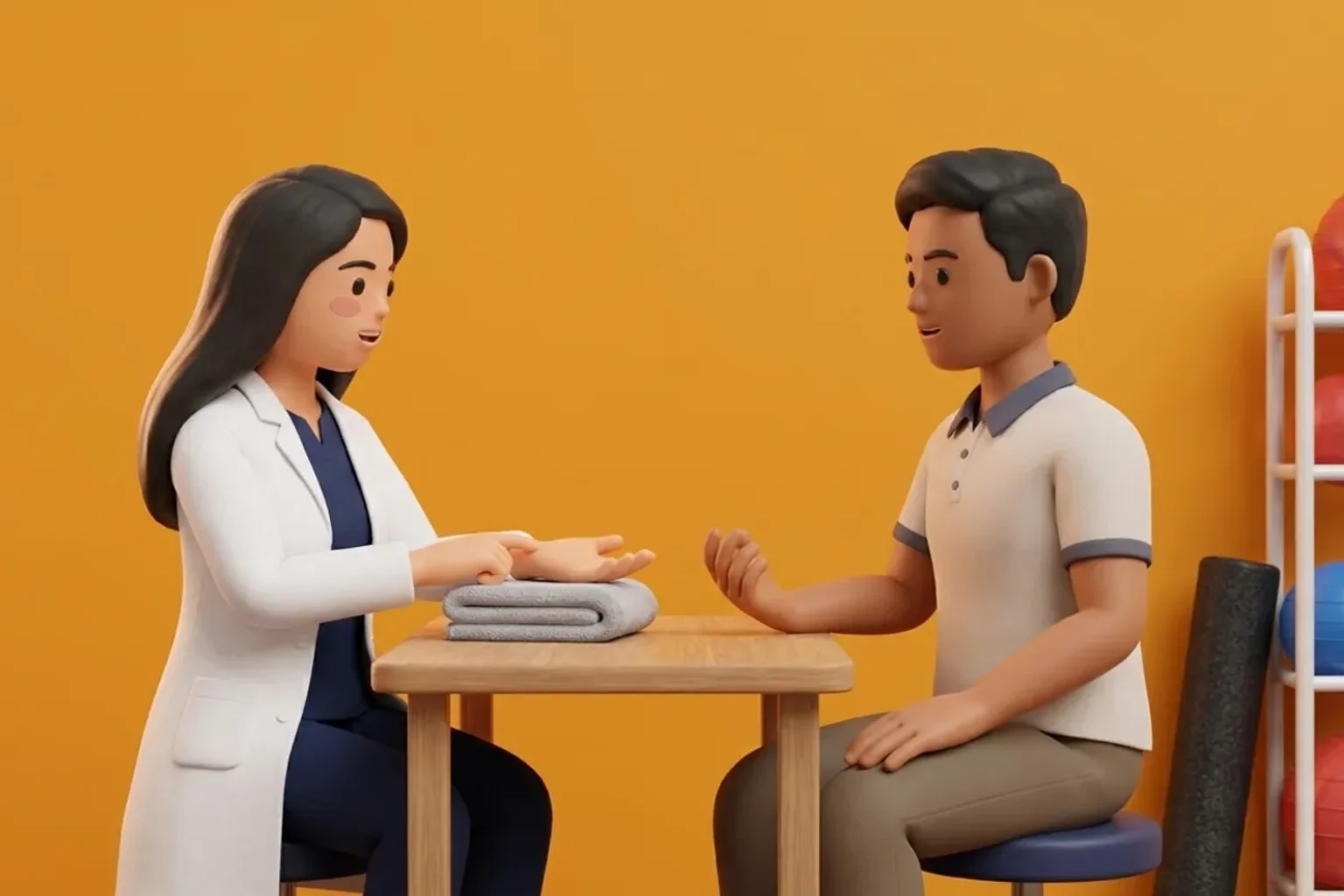
Deltoid re-education begins in gravity-minimized supine postures where the posterior plinth provides sensory stability to the scapula. The clinician utilizes tactile facilitation, placing light fingertip pressure over the anterior deltoid muscle belly while the patient visualizes lifting the wrist toward the ceiling. Short-arc isometric holds at varying angles (thirty, forty-five, and sixty degrees) build early motor unit synchronization. Once the patient can elevate thirty degrees actively without upper trapezius contraction, training advances to semi-recumbent positions on an incline wedge, progressively increasing the gravitational challenge. Visual biofeedback using a mirror ensures that the clavicle remains horizontal throughout movement.
Supine Anterior Deltoid Isometric Activation with Visual Tracking
Objective: Isolate anterior deltoid motor unit recruitment while suppressing compensatory upper trapezius shrugging
- 1Lie flat on your back on a firm bed with your knees bent and feet resting flat on the mattress.
- 2Rest your operative arm at your side with your elbow bent to ninety degrees, pointing your forearm toward the ceiling.
- 3Place the palm of your opposite hand against the front of your operative wrist to provide light resistance.
- 4Gently push your operative arm forward and upward against your hand, generating a light twenty-percent effort.
- 5Hold the contraction for 5 seconds while ensuring your shoulder blade remains relaxed on the bed, then release slowly.
| Progression Stage | Biomechanical Orientation & Motor Demand | Targeted Neuromuscular Drills & Kinematic Goals |
|---|---|---|
| Stage 1: Supine Motor Facilitation | Gravity-eliminated plane; full scapular support on plinth; minimal joint compressive shear. | Tactile deltoid stimulation, supine active-assisted wand reaches, short-arc isometric holds at 45 degrees. |
| Stage 2: Incline Progressive Loading | Incline wedge (30 to 60 degrees); graded gravitational loading; active deltoid recruitment. | Supported table slides, incline active reaches, visual mirror biofeedback to eliminate shoulder hiking. |
| Stage 3: Upright Active Elevation | Full vertical gravity vector; requires coordinated deltoid and serratus anterior co-activation. | Upward wall slides, light resistance band scaption, active reach-and-retrieve drills in functional arcs. |
| Stage 4: Functional Task Integration | Dynamic multi-planar reaching against light loads; endurance and positional awareness focus. | Domestic reach simulation (countertop to eye level), carrying light containers, rotational stability. |
Because the deltoid is working without rotator cuff assistance, it fatigues much faster than in a normal shoulder. Training into severe fatigue causes rapid biomechanical breakdown, leading to excessive superior joint rocking and compensatory neck straining. Keep repetitions low and quality high.
Frequently Asked Questions
Why does my neck and upper shoulder hurt when I try to lift my arm after reverse replacement?
Neck aching typically stems from overactivity of the upper trapezius muscle, which tries to compensate for a weak deltoid by hiking the shoulder blade upward. Physiotherapy retrains your brain to relax the neck muscles while isolating the anterior deltoid, eliminating neck strain and restoring a smooth arm elevation arc.
Do I need a doctor referral to see a rotator cuff physiotherapist on BookPhysio.in?
BookPhysio.in does not require a physician prescription. Under the National Commission for Allied and Healthcare Professions (NCAHP) Act 2021, patients across India enjoy direct access to autonomous registered physiotherapists. Through BookPhysio.in, you connect directly with verified clinicians and pay per session with transparent fees, completely free from advance package commitments, commission markups, or platform subscription charges.
Related condition guides



Related recovery guides & articles
BookPhysio.in Editorial Team
The BookPhysio.in editorial team writes and maintains this content, checking it against reliable clinical sources. Content follows our medical review policy: general information only, and no page claims a clinical review until a named registered physiotherapist has signed it off.
Read our medical review policy