
Knee Growth Plate Stress in Youth Jumping Sports: Physio Care
In short
Distal femoral and proximal tibial growth plate stress injuries threaten long bone development in young jumpers. Learn targeted physiotherapy management.
In this guide (6 sections)
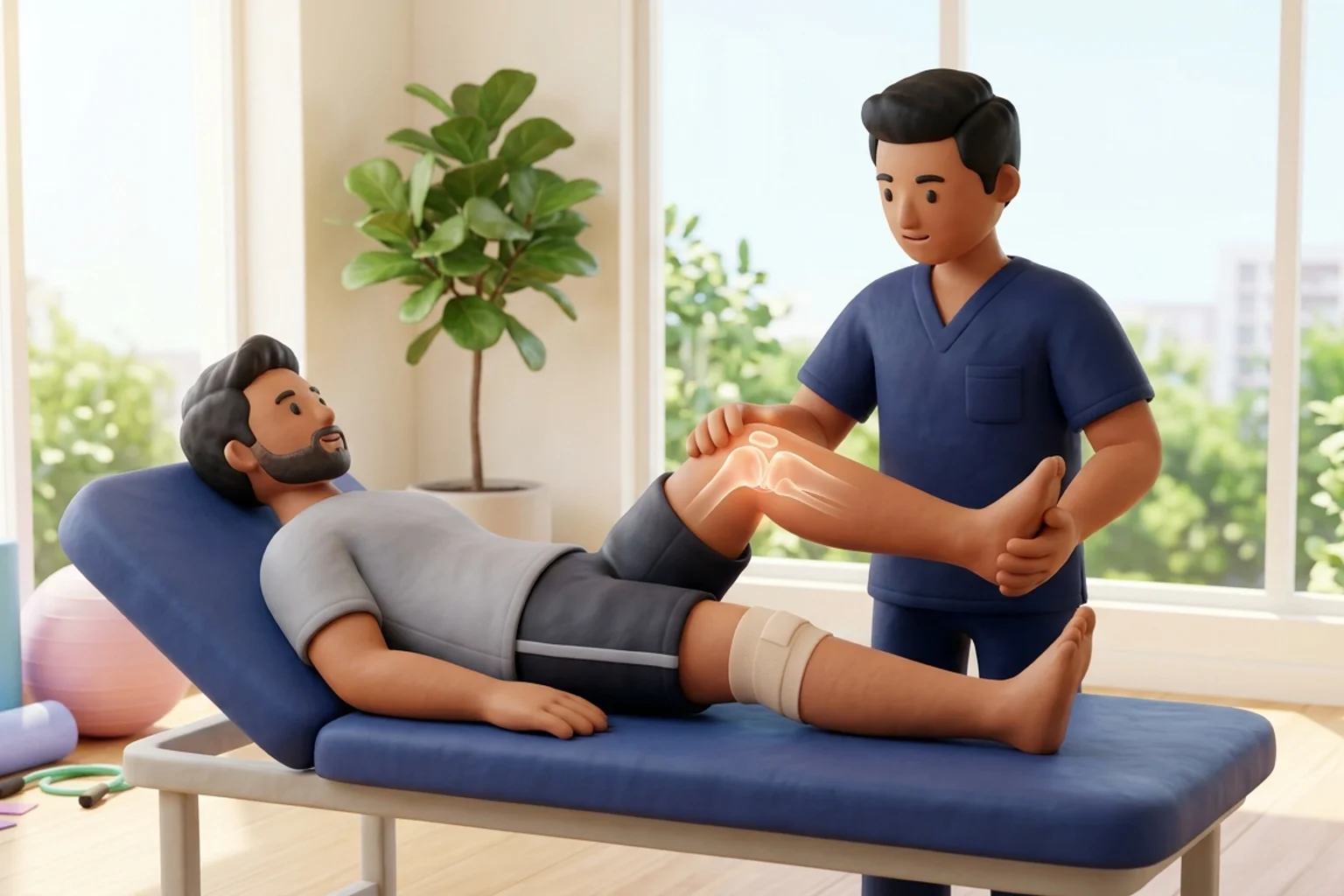
Growth plate stress injuries of the distal femur and proximal tibia represent serious overuse bone stress conditions in adolescent athletes participating in high-impact jumping sports. Occurring in basketball, volleyball, high jump, and badminton athletes aged 11 to 16, these injuries involve repetitive microvascular strain across the primary articular physes rather than traction apophyses. Because the distal femur and proximal tibia contribute 65 percent and 55 percent of their respective bone lengths, managing physeal stress is critical to prevent permanent growth arrest.
Domestic and Cultural Indian Realities
In Indian sporting schools and private sports academies, basketball and volleyball training frequently occurs on outdoor unyielding asphalt or concrete courts. Adolescent athletes undergo repetitive maximum-effort jumping and landing drills without rotational shock absorption. Knee pain is routinely dismissed as ordinary growing pains or confused with common Osgood-Schlatter apophysitis. Continuing to train on an irritated true physis risks micro-fracturing the columnar cartilage and inducing asymmetric physeal tethering.
Clinical Biomechanics and Physeal Physiology
The distal femoral and proximal tibial physes undergo complex multi-planar loading: axial compression during jump landing and varus or valgus shear during abrupt cutting maneuvers. During pubertal growth spurts, these growth plates undergo rapid cellular expansion, creating a wide and mechanically fragile zone of hypertrophy. Repetitive high-magnitude ground reaction forces exceeding tissue tolerance provoke subchondral marrow oedema and micro-trabecular failure, threatening long-term bone growth.
Clinical Assessment and Diagnostic Differentiation
Athletes report deep, poorly localized knee pain exacerbated by jumping, running, and prolonged standing. Physical examination reveals tenderness along the circumferential joint line corresponding to the distal femoral or proximal tibial physeal lines (located 1 to 2 centimetres superior and inferior to the true joint line). Crucially, clinicians must differentiate physeal stress from meniscal tears, collateral ligament sprains, and apophysitis. MRI is the diagnostic gold standard, identifying physeal widening and peri-physeal bone marrow oedema.
Targeted Rehabilitation and Loading Protocols
Initial treatment mandates complete cessation of high-impact jumping and running for 8 to 12 weeks. Protected weight-bearing with crutches is instituted if ambulation is antalgic. Non-impact aerobic conditioning (swimming and stationary cycling with low resistance) preserves fitness. As bone marrow oedema resolves, physiotherapy introduces closed-chain hip strengthening, core neuromuscular control, and rigorous jump-landing mechanics re-education to eliminate dynamic knee valgus.
Bilateral Soft Landing Retraining Drill
Objective: Re-educate eccentric lower limb deceleration mechanics to attenuate impact forces transmitted to the knee growth plates
- 1Stand balanced with feet shoulder-width apart in front of a full-length mirror.
- 2Rise up onto the balls of your feet, extending your hips and raising your arms overhead.
- 3Drop quickly into an athletic squat position, landing softly on the balls of your feet before lowering your heels smoothly.
- 4Absorb impact by flexing through your hips, knees, and ankles simultaneously, keeping your knees tracking straight over your middle toes.
- 5Hold the deep, quiet landing position for 3 seconds, ensuring silent foot contact and zero inward knee collapse.
| Clinical Feature | True Knee Physeal Stress | Traction Apophysitis (OSD / SLJ) |
|---|---|---|
| Anatomical Site | Distal femoral or proximal tibial transverse growth plate | Extra-articular tendon attachment (tibial tuberosity or patellar pole) |
| Mechanical Stress Type | Compressive impact and multi-planar joint shear | Pure tensile distraction from contracting muscle-tendon units |
| Long-Term Structural Risk | High risk of limb length inequality or angular deformity | Minimal risk of growth arrest; potential benign bony prominence |
Red Flags and Specialist Escalation
Urgent paediatric orthopaedic consultation is required if there is progressive valgus or varus malalignment, visible joint effusion, unexplained resting pain, or measurable leg length discrepancy. These features indicate premature partial physeal fusion (epiphysiodesis) or a Salter-Harris fracture, which requires orthopaedic intervention to prevent progressive skeletal deformity.
Frequently Asked Questions
Does knee growth plate stress cause permanent growth stunting in young jumpers?
When diagnosed early and managed with appropriate impact unloading, the growth plates heal without permanent growth arrest. Delayed diagnosis or playing through severe pain increases the risk of partial bony bridge formation and angular deformity.
Do young athletes in India need a doctor referral for paediatric knee physiotherapy?
BookPhysio.in does not ask for a doctor referral. Under the National Commission for Allied and Healthcare Professions (NCAHP) Act 2021, registered physiotherapists are recognized as autonomous primary contact practitioners. You can book directly with sports physiotherapists and pay directly per session.
Related condition guides


Related recovery guides & articles
BookPhysio.in Editorial Team
The BookPhysio.in editorial team writes and maintains this content, checking it against reliable clinical sources. Content follows our medical review policy: general information only, and no page claims a clinical review until a named registered physiotherapist has signed it off.
Read our medical review policy