
Dual-Task Cognitive-Motor Training for Older Adults: Paradigms and Fall Prevention
In short
Real-world falls occur while talking, dodging traffic, or carrying objects. Learn dual-task training paradigms, task prioritization rules, and fall prevention drills.
In this guide (5 sections)
The Cognitive-Locomotor Link in Geriatric Falls
Young adults walk automatically with minimal conscious cognitive processing. With advancing age and sensory attenuation, locomotion requires significant prefrontal cortex executive attention.
When an older adult is faced with a concurrent cognitive task while walking (such as talking on a mobile phone, reading street signs, or calculating market bills), neural resources are diverted away from postural stabilization. This dual-task cognitive-motor interference produces gait slowing, step width variability, and catastrophic falls.
Dual-Task Interference Paradigms and Assessments
The Dual-Task Cost (DTC) measures the percentage decrement in gait speed or cognitive accuracy when performing both tasks simultaneously compared to single-task performance: DTC (%) = [(Single Task - Dual Task) / Single Task] * 100.
| Cognitive Domain Tested | Secondary Concurrent Task | Observed Motor Response | Clinical Risk Interpretation | |
|---|---|---|---|---|
| Working Memory | Serial 7 Subtraction (count backward from 100 by 7) | Marked decrease in cadence, prolonged double-support time | DTC > 20% indicates high risk of prospective falls. | |
| Verbal Fluency | Naming animals or vegetables aloud while walking | Hesitations, stumbling, irregular step length | Frontal executive cognitive slowing during ambulation. | |
| Inhibition / Stroop | Auditory Stroop (responding to high/low pitch words) | Abrupt gait freezing, postural sway widening | Inability to suppress distracting environmental noise. | |
| Manual Motor | Carrying a full cup of water or balancing a ball on a tray | Stiffened upper body, loss of arm swing | Inability to coordinate simultaneous upper-lower body mechanics. |
Progressive Dual-Task Rehabilitation Protocol
Training follows a systematic hierarchy advancing from static balance to complex community ambulation.
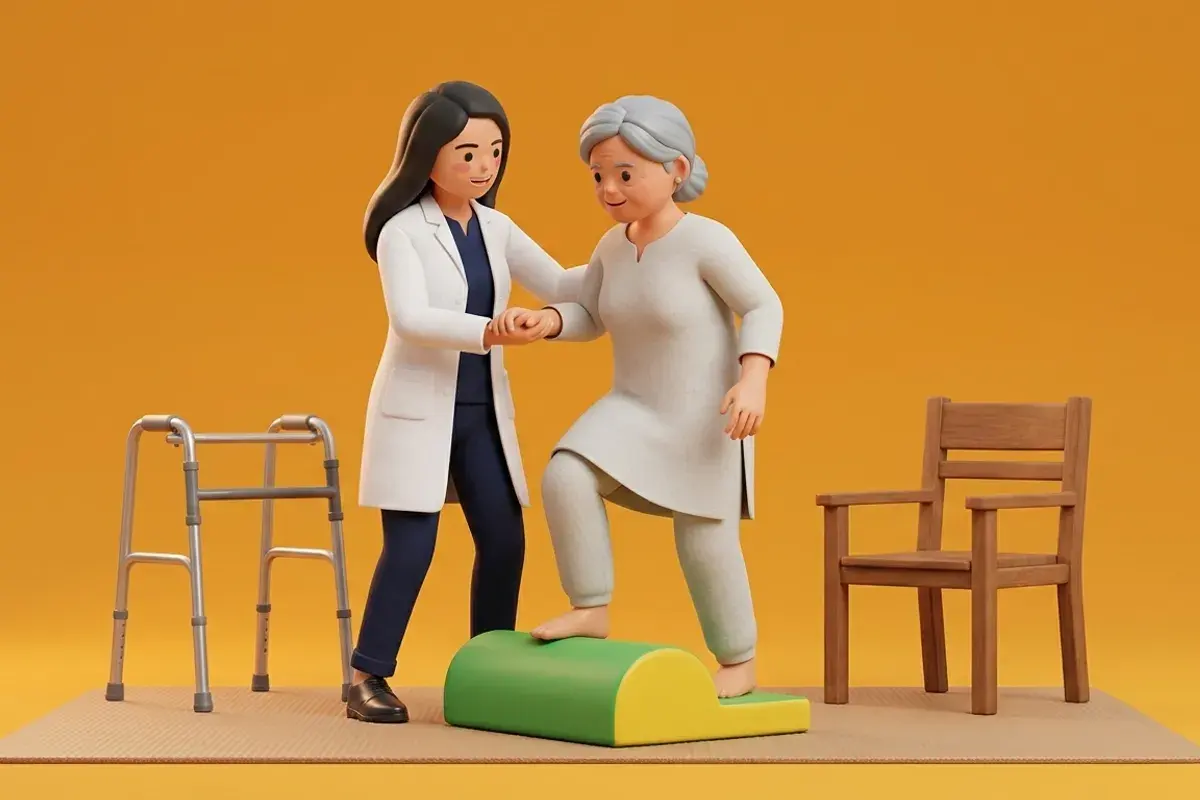
- Level 1: Static Balance + Cognitive: Tandem standing or semi-tandem balance on foam mat while performing category naming (vegetables, Indian cities) for 30 seconds.
- Level 2: Dynamic Walking + Motor Task: Straight line walking while carrying a weighted tray or bouncing a tennis ball, maintaining constant gait speed.
- Level 3: Locomotion + Executive Cognitive Task: Walking an obstacle course with cones while counting backward by 3s or reciting days of the week in reverse order.
- Level 4: Task Prioritization Training: Educating patients on the Posture First Principle: teaching older adults to immediately stop walking or pause conversation when encountering uneven ground, curbs, or crowds.
Indian Market and Street Navigation Context
Indian street environments represent high dual-task stress: navigating irregular footpaths, dodging two-wheelers, negotiating speed-breakers, and bargaining in bustling bazaars.
Home-visit physiotherapists incorporate simulated multi-stimulus training, such as stepping over threshold dividers while holding grocery bags and answering family questions.
Frequently Asked Questions
What is the Stops Walking When Talking (SWWT) test?
The SWWT test is a simple clinical observation: if an older adult must stop walking in order to answer a conversational question, their fall risk over the next 6 months is increased by 80 percent.
How many weeks of dual-task training are needed to reduce falls?
Randomized controlled trials show that 8 to 12 weeks of structured dual-task training (2 sessions weekly for 45 minutes) significantly reduces fall incidence by up to 40 percent.
Can dual-task training be used in mild cognitive impairment (MCI)?
Yes. Dual-task exercise stimulates neuroplasticity in both prefrontal executive networks and supplementary motor areas, slowing functional decline in MCI.
Related condition guides


Related recovery guides & articles
BookPhysio.in Editorial Team
The BookPhysio.in editorial team writes and maintains this content, checking it against reliable clinical sources. Content follows our medical review policy: general information only, and no page claims a clinical review until a named registered physiotherapist has signed it off.
Read our medical review policy