
Femoroacetabular Impingement (FAI) and Pubic Symphysis Stress: The Biomechanical Crosstalk
In short
Detailed clinical analysis of the biomechanical crosstalk between hip joint FAI morphology and pubic symphysis overload, explaining secondary athletic pubalgia.

In this guide (4 sections)
In the comprehensive assessment of athletic groin pain, treating the adductor muscles or pubic symphysis in isolation frequently results in clinical failure. Modern sports medicine recognizes that hip joint morphology, specifically Femoroacetabular Impingement (FAI), shares a powerful biomechanical crosstalk with the anterior pelvic ring. FAI, characterized by cam morphology (aspherical femoral head-neck junction) or pincer morphology (acetabular over-coverage), causes mechanical abutment between the proximal femur and acetabular rim during terminal hip flexion and internal rotation. When the ball-and-socket joint of the hip loses its normal rotational freedom, kinetic forces cannot be absorbed within the hip capsule. Instead, these destructive rotational torques are shunted directly into the adjacent pubic symphysis and sacroiliac joints, accelerating athletic pubalgia and chronic adductor longus enthesopathy.
Monsoon Football Plowing, Cross-Legged Dining, and Motorcycle Turning Strains
In the Indian subcontinent, FAI-pubic symphysis crosstalk frequently goes unrecognized for years. Young football players competing on uneven municipal maidans and cricket fast bowlers frequently present with chronic groin pain that is erroneously treated as an isolated muscle pull. When an athlete with underlying cam morphology attempts an explosive inside-of-the-foot pass or sudden cut, the restricted hip rotation forces the pelvis to twist violently across the pubic joint. Outside competitive sports, domestic cultural habits heavily aggravate this condition. Forcing hips with FAI into deep cross-legged floor sitting (Sukhasana) during long religious ceremonies or sitting on low stools causes recurrent bony impingement. Furthermore, swinging a leg over a tall motorcycle like a Royal Enfield Himalayan or Hero Xpulse repeatedly induces painful hip-pelvic shear.
Kinetic Transfer Mechanics, Alpha Angles, and Symphyseal Parasymphyseal Edema
The biomechanical mechanism linking FAI to pubic symphysis pathology is governed by the closed kinematic chain of the pelvis. Normal athletic running, cutting, and kicking require up to thirty-five degrees of hip internal rotation during stance-phase deceleration. In an athlete with cam morphology (alpha angle exceeding fifty-five degrees on Dunn lateral radiography), internal rotation is mechanically blocked at ten to fifteen degrees as the aspherical femoral neck impacts the anterosuperior acetabular labrum. To complete the required sporting movement, the athlete must compensate through excessive anterior pelvic tilt and hemipelvic rotation. This compensatory pelvic motion transfers massive rotational shear stress directly across the fibrocartilaginous pubic disc. Over time, this chronic stress produces micro-instability, rectus-adductor aponeurotic tearing, and extensive parasymphyseal bone marrow edema on magnetic resonance imaging.
Integrated Rehabilitation: Restoring Hip Capsule Glide and Pelvic Force Closure
Successfully resolving groin pain driven by FAI crosstalk requires an integrated two-pronged clinical protocol. First, physiotherapists address hip joint functional mobility within safe bony boundaries, utilizing manual therapy techniques such as inferior and posterior femoral glides to optimize joint centration without provoking labral pinching. Aggressive stretching into end-range flexion and internal rotation is strictly avoided. Second, rehabilitation emphasizes lumbo-pelvic neuromuscular control to buffer rotational shocks. Exercises focus on strengthening the deep hip external rotators, gluteus medius, and transversus abdominis to resist excessive pelvic twist during athletic maneuvers. Concurrently, adductor longus capacity is rebuilt through isometric and eccentric Copenhagen progressions, restoring tissue tolerance while protecting both the hip joint and the pubic symphysis.
Supine Active Hip Internal-External Rotation in Sixty Degrees Flexion within Impingement-Free Zone
Objective: Mobilize hip rotational capacity and train neuromuscular centration without triggering labral impingement
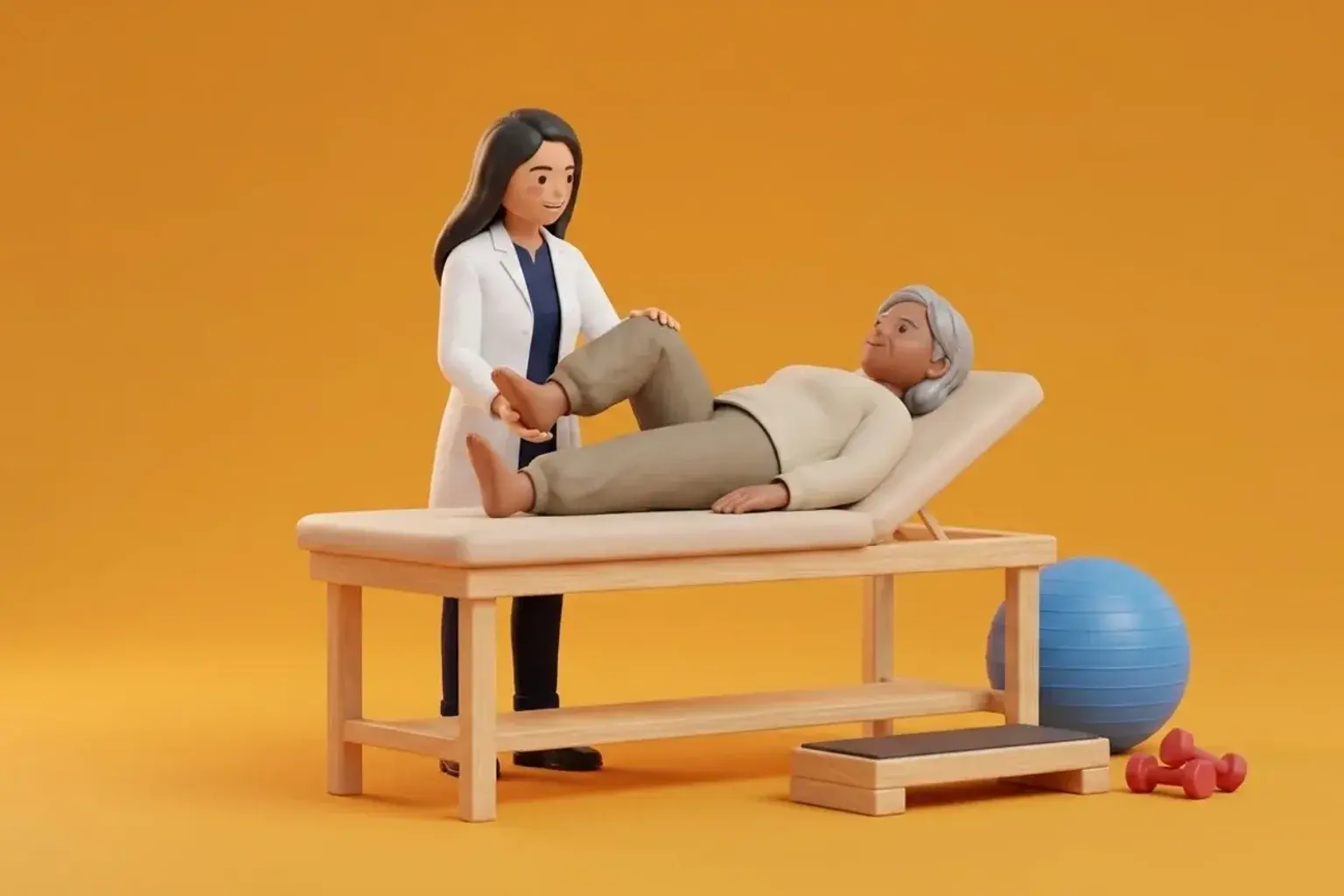
- 1Lie on your back on a comfortable exercise plinth with both knees bent to sixty degrees and feet resting flat, shoulder-width apart.
- 2Place your hands on your anterior pelvic bones (ASIS) to monitor and ensure your pelvis remains completely stable throughout.
- 3Keep your right foot planted, and slowly rotate your left knee inward toward the midline only until you feel a gentle stretch, stopping well before any groin pinch.
- 4Hold the internal rotation position smoothly for three seconds, then smoothly rotate the knee outward into comfortable external rotation.
- 5Perform the motion smoothly and rhythmically within your personal pain-free envelope, ensuring the pelvis does not rock or tilt.
| Diagnostic Feature | Isolated Adductor Longus Strain | FAI-Pubic Symphysis Crosstalk Syndrome |
|---|---|---|
| Primary Pain Location | Medial inner thigh and proximal tendon insertion at pubic tubercle | Deep anterior groin (C-sign) combined with pubic tubercle and lower abdominal aching |
| Passive Hip Range of Motion | Full passive hip flexion and internal rotation; pain provoked only on passive abduction stretch | Marked mechanical restriction of passive internal rotation (<15 deg) in 90 degrees flexion |
| Clinical Provocation Tests | Positive resisted adductor squeeze test; negative FADIR (Flexion-Adduction-Internal Rotation) | Positive FADIR test with sharp anterior pinch; positive squeeze test with pubic ache |
| Radiographic Findings | Normal hip radiographs; ultrasound shows focal tendon hypoechogenicity or tear | Cam morphology (alpha angle >55 deg), pistol-grip deformity, or pincer retroversion on X-ray |
When evaluating groin pain with suspected FAI, clinicians must evaluate for mechanical hip joint symptoms. The presence of painful clicking, catching, or giving-way sensations deep within the hip during weight-bearing pivot movements strongly indicates an acetabular labral tear or articular cartilage delamination. If conservative physiotherapy fails to improve symptoms within eight to twelve weeks, obtain 3-Tesla magnetic resonance arthrography (MRA) and arrange an orthopaedic hip preservation consultation.
Frequently Asked Questions
Can hip arthroscopy surgery for FAI cure my pubic symphysis and adductor pain?
In carefully selected athletes where FAI is the primary mechanical trigger restricting hip rotation, arthroscopic cam resection and labral repair successfully eliminate the pathological torque transferred to the pelvis. Clinical studies indicate that seventy to eighty percent of secondary athletic pubalgia symptoms resolve following successful hip arthroscopy, provided the surgery is accompanied by comprehensive post-operative core and adductor rehabilitation.
Do I need a doctor referral to treat groin pain and sports hernia on BookPhysio.in?
BookPhysio.in does not require a doctor referral. Under the National Commission for Allied and Healthcare Professions (NCAHP) Act 2021, patients across India enjoy direct access to autonomous registered physiotherapists. Through BookPhysio.in, you connect directly with verified clinicians and pay per session with transparent fees, completely free from advance package commitments, commission markups, or platform subscription charges.
Related condition guides
Related recovery guides & articles
BookPhysio.in Editorial Team
The BookPhysio.in editorial team writes and maintains this content, checking it against reliable clinical sources. Content follows our medical review policy: general information only, and no page claims a clinical review until a named registered physiotherapist has signed it off.
Read our medical review policy