
Gait Retraining in Flatfoot Deformity: Reducing Pronation Velocity, Terminal Stance Push-Off, and Midfoot Shock
In short
Learn how gait retraining reduces peak pronation velocity, mitigates medial arch strain, and restores efficient propulsion in flatfoot deformity.
In this guide (4 sections)
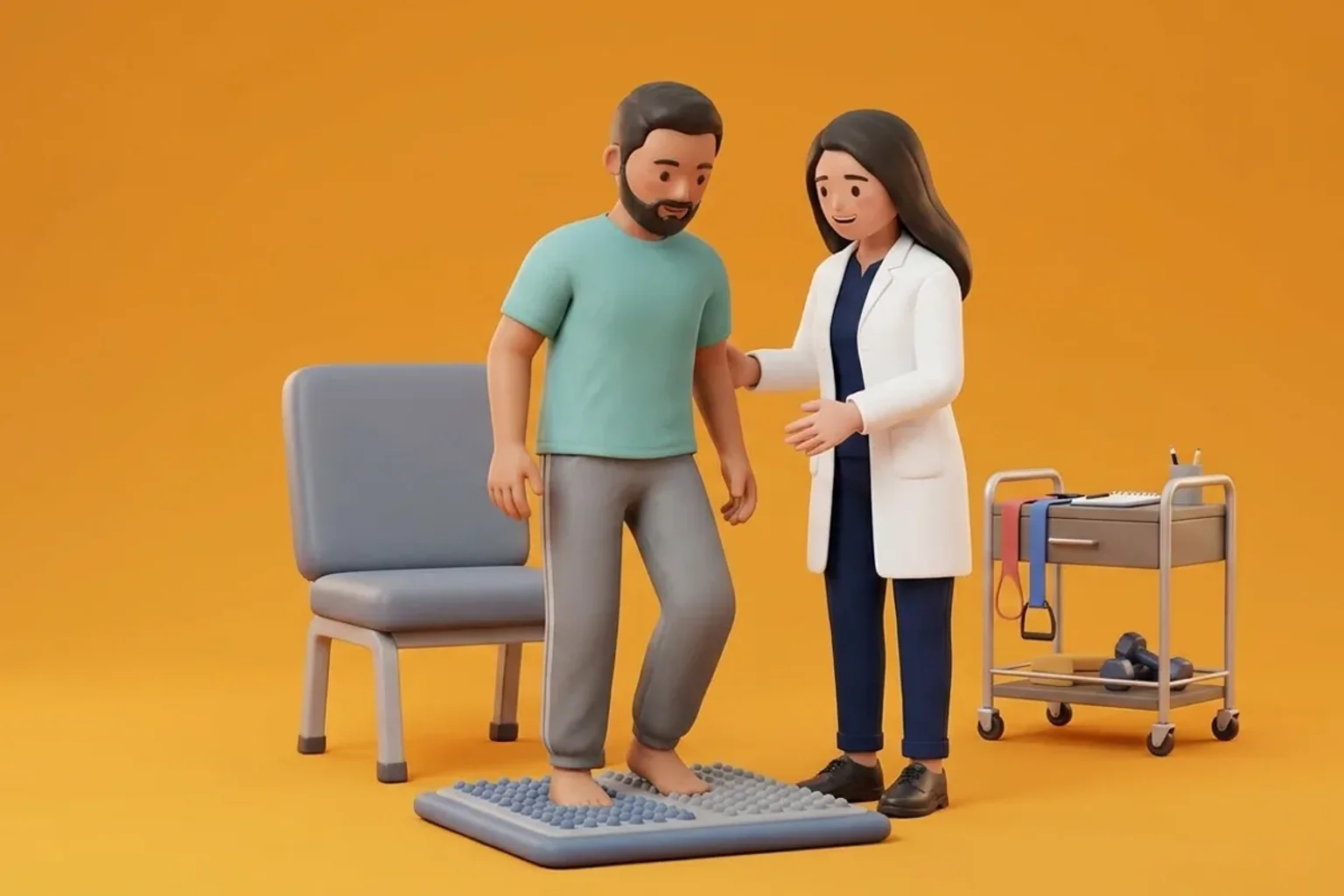
Gait retraining represents an essential dynamic intervention for managing adult-acquired flatfoot deformity and posterior tibial tendon dysfunction. While custom orthotics provide passive structural support, they do not automatically correct ingrained, maladaptive locomotor habits. Biomechanical investigations demonstrate that tendon strain is governed not merely by the total magnitude of pronation, but even more significantly by pronation velocity: the rapid rate at which the subtalar joint rotates from initial heel contact into peak eversion. When a patient walks with an abrupt, high-velocity pronation slap, dynamic tensile loads on the tibialis posterior spike dramatically. Through real-time auditory, visual, and kinesthetic cueing, physiotherapists retrain the patient's walking kinematics, dampening impact peaks and restoring a functional push-off vector.
Walking in Crowded Indian Markets, Rapid Striding, and Pavement Slap
In Indian urban centers, daily walking environments frequently encourage hurried, aggressive gait patterns. Commuters rushing through busy railway stations or walking across crowded markets often adopt a heavy, over-striding walking style to navigate congestion. When combined with flat chappals or thin-soled sandals, this rapid striding creates an audible 'foot slap' as the arch crashes downward against hard concrete or stone paving. Homemakers walking briskly across slick marble floors at home similarly exhibit excessive midfoot collapse during turns. By retraining individuals to adopt shorter, softer strides and mindful foot placement, clinicians eliminate destructive impact forces before they can traumatize fragile inner ankle tissues.
Pronation Velocity Mechanics, Tibial Internal Torsion, and Kinetic Shocks
The pathomechanics of high pronation velocity involve complex multi-segmental kinetic coupling. At initial heel strike, the subtalar joint should physiologically evert at a controlled rate of approximately one hundred to one hundred and fifty degrees per second, decelerated eccentrically by the tibialis posterior. In PTTD, this deceleration fails; pronation velocity frequently exceeds three hundred degrees per second. This rapid collapse drives the talus into sudden internal rotation, which in turn induces obligatory, high-velocity internal rotation of the tibia. This rotational shock travels up the lower limb, disrupting normal knee kinematics and concentrating intense tensile shear across the insertion of the spring ligament. Furthermore, because the midtarsal joints remain unlocked throughout stance, propulsion during terminal stance occurs over an unstable midfoot lever, increasing forefoot pressure.
Cadence Manipulation, Midfoot Strike Cues, and Step Width Modulation
Clinical gait retraining utilizes three primary biomechanical strategies. First, step cadence is systematically increased by seven to ten percent using a metronome while keeping walking speed constant. This simple adjustment naturally shortens step length, positions the initial foot strike closer to the body center of mass, and significantly dampens peak ground reaction impact. Second, patients receive acoustic biofeedback to 'walk softly,' which immediately reduces the rate of vertical force loading. Third, step width is slightly widened by one to two centimetres, neutralizing excessive dynamic hip adduction that drives the foot into valgus collapse. Treadmill training with video feedback allows patients to visualize their rearfoot alignment and practice conscious supination push-off.
Cadence-Controlled Soft-Step Walking Drill with Metronome
Objective: Increase stepping cadence to naturally reduce stride length, pronation velocity, and midfoot impact shock
- 1Download a free metronome app onto your mobile phone, setting the tempo to 110 beats per minute.
- 2Wear your prescribed supportive athletic shoes and custom functional orthotics.
- 3Walk along a flat hallway or open room, matching every single foot strike precisely to the metronome beat.
- 4Focus on taking shorter, lighter steps, consciously aiming to make zero audible sound when your shoes hit the floor.
- 5Ensure your feet point straight ahead without splaying outward into excessive external rotation.
- 6Continue walking continuously at this cadence for five minutes, maintaining smooth, upright posture.
| Gait Parameter | Maladaptive Baseline Gait | Retrained Corrective Target | Biomechanical Mechanism |
|---|---|---|---|
| Step Cadence | Low cadence (90 to 100 steps/min), long over-striding | Increased cadence (110 to 120 steps/min), shorter steps | Reduces heel strike impact peak by 15-20% and shortens eversion lever |
| Pronation Velocity | Rapid collapse (>280 deg/sec) with loud foot slap | Smooth deceleration (<150 deg/sec) with quiet landing | Dampens tensile shock on healing tibialis posterior collagen |
| Step Width | Narrow, cross-over gait pattern | Slightly widened base of support (step width 8-10 cm) | Reduces frontal plane hip adduction and hindfoot valgus torque |
During gait retraining, patients must not overcorrect by excessively walking on the outer edge of the foot. Forcing severe lateral weight-bearing can provoke stress fractures of the fifth metatarsal, lateral ankle ligament sprains, or peroneal tendinopathy. The objective is smooth, controlled deceleration into neutral, not rigid lateral avoidance.
Frequently Asked Questions
How long does it take for retrained walking habits to become permanent?
Neuromuscular motor pattern retraining typically requires four to six weeks of daily conscious practice. By performing five to ten minutes of cadence-focused walking twice daily, the new movement pattern becomes automatic and replaces the old, high-impact gait habit.
Do I need a doctor referral to treat flatfoot or PTTD on BookPhysio.in?
BookPhysio.in does not require a doctor referral. Under the National Commission for Allied and Healthcare Professions (NCAHP) Act 2021, patients across India enjoy direct access to autonomous registered physiotherapists. Through BookPhysio.in, you connect directly with verified clinicians and pay per session with transparent fees, completely free from advance package commitments, commission markups, or platform subscription charges.
Related condition guides



Related recovery guides & articles
BookPhysio.in Editorial Team
The BookPhysio.in editorial team writes and maintains this content, checking it against reliable clinical sources. Content follows our medical review policy: general information only, and no page claims a clinical review until a named registered physiotherapist has signed it off.
Read our medical review policy