
Gluteal and Quadriceps Strengthening to Power Hip-Hinge Transfers Post-Fusion
In short
Discover how building gluteal and quadriceps strength powers spine-safe hip-hinge transfers, protecting your lower back after spinal fusion surgery.
In this guide (4 sections)
Following lumbar spinal fusion or surgical decompression, patients often fall into a hazardous movement trap: using their lower back muscles to power everyday lifting, bending, and transitional movements. Because surgical instrumentation rigidly anchors the lumbar vertebrae, attempting to bend or lift from the spine concentrates extreme shear stresses across pedicle screws and adjacent mobile discs. The human lower extremity contains the body's most powerful muscular engines, specifically the gluteus maximus, gluteus medius, and quadriceps femoris. In a healthy kinetic chain, vertical elevation and forward reaching are powered almost entirely by the hip extensors and knee extensors through closed kinetic chain mechanics. Targeted strengthening of the gluteals and quadriceps restores this physiological hip-driven movement pattern, allowing patients to execute safe hip-hinge transfers and perform daily domestic tasks without placing mechanical strain on their healing spine.
Domestic Demands: Rising from Low Stools, Floor Living, and Heavy Baltis
Everyday Indian domestic life continually challenges lower limb extensor strength. Rising from a low wooden stool (patla) while chopping vegetables, standing up from a traditional low diwan, or lifting a full stainless steel water bucket (balti) requires substantial knee and hip extensor torque. If a patient's quadriceps or gluteal muscles are weak from extended post-operative bedrest, they are forced to compensate by rounding their lower back, grabbing nearby furniture, or violently jerking their torso upward to stand. This compensatory habit places severe tensile and bending forces across the lumbar instrumentation. In addition, using Indian-style squat toilets or stepping down from high public buses requires eccentric quadriceps control. Physiotherapists design progressive lower extremity conditioning programs tailored to these domestic demands, building muscular endurance that protects the back during all everyday transfers.
Gluteal Amnesia, Quadriceps Sarcopenia, and Kinetic Chain Breakdown
The pathophysiological mechanism underlying poor transfer mechanics in failed back surgery syndrome is rooted in arthrogenic muscle inhibition and disuse atrophy. Following spinal surgery, pain signaling from damaged tissues and surgical incisions reflexively inhibits the recruitment of the gluteus maximus, a phenomenon frequently termed gluteal amnesia. Simultaneously, prolonged sedentary convalescence accelerates sarcopenic wasting of type II fast-twitch muscle fibers in the quadriceps femoris. When an individual attempts to rise from a seated position with inhibited gluteals and weakened quadriceps, the pelvis is unable to produce the necessary forward drive. Instead of the hips extending powerfully, the hamstrings and lumbar erector spinae over-activate to pull the torso upright. This abnormal motor pattern generates severe compressive and shear forces across the lumbosacral junction, accelerating wear on adjacent unfused motion segments and fatiguing paraspinal muscles.
Closed-Chain Strengthening: Sit-to-Stand Progression, Bridges, and Wall Squats
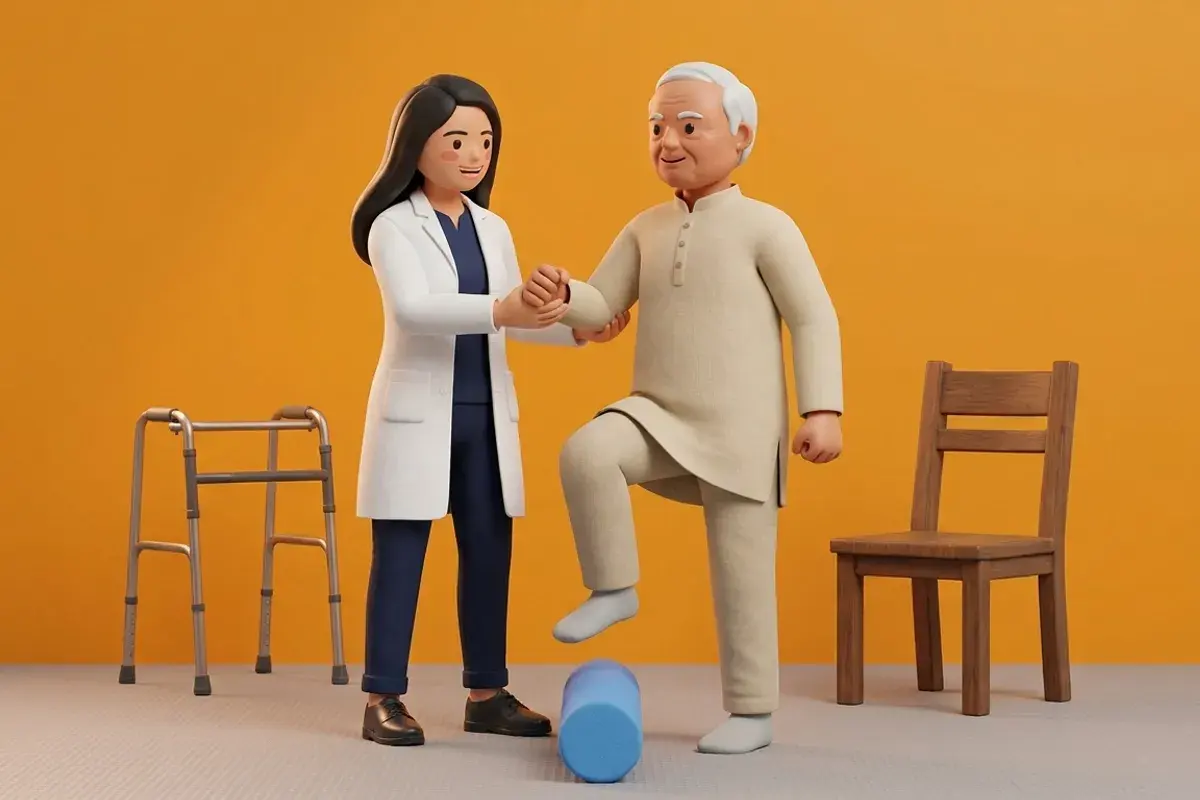
Rehabilitation prioritizes closed kinetic chain exercises that train the hips and knees simultaneously while the lumbar spine remains in neutral. Therapy begins with supported supine bridging, teaching the patient to squeeze the gluteal muscles to lift the pelvis without arching the lower back. Clinicians then progress to the chair sit-to-stand protocol: the patient begins on a raised, firm chair, hinges forward from the hips with a flat back, and pushes firmly through the heels to stand upright, ensuring the knees track over the toes. As lower limb strength and endurance improve over weeks, the chair height is gradually lowered toward standard domestic heights. Wall-supported shallow squats and mini-lunges are integrated to build eccentric quadriceps control, ensuring the patient can lower themselves gently to low chairs or commodes without dropping abruptly.
Supported Wall Squat with Isometric Gluteal Squeeze
Objective: Build quadriceps and gluteal endurance while keeping the lumbar spine completely protected in a neutral, supported alignment
- 1Stand with your back resting flat against a smooth wall, positioning your feet shoulder-width apart approximately 18 to 24 inches away from the wall.
- 2Ensure your entire spine and pelvis rest in comfortable, even contact with the wall, with your arms relaxed at your sides.
- 3Inhale gently, and as you exhale, engage your lower abdomen and slide slowly down the wall until your knees bend to a comfortable 30 to 45 degree angle.
- 4Hold this shallow wall squat for 8 to 10 seconds, actively squeezing your gluteal muscles and pressing firmly through your heels.
- 5Slide smoothly back up the wall to full standing height, maintaining continuous, relaxed breathing without holding your breath.
| Biomechanical Parameter | Spine-Dominant Transfer (Compensatory) | Hip-Dominant Transfer (Gluteal Powered) |
|---|---|---|
| Primary Prime Movers | Lumbar erector spinae and hamstrings pull upper body upright from flexed position | Gluteus maximus and quadriceps femoris generate powerful vertical extensor drive |
| Lumbar Spinal Alignment | Severe lumbar flexion and flattening of lordosis, loading posterior implants | Lumbar spine remains locked in safe, neutral lordosis throughout movement |
| Shear Force on Hardware | High anterior shear (>2,500 N) across pedicle screws, risking construct micro-motion | Minimal shear forces; compressive loads absorbed safely by femur and hip joints |
| Domestic Transfer Safety | Frequent catches, instability, and fear of falling when rising from low furniture | Smooth, confident, independent transfers across all Indian domestic furnishings |
If you experience sudden giving way or buckling of your knee while standing or walking, accompanied by numbness in the front of your thigh, do not push through exercises. This may indicate acute compression of the L3 or L4 nerve root (femoral nerve supply). Cease weight-bearing exercises and contact your spine specialist for an immediate neurological evaluation.
Frequently Asked Questions
Why do my thighs burn so quickly when doing these exercises after back surgery?
Quadriceps burning is completely normal and indicates that your thigh muscles are working hard to rebuild strength. After weeks or months of reduced activity following surgery, your leg muscles lose endurance quickly. As you practice these exercises daily, your thighs will grow stronger, and everyday transfers will feel much easier.
Do I need a doctor referral to see a post-spinal surgery physiotherapist on BookPhysio.in?
BookPhysio.in does not require a doctor referral. Under the National Commission for Allied and Healthcare Professions (NCAHP) Act 2021, patients across India enjoy direct access to autonomous registered physiotherapists. Through BookPhysio.in, you connect directly with verified clinicians and pay per session with transparent fees, completely free from advance package commitments, commission markups, or platform subscription charges.
Related condition guides



Related recovery guides & articles
BookPhysio.in Editorial Team
The BookPhysio.in editorial team writes and maintains this content, checking it against reliable clinical sources. Content follows our medical review policy: general information only, and no page claims a clinical review until a named registered physiotherapist has signed it off.
Read our medical review policy