
Hip Joint Long-Axis and Lateral Traction: Evidence-Based Manual Therapy and Safety Contraindications
In short
Explore the evidence-based mechanisms of manual hip joint traction for reducing intra-articular pressure, stretching tight capsules, and easing osteoarthritis.
In this guide (4 sections)
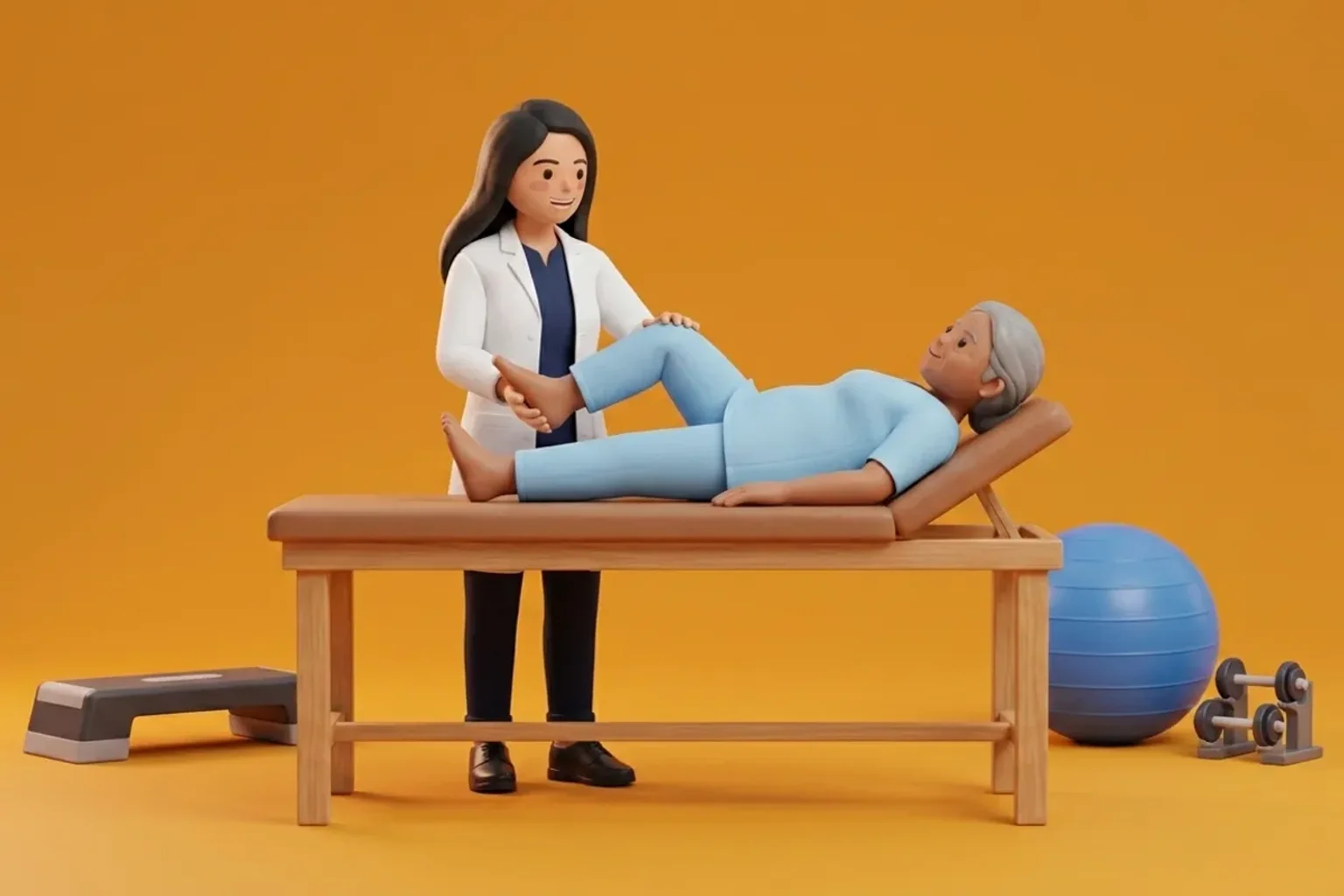
Manual joint traction represents a foundational modality of orthopedic manual physiotherapy for hip joint disorders, widely utilized to alleviate pain and restore mobility in patients with hip osteoarthritis, capsular fibrosis, and femoroacetabular impingement. By applying an external tensile force along the anatomical axis of the femur or perpendicular to the acetabular plane, the clinician gently separates the femoral head from the acetabular socket. This mechanical separation, known as articular distraction or decoaptation, directly alters intra-articular physical dynamics. In a degenerative or inflamed hip, intra-articular pressure is significantly elevated, and contracted capsular tissues restrict physiological synovial fluid circulation. Sustained or oscillatory manual traction drops intra-articular pressure, creates negative pressure that draws synovial fluid across avascular articular cartilage, and stretches shortened capsular ligaments without producing abrasive friction. When delivered appropriately, traction provides rapid, clinically meaningful pain relief.
Relieving Capsular Tightness from Indian Floor Sitting and Low Stools
The need for capsular decompression is particularly pronounced among Indian patients due to the high biomechanical demands of domestic daily life. Ingrained practices such as sitting cross-legged on floor mats for meals, squatting on low wooden stools (patla) for household cleaning, or crouching during traditional cooking rituals place the hip joint into extreme flexion, adduction, and internal or external rotation. Over time, individuals with early degenerative joint disease develop dense capsular contractures, particularly along the inferior and posterior joint capsule. When these individuals attempt to stand up after prolonged floor sitting, the contracted capsule wedges the femoral head tightly against the acetabular rim, causing sharp groin pain and an inability to stand fully upright. Applying targeted manual traction in the physiotherapy clinic releases this capsular stiffness, decompressing the joint and enabling patients to resume valued cultural routines with significantly greater ease.
Decoaptation Mechanics, Fluid Pressure Reductions, and Mechanoreceptor Gating
The therapeutic mechanisms underlying manual hip traction operate across mechanical, biochemical, and neurophysiological domains. Mechanically, distraction forces ranging from fifteen to twenty-five kilograms elongate tightened capsuloligamentous structures, particularly the robust iliofemoral and ischiofemoral ligaments, restoring the joint's loose-packed resting capacity. Cross-sectional studies using diagnostic ultrasound and fluoroscopy confirm that manual traction achieves measurable joint space widening of one to two millimeters. This mechanical separation causes a steep drop in intra-articular hydrostatic pressure, facilitating the transudation of oxygenated synovial fluid into starved chondrocytes within the articular cartilage. Neurophysiologically, the gentle, sustained stretch selectively stimulates low-threshold type I (Ruffini) and type II (Pacinian) mechanoreceptors located within the fibrous joint capsule and synovial membrane. These mechanoreceptors send high-velocity afferent signals to the dorsal horn of the spinal cord, closing the presynaptic gate to incoming nociceptive pain signals.
Clinical Technique Protocols: Long-Axis Distraction and Belt-Assisted Lateral Pulls
Manual hip traction is performed using two primary clinical vectors: long-axis distraction and lateral distraction. For long-axis traction, the patient lies supine while the therapist places the hip in its open-packed resting position (approximately thirty degrees of flexion, thirty degrees of abduction, and slight external rotation). The therapist grasps the distal leg above the malleoli or uses a padded harness around the proximal ankle, applying a smooth, sustained Grade III distraction for thirty to sixty seconds across three to five sets. For patients with coexisting knee osteoarthritis or ligamentous laxity, long-axis ankle pulling is strictly avoided; instead, the clinician utilizes a padded mobilization belt looped high around the patient's proximal inner thigh to apply lateral distraction at ninety degrees to the femoral shaft. To empower self-management, patients are instructed in home self-traction techniques using heavy resistance bands anchored to unmoving structures.
Home-Based Supine Hip Joint Decompression with Elastic Resistance Band
Objective: Apply gentle, home-based long-axis joint traction to decompress the hip capsule and relieve resting stiffness
- 1Secure a heavy looped mobility band around a solid, unmoving anchor point such as a heavy bedpost or closed door anchor near floor level.
- 2Lie flat on your back on a comfortable floor mat, positioning your body so your feet are pointing toward the anchor point.
- 3Step your affected leg into the loop, positioning the wide band securely around the top of your ankle or just below your knee crease.
- 4Scoot your body backward along the floor away from the anchor until you feel a firm, comfortable tensile pull along your entire leg.
- 5Completely relax all the muscles in your leg, allowing the band to gently pull your hip joint for two to three minutes while practicing calm breathing.
| Traction Modality | Clinical Technique & Vector | Primary Indications | Absolute Contraindications |
|---|---|---|---|
| Long-Axis Distraction (Loose-Packed) | Tensile pull through distal tibia in 30° flexion and 30° abduction | General hip OA, morning joint stiffness, capsular contracture | Coexisting knee ligament instability, total knee replacement, severe osteoporosis |
| Lateral Belt Traction (90-Degree) | Padded mobilization belt high in groin pulls laterally perpendicular to femur | Irritable FAI, anterosuperior labral tears, coexisting knee pathology | Acute groin infection, femoral hernia, unhealed pelvic fractures |
| Home Self-Traction (Elastic Band) | Anchored elastic resistance band provides low-force sustained distraction | Daily maintenance between clinical visits, chronic degenerative OA | Inability to transfer safely to and from the floor, severe balance deficits |
High-force manual traction is strictly contraindicated in patients with confirmed avascular necrosis (due to risk of subchondral collapse), hip joint hypermobility or Ehlers-Danlos syndrome, acute inflammatory arthritis flares, or active deep vein thrombosis in the lower extremity.
Frequently Asked Questions
Can hip traction make my hip joint loose or unstable?
No. When performed by a qualified physiotherapist, manual traction separates the hip joint by only one or two millimeters. This tiny amount of movement is plenty to relieve pressure on your cartilage and stretch tight capsular fibers, but it is completely safe and will not stretch your strong hip ligaments to the point of causing joint looseness or instability.
Do I need a doctor referral to see a hip physiotherapist on BookPhysio.in?
BookPhysio.in does not require a doctor referral. Under the National Commission for Allied and Healthcare Professions (NCAHP) Act 2021, patients across India enjoy direct access to autonomous registered physiotherapists. Through BookPhysio.in, you connect directly with verified clinicians and pay per session with transparent fees, completely free from advance package commitments, commission markups, or platform subscription charges.
Related condition guides



Related recovery guides & articles
BookPhysio.in Editorial Team
The BookPhysio.in editorial team writes and maintains this content, checking it against reliable clinical sources. Content follows our medical review policy: general information only, and no page claims a clinical review until a named registered physiotherapist has signed it off.
Read our medical review policy