
Home Breathing Exercise Compliance: Daily Incentive Spirometer Logs
In short
Sustain post-discharge respiratory recovery with daily spirometry logs. Learn habit formation, volume benchmarks, and family accountability strategies.
In this guide (2 sections)
While intensive respiratory physiotherapy is universally provided during acute hospital stays, pulmonary vulnerability does not cease at hospital discharge. Following major abdominal, thoracic, and thoracoabdominal operations, functional residual capacity and vital capacity remain depressed for four to six weeks. Without structured home routines and accountability systems, patient compliance with breathing exercises drops by over seventy percent within the first forty-eight hours at home, leading to delayed secondary atelectasis and avoidable readmissions. Establishing structured daily home incentive spirometer logs and family-supported exercise schedules preserves acute rehabilitation gains and ensures complete pulmonary restoration.
Surgical Pathophysiology and Thoracoabdominal Mechanics
The physiological justification for continuing incentive spirometry at home centers on the slow kinetics of alveolar remodeling and surfactant regeneration. General anesthesia, surgical trauma, and weeks of shallow breathing disrupt the synthesis and recycling of pulmonary surfactant by type II alveolar pneumocytes. Surfactant has a biological half-life of twenty-four to forty-eight hours; without periodic deep lung inflation (sigh volumes of three to four times resting tidal volume), surfactant molecules are squeezed out of the alveolar lining. As surface tension rises, critical closing pressure increases, causing progressive microvascular atelectasis in dependent lung zones. Performing ten sustained maximal inspirations with an end-inspiratory hold every hour provides the mechanical stretch needed to stimulate surfactant secretion, recruit collateral ventilation, and maintain alveolar patency throughout the convalescent phase.
| Clinical Domain | Compliant Patient (Daily Logging) | Non-Compliant Patient (No Home Exercises) | Clinical Impact | |
|---|---|---|---|---|
| Inspiratory Capacity | Steadily climbs to > 85% of baseline by Week 3 | Remains plateaued at 50-60% of baseline | Faster restoration of normal lung volume and endurance | |
| Basal Crackles & Secretions | Completely clear lung fields by Day 10 | Persistent dullness and late inspiratory crackles | Non-compliance predisposes to hypostatic pneumonia | |
| Post-Discharge Readmission | Low 30-day respiratory readmission (< 2%) | High 30-day readmission risk (8-12%) | Direct protection against delayed pulmonary failure | |
| Exertional Breathlessness | Borg CR10 score < 2 during household walking | Persistent dyspnea (Borg 4-5) with simple tasks | Enhanced confidence and independence in daily activities |
Structuring the Daily Home Log and Habit Anchoring Protocol
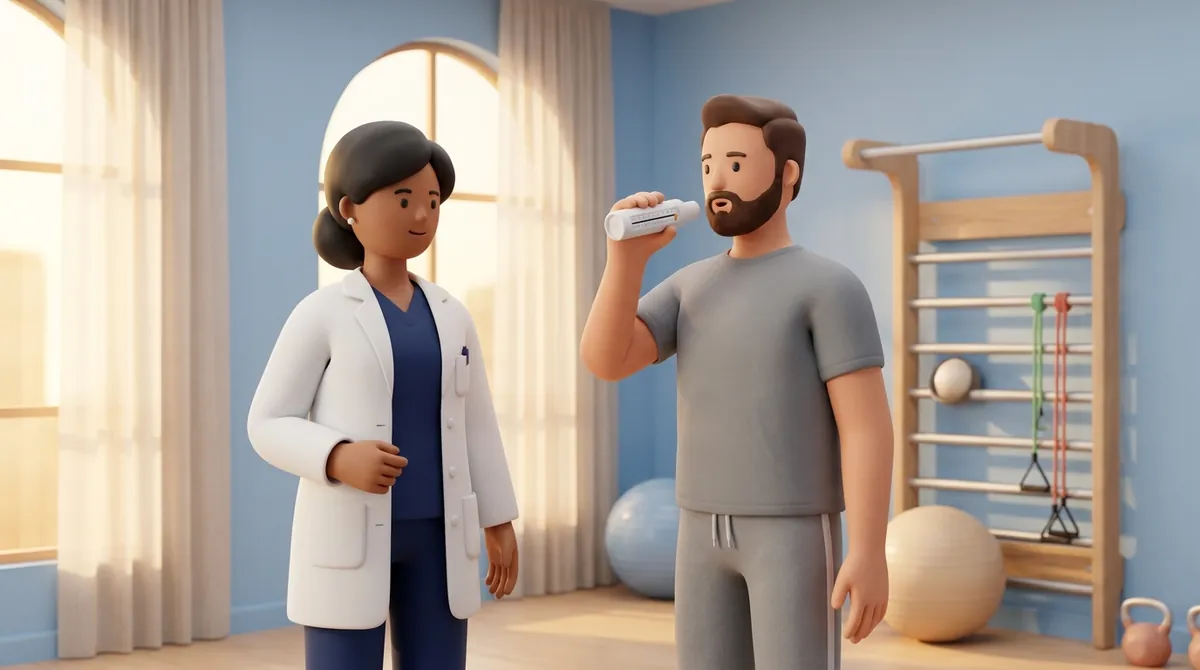
Before leaving the hospital, the patient is provided with a printed 30-day incentive spirometry tracking sheet. The protocol mandates performing ten slow breaths on the volume-oriented spirometer every waking hour (targeting at least eight sessions daily). To establish robust behavioral compliance, sessions are anchored to established daily habits: performing a set immediately after waking, before each main meal, mid-afternoon, and before bedtime. The highest achieved volume in milliliters is recorded in the daily log alongside resting pulse oximetry.
Five-Step Structured Home Incentive Spirometry Sequence
Objective: Execute sustained maximal inspiration and record objective volume progress using the home spirometer log.
- 1Sit completely upright in a supportive chair, placing the volume incentive spirometer on a stable table at eye level.
- 2Breathe out completely and gently through the mouth until lungs feel empty.
- 3Place the mouthpiece firmly between the teeth and seal lips tightly around it.
- 4Inhale slowly and steadily, keeping the yellow flow indicator ball centered in the 'Good' zone.
- 5Raise the piston to your target volume mark, hold for 3 to 4 seconds, remove mouthpiece, and exhale passively.
Engaging Family Accountability and Digital Tracking in India
In Indian family environments, family caregivers are exceptionally dedicated to patient care. A designated family member (such as a spouse or adult child) can act as the home recovery coordinator, reviewing the daily spirometry log each evening. Pinning the chart near the dining table or kitchen refrigerator ensures visibility. For tech-savvy households, taking a daily smartphone photo of the log and sharing it with the home physiotherapist reinforces consistency and progress.
Long-Term Recovery Trajectory and Milestones
Home incentive spirometer logging is typically maintained for three to four weeks post-discharge until the patient regularly achieves greater than eighty-five percent of their predicted baseline volume and can walk thirty minutes continuously without breathlessness.
Alert your clinical team if the daily achieved spirometry volume drops by more than twenty percent over two consecutive days, or if accompanied by fever, productive yellow-green cough, or SpO2 falling below 92 percent.
How many times a day do I really need to use the breathing device once I am at home?
You should use your incentive spirometer for ten deep breaths every hour during the daytime, aiming for at least eight sessions a day. Consistency is what keeps your lung sacs popped open and prevents pneumonia while your body completes its internal healing.
Do I need a doctor referral to consult a home physiotherapist in India?
Under the National Commission for Allied and Healthcare Professions (NCAHP) Act 2021, patients in India enjoy direct access to registered physiotherapists without requiring a mandatory doctor referral. At BookPhysio.in, you consult verified physiotherapists and pay directly per session without hidden fees or platform commissions.
Related condition guides



Related recovery guides & articles
BookPhysio.in Editorial Team
The BookPhysio.in editorial team writes and maintains this content, checking it against reliable clinical sources. Content follows our medical review policy: general information only, and no page claims a clinical review until a named registered physiotherapist has signed it off.
Read our medical review policy