
Hyperacute Stroke Time-Is-Brain Physiotherapy Assessment in Stroke Units
In short
Hyperacute stroke assessment within dedicated stroke units. Neuromotor baseline scoring, penumbral perfusion protection, and early physiological stabilization.
In this guide (2 sections)
The hyperacute phase of ischemic stroke demands rapid, structured clinical appraisal where every minute preserved salvages millions of cortical neurons. Within organized stroke care units, the physiotherapist works closely with emergency neurology teams to establish an accurate motor and functional baseline. Initial evaluation focuses on distinguishing reversible penumbral deficits from dense core infarction while ensuring systemic hemodynamics remain strictly within prescribed neuroprotective targets.
Penumbral Pathophysiology and Baseline Neuromotor Screening
Ischemic stroke produces a central core of unsalvageable necrotic brain tissue surrounded by an ischemic penumbra: electrically silent but structurally viable parenchyma supported by collateral microvessels. Excessive physical exertion or uncalibrated head-up positioning in the initial hours can precipitate critical cerebral hypoperfusion, transforming viable penumbra into irreversible necrosis. Neuromotor screening systematically documents voluntary movement, primitive synergy emergence, tone, cranial nerve integrity, and trunk stability without exhausting patient cardiovascular reserves.
| Assessment Domain | Clinical Test Battery | Normal Target Range | Physiotherapy Action Threshold | |
|---|---|---|---|---|
| Motor Drift & Power | Pronator drift test and MRC muscle grading | Grade 5 bilateral symmetrical force | Grade 0 to 2 indicates high risk of dependent limb traction injury | |
| Trunk Stability | Trunk Control Test (rolling, balance, sitting) | Score 100 on standard 4-item battery | Score below 50 mandates two-person supported handling | |
| Cerebral Perfusion | Continuous arterial blood pressure and mean arterial pressure | MAP 85 to 110 mmHg or as prescribed | Decline greater than 20 mmHg halts upright verticalization | |
| Airway & Respiration | Pulse oximetry, respiratory rate, cough efficacy | SpO2 above 95 percent on room air, RR 12-20 | Weak voluntary cough requires immediate suction readiness |
Stepwise Bedside Screening and Initial Mobilization Readiness Protocol
The initial evaluation begins with passive observational inspection of limb posturing and respiratory pattern, followed by gentle active-assisted range of motion and segmental trunk assessment. Clinicians confirm hemodynamic stability over a consecutive 15-minute resting baseline before initiating gentle bedside positional adjustments.
Bedside Scapular Protraction and Passive Glenohumeral Alignment Drill
Objective: Maintain shoulder joint congruency and prevent traction on denervated brachial plexus structures during hyperacute bed rest.
- 1Position the patient in supine with the head of the bed angled between 15 and 30 degrees according to medical clearance.
- 2Support the flaccid upper limb at the elbow and wrist, avoiding any direct tensile traction on the wrist joint.
- 3Gently glide the scapula forward into protraction, preventing shoulder retraction and downward rotation.
- 4Slowly elevate the humerus in the scapular plane up to 60 degrees while gently cueing the patient to breathe steadily.
- 5Rest the paretic arm on a contoured pillow or foam support in slight abduction and external rotation.
Indian Hospital-to-Home Transition and Caregiver Involvement
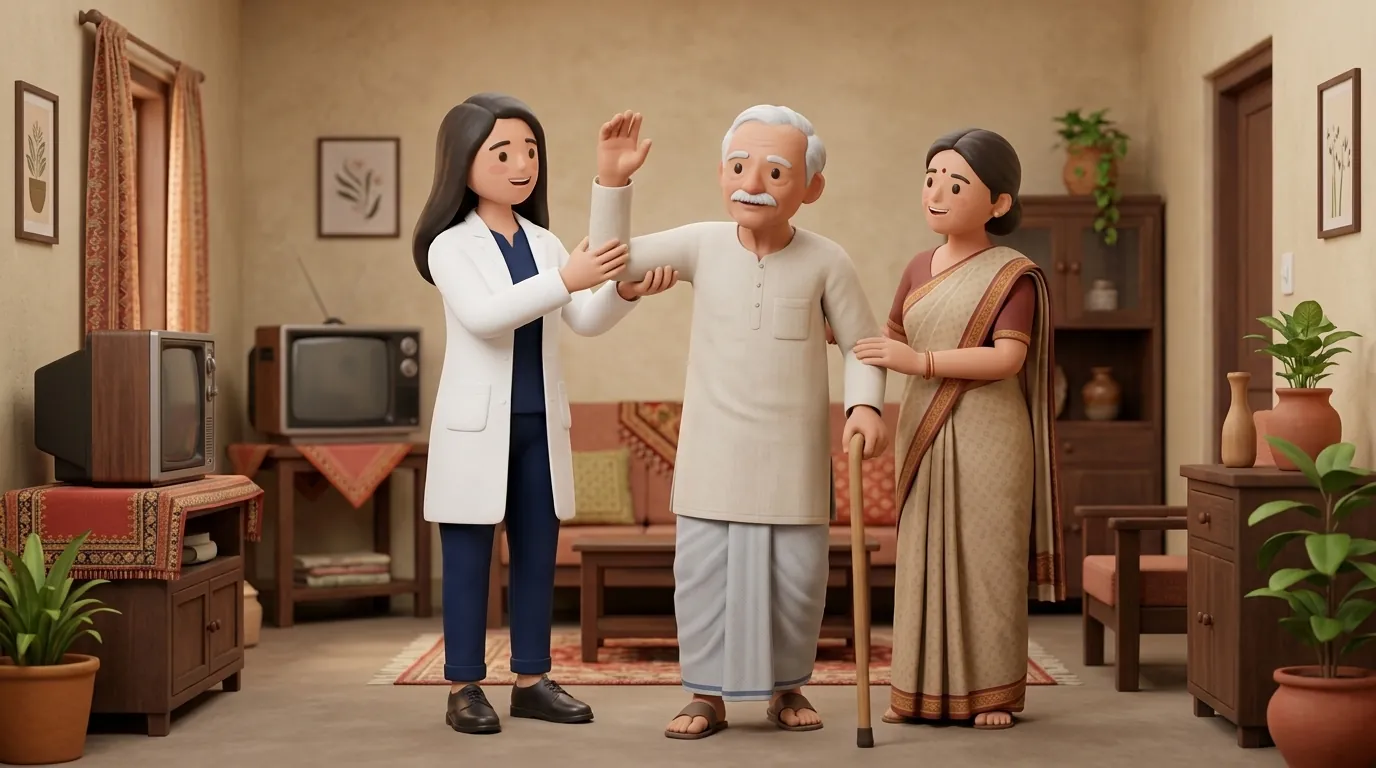
In Indian stroke care wards, family attendants play an active bedside role from day one. Educating family members on never pulling the weak arm during positional adjustments prevents catastrophic shoulder dislocation. As home discharge approaches, families must evaluate domestic furniture: replacing low rope cots (charpais) or soft cotton floor mattresses with firm, stable bed frames elevated between 45 and 50 centimeters simplifies safe bedside care.
Clinical Trajectory and Surveillance During the First Week
The initial seven days dictate long-term functional recovery potential. Neurological status can fluctuate rapidly due to reperfusion dynamics, secondary edema, or hemorrhagic transformation. Daily standardized rescreening ensures exercise intensity matches biological recovery without compromising cerebral perfusion.
- Serial Neurological Tracking: Perform daily motor scores to detect subtle improvements or sudden deterioration that warrants immediate neuro-imaging.
- Collateral Perfusion Maintenance: Avoid sudden orthostatic drops by elevating the trunk gradually over 10 to 15 minutes before any seated activity.
- Family Caregiver Empowerment: Train family attendants in body mechanics, using slide sheets or draw sheets rather than manual limb pulling.
Immediately halt assessment and notify the stroke neurology team if the patient exhibits sudden speech loss, acute facial droop worsening, pupillary asymmetry, or a drop in consciousness level.
How soon after stroke symptom onset should physiotherapy assessment begin?
Initial physiotherapy assessment occurs within 24 hours of stroke unit admission once medical stability is confirmed by the neurology team. The focus is on gentle baseline motor documentation, respiratory protection, and safe bed positioning rather than strenuous out-of-bed verticalization.
Why must sudden sitting up be avoided in hyperacute stroke?
Cerebral autoregulation is profoundly impaired in ischemic brain tissue. Abrupt upright positioning can cause an acute drop in cerebral perfusion pressure across collateral vessels, worsening penumbral ischemia and causing neurological deterioration.
Do I need a doctor referral to begin home neuro-physiotherapy in India?
Under the National Commission for Allied and Healthcare Professions (NCAHP) Act 2021, patients in India enjoy direct access to registered physiotherapists without requiring a mandatory doctor referral. At BookPhysio.in, you consult verified physiotherapists and pay directly per session without hidden fees or platform commissions.
Related condition guides

Related recovery guides & articles
BookPhysio.in Editorial Team
The BookPhysio.in editorial team writes and maintains this content, checking it against reliable clinical sources. Content follows our medical review policy: general information only, and no page claims a clinical review until a named registered physiotherapist has signed it off.
Read our medical review policy