
Indian Traditional Squatting and Achilles Tendinopathy: Biomechanics and Ergonomic Modifications
In short
Examine how traditional full squatting and Indian toilet postures create severe Achilles compressive shear, and discover practical ergonomic modifications.

In this guide (4 sections)
Deep squatting is deeply embedded in the cultural, religious, and daily domestic fabric of Indian life. From performing traditional household tasks to practicing classical yoga asanas (such as Malasana or Utkatasana) and utilizing Indian-style squat toilets, full knee and ankle flexion is an everyday functional requirement for millions of people. While full-depth squatting demonstrates impressive joint mobility in healthy individuals, it imposes extreme biomechanical stress upon the Achilles tendon, particularly in patients suffering from insertional tendinopathy, retrocalcaneal bursitis, or Haglund deformity. A complete, flat-heeled squat requires between thirty and thirty-five degrees of closed-chain talocrural dorsiflexion. At this extreme joint angle, the Achilles tendon experiences massive tensile elongation combined with intense compressive impingement against the calcaneal tuberosity, creating severe tissue shear that frequently sabotages rehabilitation.
Domestic Floor Chores, Indian Toilets, and Puja Ritual Challenges
In countless households across both rural and urban India, daily domestic chores are performed while maintaining prolonged deep squatting postures. Sweeping and mopping floors (jhadu-pocha), washing clothes by hand, cleaning cooking utensils, or chopping vegetables on floorboards (boti) requires individuals to remain in deep squats for thirty to sixty minutes consecutively. Furthermore, approximately fifty to sixty percent of Indian homes utilize traditional floor-level squat toilets, which demand an abrupt, high-load full squat multiple times daily. Religious ceremonies and puja rituals also require sitting in deep squats or rising repeatedly from floor level. For an individual with an inflamed Achilles insertion, each descent into a full squat forcefully wedges the inflamed tendon and retrocalcaneal bursa against the rigid heel bone under full bodyweight. Patients describe severe, throbbing pain that makes rising from a squat nearly impossible without pushing off furniture.
Dorsiflexion Arthrokinematics, Compressive Shear, and Enthesophyte Formation
The pathomechanics of full squatting reveal why the maneuver is so hazardous in insertional Achilles pathology. Under normal conditions, closed-chain dorsiflexion involves anterior roll of the tibia over the talus coupled with posterior talar gliding. Once dorsiflexion exceeds twenty degrees, the distal Achilles tendon is pulled tightly across the posterosuperior aspect of the calcaneus, transforming the biological mechanical vector from longitudinal tension into localized perpendicular compression. In midportion tendinopathy, high tensile forces can provoke microdamage if calf strength is deficient; in insertional tendinopathy, the compressive contact pressure rises exponentially. Histological studies confirm that chronic compressive shear at the enthesis induces tenocyte chondroid metaplasia, synthesis of large hydrophilic proteoglycans, and progressive fibrocartilaginous calcification. Over time, traction and compression spurring (enthesophytes) develop within the tendon insertion, worsening structural impingement during every subsequent squat and provoking persistent reactive flares that severely limit daily mobility.
Ergonomic Floor Modifications, Heel Wedges, and Commode Adaptations
Managing Achilles tendinopathy in individuals who routinely perform deep squatting does not require abandoning cultural practices permanently, but demands strategic ergonomic modification during the active healing phase. The foremost domestic intervention is eliminating end-range dorsiflexion. For patients utilizing Indian squat toilets, installing a temporary elevated commode chair or Western toilet conversion frame eliminates the deep squat requirement entirely. When performing floor-level household chores, patients should utilize a low wooden stool (patla or morha) measuring six to eight inches in height, which supports the ischial tuberosities and reduces ankle dorsiflexion from thirty-five degrees down to a safe fifteen degrees. During religious ceremonies or yoga practice, placing a firm wooden wedge or rolled yoga mat beneath the heels maintains the ankles in slight plantarflexion, decompressing the Achilles insertion while allowing comfortable, stable kneeling and sitting throughout traditional religious ceremonies, social gatherings, and family events completely free from posterior heel pain.
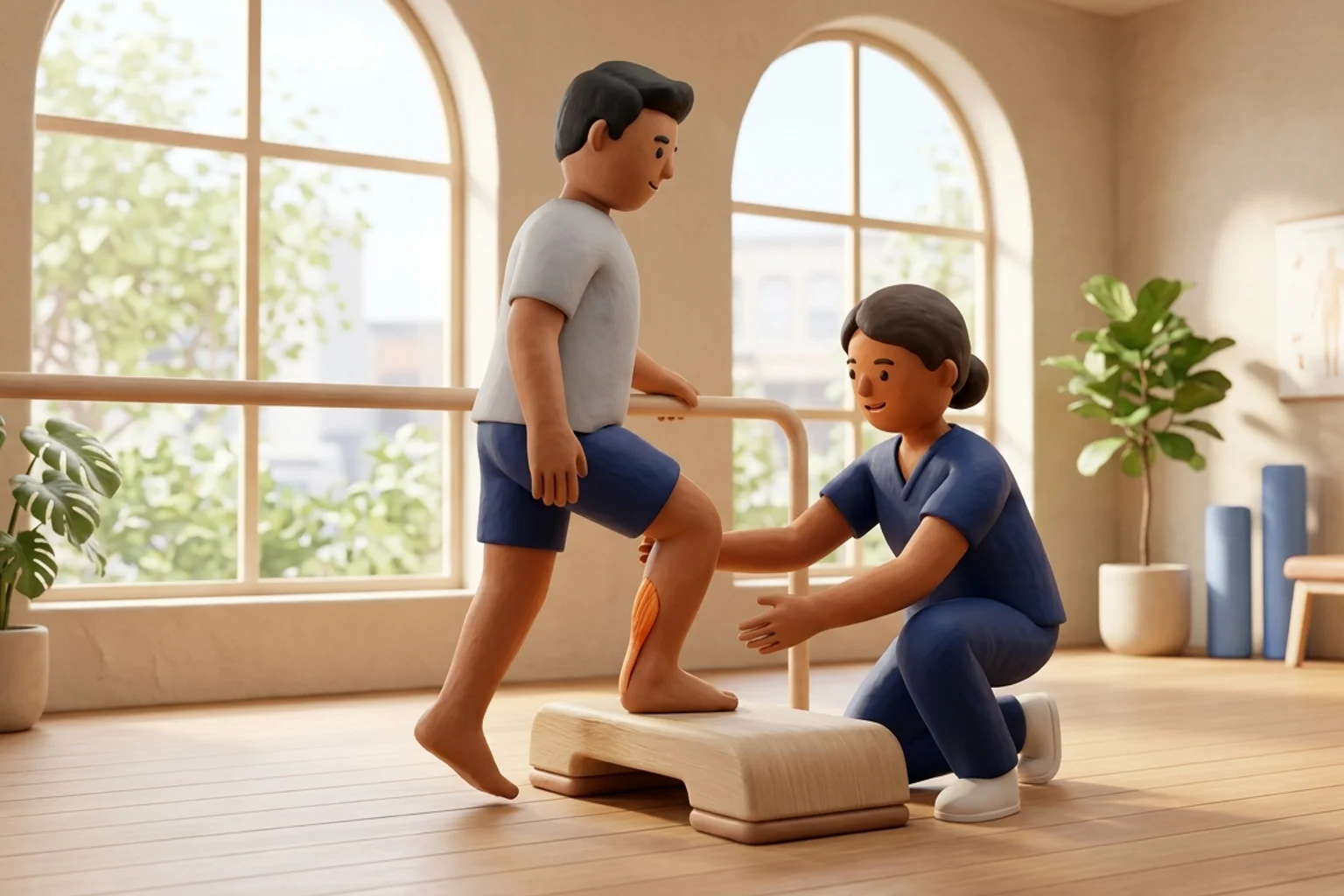
Heel-Elevated Supported Squat to Bench with Progressive Depth Control
Objective: Rebuild lower extremity kinetic chain strength while strictly protecting the Achilles tendon from dorsiflexion impingement
- 1Position a sturdy chair or bench behind you, and place a 2-inch firm wooden block or weight plate beneath both heels.
- 2Stand with feet shoulder-width apart, resting your heels securely on the elevated block with toes flat on the floor.
- 3Extend your arms forward for balance, inhale deeply, and slowly sit your hips backward toward the bench over three seconds.
- 4Lightly touch your buttocks to the bench without relaxing your muscular tension, ensuring your knees track in line with your second toes.
- 5Drive firmly through your midfoot to stand back up to the starting position over two seconds, exhaling smoothly.
| Biomechanical Parameter | Flat-Foot Traditional Squat | Heel-Elevated Squat (2-Inch Block) | Low Stool (Patla) Seating |
|---|---|---|---|
| Talocrural Dorsiflexion Angle | 30 to 35 degrees of extreme closed-chain dorsiflexion | 12 to 15 degrees of mild, safe dorsiflexion | Less than 10 degrees of neutral ankle alignment |
| Entheseal Compressive Force | Maximal crushing force against calcaneal tuberosity | Minimal to zero bone-on-tendon compressive contact | Completely eliminated; retrocalcaneal space remains open |
| Tibial Translation Demand | Extreme forward translation stressing anterior ankle capsule | Moderate forward translation centered over midfoot | Negligible tibial translation; ischial support |
| Suitability for Insertional Pathology | Strictly contraindicated during active tendinopathy | Safe for progressive strengthening and conditioning | Ideal for performing long-duration domestic chores |
While deep squatting is universally hazardous in insertional Achilles tendinopathy and retrocalcaneal bursitis, patients with pure midportion tendinopathy can often tolerate squatting provided it is performed slowly and within pain-free boundaries. Midportion lesions do not suffer from direct bone impingement; their limitation is tensile strain. If a patient with midportion tendinopathy experiences no pain during or 24 hours after squatting, gradual progression is permitted under physiotherapy monitoring.
Frequently Asked Questions
Can I continue using an Indian-style toilet while recovering from Achilles tendinopathy?
Using a traditional Indian floor-level squat toilet is strongly discouraged during the active healing phase of insertional Achilles tendinopathy. Squatting fully with your heels flat forces your ankle into more than thirty degrees of dorsiflexion, which crushes your inflamed tendon against your heel bone under full bodyweight. If you do not have a Western toilet in your home, purchase an affordable portable raised commode chair that fits directly over the Indian toilet pan. This allows you to sit at normal chair height, completely protecting your Achilles tendon from damaging compressive stress.
Do I need a doctor referral to treat Achilles tendinopathy on BookPhysio.in?
BookPhysio.in does not require a doctor referral. Under the National Commission for Allied and Healthcare Professions (NCAHP) Act 2021, patients across India enjoy direct access to autonomous registered physiotherapists. Through BookPhysio.in, you connect directly with verified clinicians and pay per session with transparent fees, completely free from advance package commitments, commission markups, or platform subscription charges.
Related condition guides
Related recovery guides & articles
BookPhysio.in Editorial Team
The BookPhysio.in editorial team writes and maintains this content, checking it against reliable clinical sources. Content follows our medical review policy: general information only, and no page claims a clinical review until a named registered physiotherapist has signed it off.
Read our medical review policy