
Genu Recurvatum Following Revision Knee Arthroplasty: Eccentric Quadriceps Retraining
In short
Genu recurvatum (knee hyperextension) following revision knee arthroplasty threatens posterior capsule integrity and accelerates prosthetic post wear. Learn the biomechanical drivers, orthotic management, and eccentric quadriceps exercises required to restore stable sagittal stance.
In this guide (6 sections)
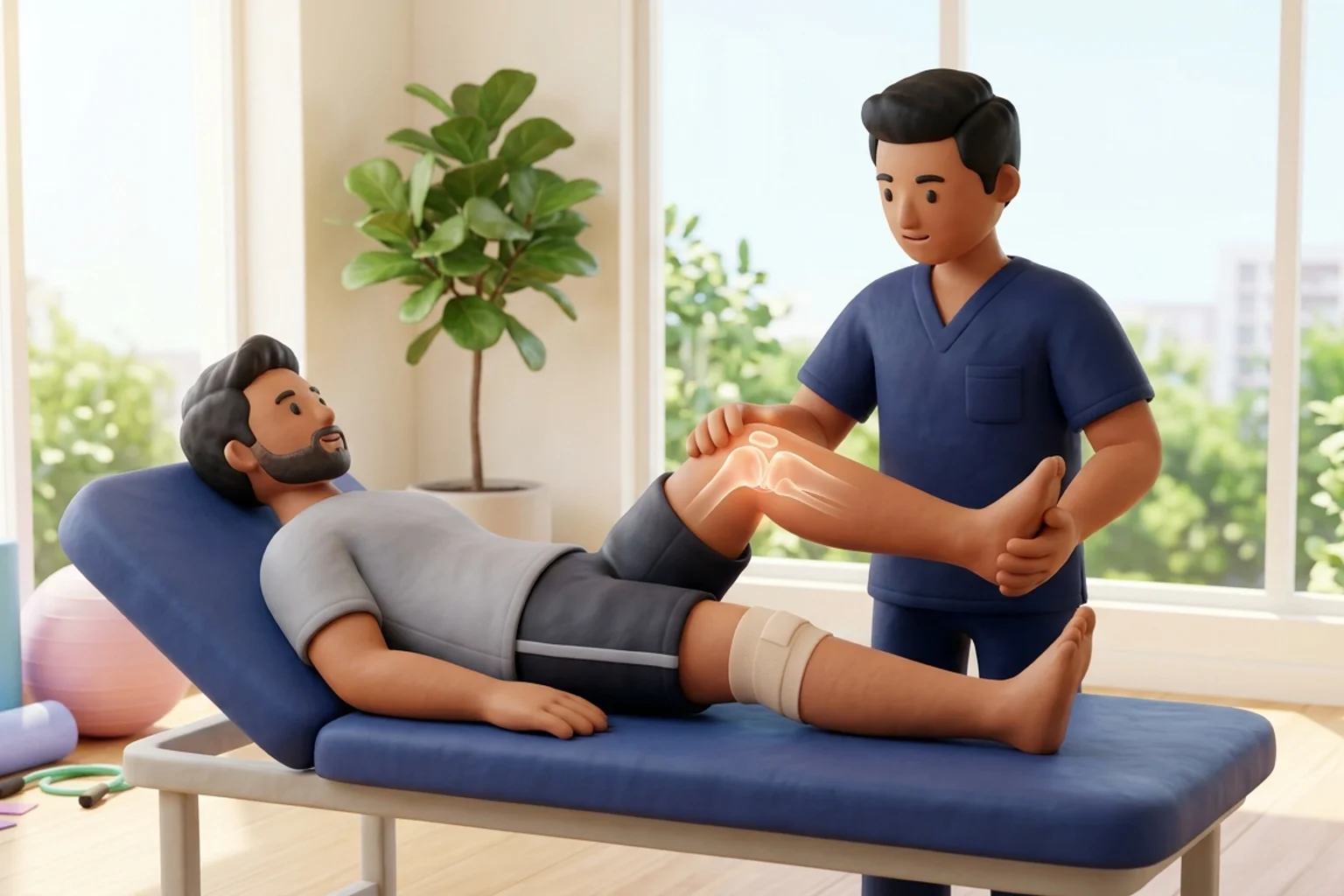
Genu recurvatum, or pathological knee hyperextension beyond neutral zero degrees, is a challenging sagittal plane complication encountered following revision total knee arthroplasty. It frequently results from extensive posterior capsular release during previous surgeries, distal femoral bone over-resection, undersized femoral components, or severe quadriceps and gastrocnemius muscle weakness. In the normal gait cycle, the knee absorbs ground reaction forces by flexing 10 to 15 degrees during loading response. When recurvatum occurs, the knee snaps backward into hyperextension upon heel strike, locking against the posterior capsule and transferring destructive shear forces directly onto the prosthetic constraint post and fixation stems. Physiotherapy must focus on restoring eccentric quadriceps control, dynamic hamstring co-contraction, and proprioceptive stance awareness.
Domestic and Cultural Indian Realities
Living with genu recurvatum in an Indian household presents significant balance and joint preservation challenges. Walking barefoot on smooth marble or polished vitrified tiles removes heel cushioning, increasing the impact shock that triggers uncontrolled backward knee locking. Patients must wear supportive indoor footwear with a slight heel raise (approximately 1 to 1.5 cm) to encourage early knee flexion during stance. Floor sitting in sukhasana and squatting are strictly contraindicated, as deep flexion followed by forceful unassisted standing overstretches the posterior capsule. Bathrooms must be equipped with an elevated western commode at 20 inches height with solid support grab rails. In narrow internal stairways, patients must use handrails and descend with a step-to pattern to avoid sudden backward joint snaps.
Clinical Biomechanics and Reconstructive Fixation
The biomechanical hazard of genu recurvatum in a revision knee prosthesis is anterior edge loading and posterior constraint wear. When the knee hyperextends beyond neutral, the anterior lip of the polyethylene insert pinches against the femoral component, while the posterior capsule and popliteal structures undergo excessive tensile stretching. Over thousands of gait cycles, this repetitive hyperextension loading loosens the tibial baseplate and damages the central constraint post. Restoring neuromuscular control requires shifting reliance away from passive structural locking toward active muscular braking. Eccentric quadriceps strengthening trains the knee extensors to absorb ground reaction loads in slight flexion, while hamstring strengthening prevents uncontrolled terminal knee extension.
Rehabilitation Assessment and Functional Progression
Clinical assessment measures passive hyperextension in supine using a goniometer, dynamic recurvatum during stance phase, and quadriceps lag. An extension-stop hinged knee brace or Swedish knee cage orthosis is often prescribed initially to physically block hyperextension beyond zero degrees during community ambulation. Gait retraining with mirror biofeedback teaches the patient to maintain a soft knee (2 to 5 degrees of deliberate flexion) throughout the midstance phase. Weight-bearing exercises transition from bilateral support to single-leg stance drills as eccentric control develops.
Targeted Rehabilitation and Joint Preservation Exercises
Rehabilitation prioritises eccentric quadriceps training, closed-chain hamstring curls, and backward walking drills that naturally enforce knee flexion.
Supported Backward Walking with Soft Knee Biofeedback
Objective: Retrain hamstring co-contraction and prevent backward knee locking during gait stance phase
- 1Stand upright between parallel bars or alongside a sturdy long dining table with hands resting on the surface for balance.
- 2Slowly step backward with the operated leg, making contact first with the ball of the foot and toes.
- 3As you roll backward onto the heel, deliberately keep the knee slightly soft (bent 5 degrees), avoiding any backward snap.
- 4Transfer weight smoothly onto the operated leg while maintaining this soft-knee posture.
- 5Step backward with the unoperated leg to match and repeat the controlled deliberate sequence.
| Recovery Stage | Orthotic Protocol | Biomechanical Focus | Key Exercise Interventions |
|---|---|---|---|
| Stage 1 (Weeks 0 to 4) | Hinged brace locked with 0 deg extension stop | Prevent posterior capsule stretching; pain management | Standing soft-knee balance, isometric hamstring sets, calf raises |
| Stage 2 (Weeks 5 to 8) | Extension stop brace worn for all outdoor walking | Eccentric quadriceps deceleration; neuromuscular control | Supported backward walking, mini wall squats (0-30 deg), mirror gait training |
| Stage 3 (Weeks 9 to 16) | Wean from brace indoors; maintain for uneven ground | Dynamic single-leg stability in slight knee flexion | Step-downs with controlled eccentric descent, seated hamstring curls |
| Stage 4 (Beyond 4 Months) | Brace discontinued or retained only for fatigue | Automatic gait kinematics with soft knee stance | Long-term joint protection, endurance walking, community mobility |
Red Flags and Immediate Surgical Escalation
A sudden sensation of the knee giving way accompanied by an audible pop, severe joint instability, or visible posterior tibial sagging indicates catastrophic disruption of the posterior cruciate substitution mechanism or fracture of the polyethylene constraint post, requiring urgent orthopaedic evaluation.
Frequently Asked Questions
Why does my knee snap backward when I walk after revision surgery?
When posterior capsular tissues are loose or quadriceps muscles are weak, the knee lacks the muscular braking force needed to absorb weight in slight flexion. As a result, the joint snaps backward against its physical limits. Physiotherapy retrains your thigh and hamstring muscles to provide dynamic support, restoring stable mobility.
How do I arrange home physiotherapy for knee hyperextension in India?
Patients across India can book qualified orthopaedic physiotherapists through BookPhysio.in under the NCAHP Act 2021. Our registered practitioners deliver evidence-based gait retraining at home with transparent pay-direct session fees.
Related condition guides



Related recovery guides & articles
BookPhysio.in Editorial Team
The BookPhysio.in editorial team writes and maintains this content, checking it against reliable clinical sources. Content follows our medical review policy: general information only, and no page claims a clinical review until a named registered physiotherapist has signed it off.
Read our medical review policy