
Knee osteoarthritis and floor sitting in India: what the evidence actually says
In short
Should Indian patients with knee arthritis completely abandon sitting cross-legged for puja and using squat toilets? Discover what clinical biomechanics and modern physiotherapy recommend.
In this guide (6 sections)
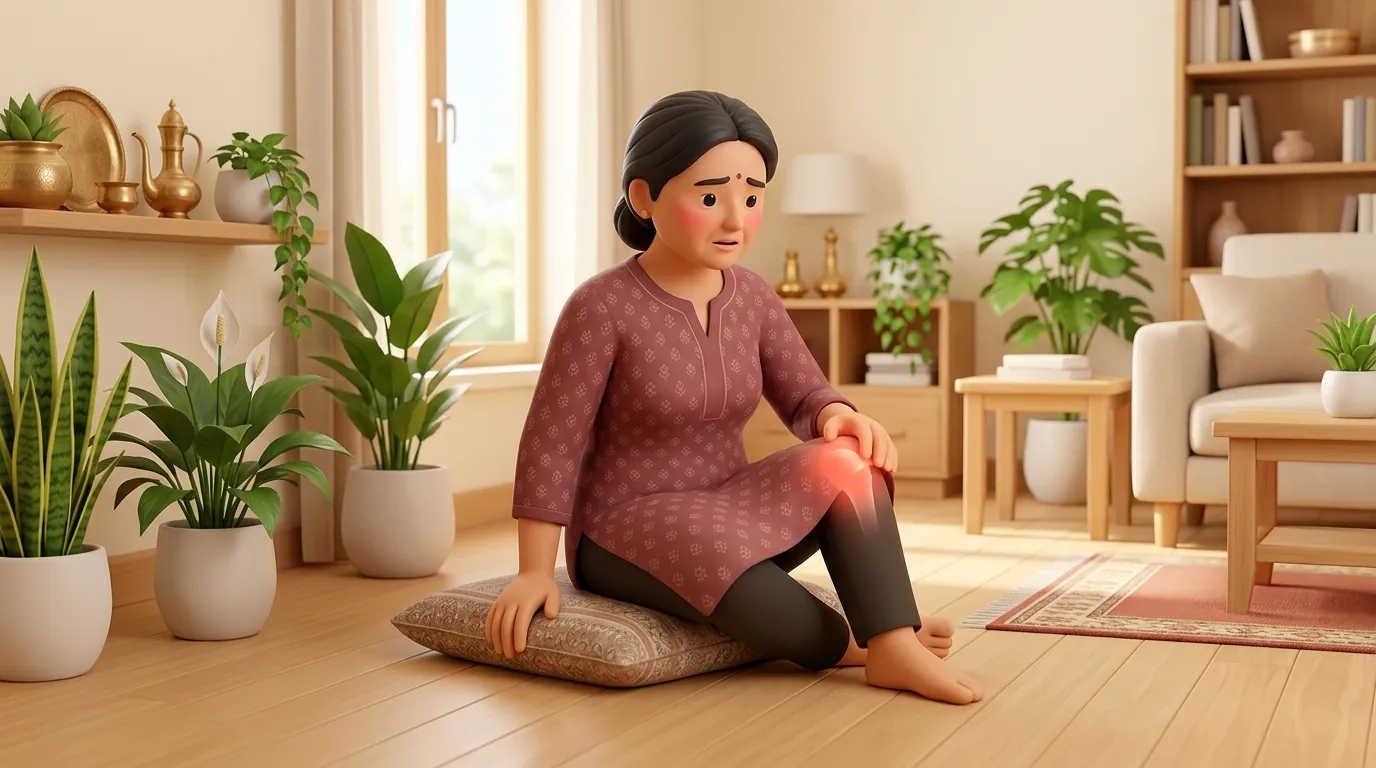
In Indian society, deep knee flexion activities: sitting cross-legged on the floor in Sukhasana or Padmasana for daily puja and family dining, sitting on low stools during food preparation, and utilizing traditional Indian-style squat toilets (desi commodes): are deeply woven into religious devotion, cultural heritage, and daily domestic routine. Consequently, when an Indian adult in their 50s or 60s is diagnosed with knee osteoarthritis (sandhivata), receiving the standard medical advice: 'Stop sitting on the floor forever and never squat again': can feel culturally alienating and emotionally devastating.
However, orthopaedic biomechanics and modern physiotherapy reveal that the relationship between deep knee flexion and joint cartilage is far more nuanced than a simplistic blanket ban. While extreme deep flexion does exert massive compressive forces across worn articular cartilage, absolute disuse and avoidance lead to severe joint contractures, capsular tightness, and profound quadriceps atrophy. Understanding joint biomechanics allows patients to adopt smart clinical modifications that protect articular cartilage while preserving functional independence and cultural participation.
1. Biomechanics of Deep Knee Flexion in Indian Lifestyles
To understand why deep flexion causes knee pain in arthritic joints, one must examine the mechanical force vectors across the patellofemoral and tibiofemoral joints:
- Level Walking (0 to 60 Degrees of Flexion): Compressive tibiofemoral joint forces equal roughly 2 to 3 times body weight. Healthy and mild arthritic cartilage easily tolerates these forces during daily strolls.
- Stair Climbing (90 to 100 Degrees of Flexion): Patellofemoral contact forces escalate to 3.5 to 4 times body weight as the quadriceps pull the patella firmly against the femoral trochlea.
- Cross-Legged Floor Sitting / Sukhasana (120 to 135 Degrees): Requires extreme knee flexion combined with external hip rotation and tibial torsion, compressing the posterior horns of the medial and lateral menisci.
- Deep Squatting / Indian Squat Toilets (135 to 160 Degrees): Patellofemoral compressive forces peak at 7 to 8 times body weight, while tibiofemoral shear forces reach maximum mechanical loading.
| Daily Domestic Activity | Traditional High-Load Habit | Orthopaedic Risk Factor | Physiotherapy Recommended Modification | |
|---|---|---|---|---|
| Religious Worship / Puja | Sitting directly on a thin floor mat (darbha / chatai) for 45 to 60 minutes | Extreme sustained knee flexion compressing worn patellofemoral cartilage | Use a raised wooden prayer stool (chowki / patla) 6 to 9 inches high, or a comfortable chair | |
| Toilet Hygiene | Traditional Indian-style squat toilet (desi commode) | Massive 7-8x bodyweight axial load; extreme struggle rising up without grab bars | Install a Western toilet or place an elevated commode chair with bilateral armrests over the squat pan | |
| Dining and Socializing | Sitting flat on the floor in Sukhasana with joint family | Torsional twisting on degenerated medial meniscus horns during standing transitions | Dine at a dining table or place a firm cushion under hips to elevate pelvis above knee level |
2. Can Cartilage Adapt? The 'Use It and Adapt It' Philosophy
Articular cartilage is an avascular tissue that depends entirely on cyclical mechanical compression for nutrition. Like a sponge, cartilage absorbs synovial fluid rich in oxygen and nutrients when compressed and decompressed during dynamic movement. Complete immobilization or avoiding all bending starves cartilage and accelerates joint degradation.
For patients with mild to moderate (Kellgren-Lawrence Grade 1 or 2) osteoarthritis who possess good baseline hip mobility, gradual, controlled knee flexion conditioning can maintain joint tolerance. Conversely, for advanced (Grade 3 or 4) osteoarthritis with bone-on-bone friction and joint deformities, forced deep squatting must be modified to prevent acute mechanical tearing and joint effusion.
3. Physiotherapy Rehabilitation Circuit for Indian Knee Pain
Quadriceps and Joint Preservation Circuit for Knee Osteoarthritis
Objective: Build muscular shock absorbers, offload worn joint compartments, and restore safe functional mobility.
- 1Terminal Knee Extension (TKE) with Band: Loop a resistance band behind the knee, anchored to a sturdy table. Straighten the knee against band tension, contracting the vastus medialis obliquus (VMO) for 3 seconds. 3 sets of 12 reps.
- 2High Chair Sit-to-Stand (Partial Squatting): Sit on a sturdy dining chair with a cushion (hip height slightly above knees). Stand up smoothly without using hands if possible, keeping knees aligned over toes. 3 sets of 10 reps.
- 3Straight Leg Raises (SLR) with Ankle Weight: Lie on your back, bend the non-affected knee. Keep the affected knee completely straight and lift the leg 30 cm off the bed, holding for 5 seconds. 3 sets of 10 reps.
- 4Hamstring and Calf Towel Stretches: Sit on a firm bed, loop a towel around the ball of your foot, and gently pull back to stretch tight posterior muscle chains that restrict knee extension.
4. Practical Home Adaptation Guide for Indian Joint Families
Supporting an arthritic elder at home requires compassionate, low-cost domestic adjustments: Install sturdy stainless steel grab bars beside the bathroom commode and shower area. Replace slippery smooth marble or tile bathroom floor surfaces with non-slip anti-skid rubber mats to prevent devastating slip-and-fall fractures. Provide supportive footwear with cushioned EVA soles for indoor walking on hard concrete or tile floors, rather than walking barefoot.
5. Consultation Rates and Clinical Care Access in India
Early physiotherapy intervention can postpone or entirely prevent the need for total knee replacement surgery. In Indian cities, outpatient physiotherapy consultations for knee osteoarthritis typically range from ₹400 to ₹1,500 per session. For elderly patients suffering severe mobility limitation who struggle to travel through traffic, home visit physiotherapy is readily accessible, typically costing between ₹600 and ₹2,000 per session. BookPhysio.in connects patients with verified state council registered physiotherapists with direct session payment and zero platform markups.
6. Frequently Asked Questions
Can I sit cross-legged for puja if I have mild knee osteoarthritis?
If you have mild osteoarthritis and can sit and rise from the floor without acute sharp pain or needing to pull yourself up by furniture, you may continue for short intervals (10 to 15 minutes). However, place a firm cushion or folded yoga blanket under your buttocks to raise your hips above your knees, which reduces extreme flexion and hip torque. If sitting triggers sharp pain or knee swelling, switch to a low wooden prayer stool (chowki) or chair.
Why is an Indian squat toilet so difficult for people with knee arthritis?
An Indian squat toilet requires full 140 to 160-degree knee flexion while bearing 100 percent of body weight. In this extreme position, the patella is forced against the femur with forces up to 7 to 8 times body weight. Furthermore, rising out of a deep squat requires massive quadriceps force: an arthritic knee with weakened muscles cannot generate this force, leading to intense pain and high fall risk.
Can physiotherapy regrow worn-out knee cartilage in osteoarthritis?
No therapy: neither physiotherapy, medications, nor stem cell injections: can regrow completely worn cartilage. What physiotherapy achieves is building powerful muscular shock absorbers (the quadriceps, hamstrings, and gluteals) that absorb impact forces before they reach the joint. Strengthening the surrounding muscles redistributes weight and typically reduces pain by 50 to 80 percent, allowing full daily activity.
Should I apply warm mustard oil or ice on my arthritic knees?
For chronic, dull arthritic stiffness that feels worse in the morning or during cold monsoon weather, warm compresses or warm oil massage provide soothing comfort by increasing local circulation and relaxing tense periarticular muscles. If the knee experiences an acute flare-up with visible swelling, heat, or redness after walking, use a cold ice pack wrapped in a cloth for 10 to 15 minutes to reduce inflammation.
Does walking on hard marble floors barefoot worsen knee arthritis in Indian homes?
Yes. Walking barefoot on hard polished marble, vitrified tile, or concrete floors transmits unattenuated ground impact shockwaves directly into the knee joint with every step. Wearing cushioned indoor footwear or orthotic slippers with supportive EVA soles absorbs heel-strike impact and significantly eases knee pain throughout the day.
Related condition guides



Related recovery guides & articles
BookPhysio.in Editorial Team
The BookPhysio.in editorial team writes and maintains this content, checking it against reliable clinical sources. Content follows our medical review policy: general information only, and no page claims a clinical review until a named registered physiotherapist has signed it off.
Read our medical review policy