
Lateral Wedge Insoles and Footwear Modifications for Meniscal Compartment Load
In short
Discover how lateral wedge insoles and specialized footwear modifications biomechanically offload the medial meniscus and protect joint cartilage.
In this guide (4 sections)
Footwear mechanics and orthotic interventions play an influential role in modifying the ground reaction forces transmitted across the knee joint during human locomotion. Because over 75 percent of all degenerative and traumatic meniscal tears involve the medial meniscus, clinical biomechanics focuses heavily on strategies that reduce medial compartment contact pressure. The external knee adduction moment (KAM) is the primary surrogate marker of medial compartment load: during the stance phase of walking, the ground reaction force vector passes medial to the knee joint centre, creating an adduction torque that compresses the medial tibial plateau. Lateral wedge insoles, placed beneath the foot to induce subtle subtalar eversion, mechanically shift the ground reaction force vector laterally toward the joint centre, significantly lowering peak medial contact pressures and providing non-invasive pain relief.
Indian Barefoot Habits: Domestic Marble Floors and Traditional Slippers
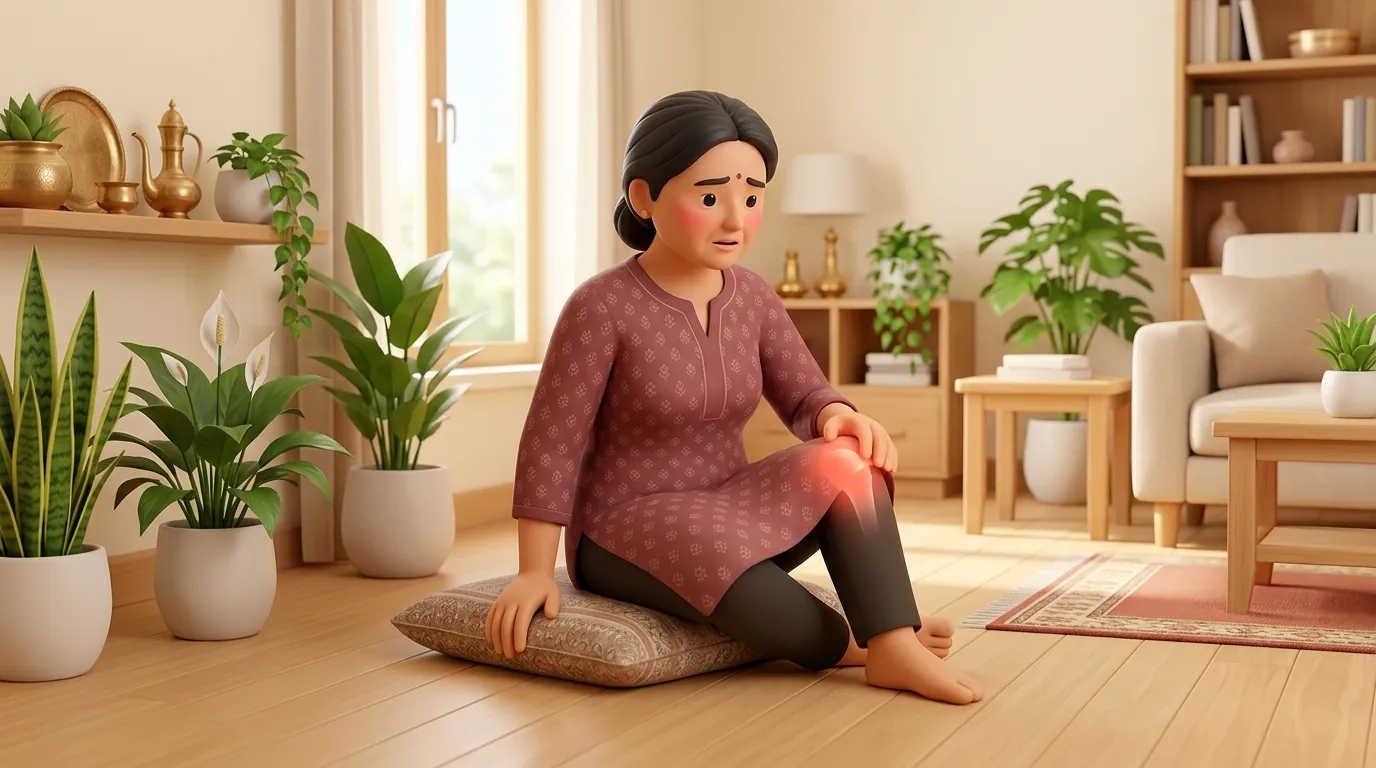
In traditional Indian households, walking barefoot inside the home is a customary social, religious, and hygienic norm. However, residential floors across urban and suburban India are largely constructed from unyielding materials, such as polished marble, ceramic tiles, or granite. Walking barefoot across these rigid domestic surfaces deprives the foot of all external shock absorption, transmitting high-frequency heel-strike impact shock directly up the tibia into the medial meniscus. When outside the home, many individuals wear thin, unsupportive flat rubber flip-flops (chappals) or traditional leather footwear (such as Kolhapuris or juttis), which offer zero arch contouring, negligible cushioning, and zero medial-lateral stability. Transitioning Indian patients to supportive, cushioned domestic indoor footwear fitted with custom insoles represents a vital lifestyle intervention.
Subtalar Eversion, Ground Reaction Force Vector Shift, and Moment Arm Reduction
The biomechanical mechanism of a lateral wedge insole relies on altering the orientation of the subtalar joint and the resulting ground reaction force (GRF) vector. A lateral wedge typically features an inclination of 4 to 8 degrees, thicker along the lateral border of the foot and tapering medially. By elevating the lateral aspect of the calcaneus, the wedge induces mild calcaneal eversion and pronation of the subtalar joint during early and midstance. This subtalar adjustment shifts the centre of pressure (COP) beneath the foot laterally. Consequently, the ground reaction force vector moves closer to the knee joint centre of rotation, directly shortening the perpendicular lever arm of the external knee adduction moment. Biomechanical gait laboratory analyses demonstrate that an 5 to 6-degree lateral wedge reduces peak knee adduction moment by 5 to 12 percent, substantially offloading the medial meniscus posterior horn.
Orthotic Prescription Parameters: Full-Length Wedges and Footwear Selection
Prescribing lateral wedges requires careful attention to insole design and patient comfort. Research indicates that full-length lateral wedges, which extend from the heel through the metatarsal heads, provide superior biomechanical control compared to heel-only wedges, which can feel unstable beneath the calcaneus. Incorporating a supportive medial longitudinal arch support prevents excessive, uncontrolled foot pronation that could cause secondary medial ankle or posterior tibial tendon strain. Insoles are paired with supportive footwear featuring a firm heel counter, a wide and stable outsole, and well-cushioned midsole foam (such as ethylene-vinyl acetate or polyurethane). Patients adopt a gradual break-in schedule: wearing the insoles for 1 to 2 hours initially, building to full-day use over two weeks.
Towel Curl and Arch Dome Strengthening for Intrinsic Foot Stability
Objective: Strengthen intrinsic foot muscles and posterior tibialis to maintain dynamic arch control when using wedge orthotics
- 1Sit upright on a dining chair with your bare feet resting flat on a smooth tiled or wooden floor.
- 2Place a light cotton hand towel flat on the floor directly beneath the sole of your affected foot.
- 3Keeping your heel firmly anchored to the floor, use your toes to scrunch and pull the towel toward your heel in small waves.
- 4Continue scrunching until the entire length of the towel is gathered beneath your foot arch.
- 5Now push the towel back out smoothly by spreading and extending your toes, maintaining strong, controlled foot movements.
| Intervention Type | Biomechanical Mechanism | Medial Offloading Efficacy | Comfort and Adaptation Profile | Clinical Indication |
|---|---|---|---|---|
| 5-Degree Lateral Wedge Insole | Everts calcaneus; shifts ground reaction force vector laterally | Moderate reduction (5% to 10% peak KAM reduction) | High comfort when paired with arch support; low adaptation time | Medial meniscal tears, root tears, medial osteoarthritis |
| Medial Arch Support Only | Controls hyperpronation; distributes plantar pressure | Minimal effect on KAM; may slightly increase medial load | Very high comfort; improves general foot fatigue | Concomitant pes planus; not recommended alone for medial tears |
| Cushioned EVA Indoor Footwear | Attenuates high-frequency heel strike shock waves | Reduces peak impact force rate without shifting moment arm | Essential for hard domestic Indian marble/tile floors | Universal domestic recommendation for all knee pathologies |
| Flat Unsupportive Chappals | Zero shock absorption; zero torsional control | Exacerbates unbuffered impact shock to knee joint | Common cultural habit; high contributor to domestic joint pain | Strictly discouraged during meniscal rehabilitation |
If a lateral wedge insole is angled too steeply (exceeding 8 to 10 degrees), it can induce excessive subtalar eversion, compressing the lateral ankle compartment and straining the peroneal tendons. If a patient develops pain along the lateral border of the foot, tenderness behind the lateral malleolus, or feelings of ankle instability, the insole must be removed immediately and reassessed by a podiatrist or physiotherapist to reduce wedge inclination.
Frequently Asked Questions
Should I wear my supportive shoes with insoles inside my home in India?
Yes, absolutely. A dedicated pair of clean, indoor-only supportive sandals or cushioned running shoes kept exclusively for home use protects your knee from the unforgiving impact of hard marble or granite floors. Wearing supportive indoor footwear provides constant shock absorption, reducing knee inflammation and making domestic chores significantly more comfortable.
Do I need a doctor referral to treat a meniscal tear on BookPhysio.in?
BookPhysio.in does not require a doctor referral. Under the National Commission for Allied and Healthcare Professions (NCAHP) Act 2021, patients across India enjoy direct access to autonomous registered physiotherapists. Through BookPhysio.in, you connect directly with verified clinicians and pay per session with transparent fees, completely free from advance package commitments, commission markups, or platform subscription charges.
Related condition guides


Related recovery guides & articles
BookPhysio.in Editorial Team
The BookPhysio.in editorial team writes and maintains this content, checking it against reliable clinical sources. Content follows our medical review policy: general information only, and no page claims a clinical review until a named registered physiotherapist has signed it off.
Read our medical review policy