
Manual Labor Elbow Overload: Heavy Cement Sacks and Industrial Strains
In short
Address elbow joint overload in manual laborers. Learn the mechanics of lifting fifty-kilogram cement sacks, bicep strains, and ergonomic lifting techniques.
In this guide (4 sections)
Manual labor remains the foundation of India’s booming construction, manufacturing, and agricultural sectors. Hundreds of thousands of porters, warehouse workers, and construction laborers subject their musculoskeletal systems to daily mechanical loads far exceeding standard occupational ergonomic limits. Lifting and carrying fifty-kilogram jute sacks of Portland cement, hoisting heavy baskets of wet concrete, and dragging overloaded handcarts across uneven worksites impose extreme compressive, tensile, and shear stresses across the elbow complex. Chronic exposure to these unphysiological loads precipitates a spectrum of severe elbow pathologies, including distal biceps enthesopathy, medial epicondylar traction spurring, radiocapitellar joint degeneration, and premature post-traumatic osteoarthritis.
Construction Sites, Wholesale Mandis, and Rickshaw Pulling Realities
In wholesale grain mandis, dockyards, and metropolitan railway freight terminals across India, porters (coolies) routinely carry stacked sacks weighing up to sixty kilograms on their shoulders and heads. To balance these unwieldy loads, laborers hold their arms in sustained overhead flexion or lock their elbows at ninety degrees under maximal isometric tension. Similarly, manual cycle-rickshaw pullers and handcart pushers navigate crowded traffic while applying relentless isometric pulling forces on wooden steering shafts. When sudden road hazards demand immediate emergency braking or when catching a dropped cement sack, the elbow experiences massive, unbuffered eccentric extension spikes that rupture soft tissue stabilizers.
Cancellous Trabecular Microfractures, Tendon Entheses, and Degeneration
The elbow is inherently a congruous hinge joint designed primarily for positioning the hand in space, rather than bearing repetitive axial loads exceeding half the individual’s body weight. When an individual hoists a fifty-kilogram sack from ground level, the distal biceps and brachialis generate internal muscle forces exceeding two thousand Newtons to counteract the external flexion load. Over months of repetitive loading, the hypovascular zone of the distal biceps tendon develops micro-tearing and mucoid degeneration. Concurrently, repetitive compressive impact across the radiocapitellar joint triggers subchondral micro-fractures, loss of articular cartilage thickness, and reactive marginal osteophyte formation. This chronic articular battering causes early joint space narrowing and painful loss of terminal elbow extension.
Ergonomic Body Mechanics, Kinetic Chain Redistribution, and Load Protocols
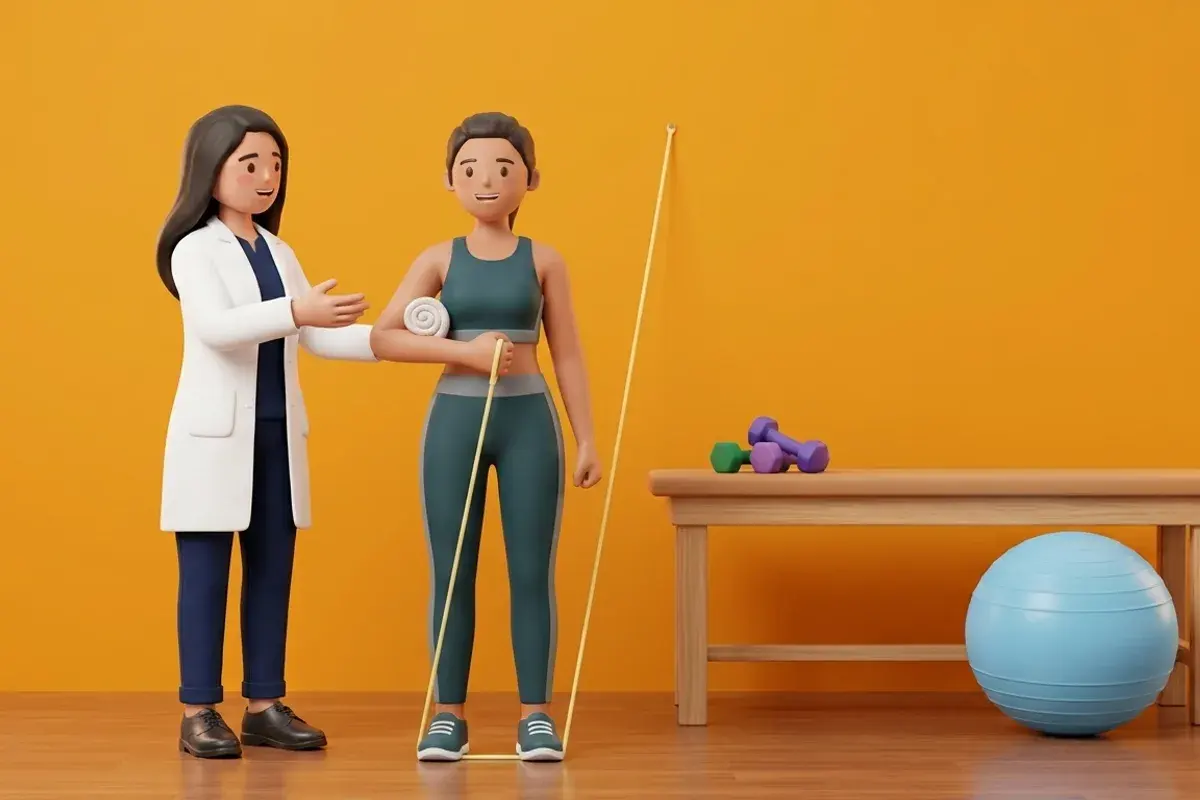
Managing manual labor elbow overload requires an approach combining clinical tissue healing with realistic ergonomic adaptation. Because completely ceasing work is often economically impossible for daily wage earners, rehabilitation focuses on kinetic chain energy redistribution. Physiotherapists teach workers to utilize lower extremity hip hinge mechanics and core bracing when initiating heavy lifts, rather than curling loads with their upper limbs. Exercise therapy builds scapular retractors, strengthens the forearm flexor-pronator mass to provide dynamic joint protection, and incorporates isometric grip strengthening. Workers are provided with supportive compression sleeves to reduce soft tissue oscillation and enhance proprioceptive feedback during heavy carrying.
Hip-Hinge Heavy Carry Simulation and Isometric Forearm Lock
Objective: Train whole-body kinetic chain lifting mechanics to distribute load through hips and legs rather than the elbow flexors
- 1Stand tall with feet shoulder-width apart, holding a five-kilogram weighted bag or dumbbell close against your chest with both hands.
- 2Hinge backward at your hips, keeping your spine straight and chest proud, lowering your torso forty-five degrees while softening your knees.
- 3Ensure your elbows remain tucked firmly against your rib cage, maintaining ninety degrees of flexion without letting the weight pull your arms straight.
- 4Drive through your heels and squeeze your glutes to return to the tall standing position, using hip power to lift the load.
- 5Pause at the top for three seconds, maintaining firm abdominal tension, and repeat with controlled breathing.
| Workplace Mechanical Task | Biomechanical Stress Concentration | Common Secondary Clinical Pathology |
|---|---|---|
| Lifting 50 kg Sacks from Ground | Violent eccentric and isometric loading of distal biceps and brachialis entheses during initial hoist | Distal biceps partial and complete avulsions; brachialis strain; bicipitoradial bursitis |
| Carrying Overhead Loads | Axial compressive loading through the radiocapitellar joint combined with sustained valgus torque | Radiocapitellar chondral wear; marginal osteophyte impingement; valgus extension overload |
| Pulling Heavy Handcarts | Repetitive high-tension isometric grip coupled with forearm pronator-flexor mass fatigue | Medial epicondylitis (Golfer’s elbow); ulnar collateral ligament attenuation; cubital tunnel syndrome |
| Shoveling Heavy Sand and Rubble | Asymmetric rotational torque with sudden end-range extension recoil when shovel strikes obstinate rock | Posterior olecranon impingement; triceps tendinopathy; lateral collateral ligament microtrauma |
If a heavy sack or crate falls directly across a laborer’s forearm or elbow, beware of acute compartment syndrome. Severe, unremitting deep forearm pain out of proportion to exam findings, tense wood-like muscle swelling, and severe pain during passive finger extension constitute an absolute surgical emergency requiring immediate fasciotomy.
Frequently Asked Questions
Can I wear an elbow support strap while lifting heavy sacks at work?
Yes. Wearing a supportive neoprene sleeve or counterforce forearm strap can enhance proprioceptive feedback, improve joint warmth, and reduce vibration strain across muscle origins. However, the strap must not be wrapped so tightly that it compresses forearm veins or causes numbness in your fingers.
Do I need a doctor referral to see an elbow physiotherapist on BookPhysio.in?
BookPhysio.in does not require a physician prescription. Under the National Commission for Allied and Healthcare Professions (NCAHP) Act 2021, patients across India enjoy direct access to autonomous registered physiotherapists. Through BookPhysio.in, you connect directly with verified clinicians and pay per session with transparent fees, completely free from advance package commitments, commission markups, or platform subscription charges.
Related condition guides



Related recovery guides & articles
BookPhysio.in Editorial Team
The BookPhysio.in editorial team writes and maintains this content, checking it against reliable clinical sources. Content follows our medical review policy: general information only, and no page claims a clinical review until a named registered physiotherapist has signed it off.
Read our medical review policy