
Meniscal Repair Rehabilitation: Flexion Angle Limits, Weight-Bearing and Shear Protection
In short
Unlike meniscectomy, meniscal repair requires strict tissue protection for biological healing. Learn flexion angle limits, weight-bearing restrictions, and milestone progressions.
In this guide (5 sections)
The Biological Imperative to Save the Meniscus
The fibrocartilaginous menisci serve indispensable biomechanical functions: absorbing 50 to 70 percent of joint compressive loads, deepening the shallow tibial plateaus, and providing secondary knee stability.
Resecting meniscal tissue (meniscectomy) dramatically increases peak contact stresses on femoral and tibial articular cartilage, predisposing to accelerated early-onset osteoarthritis.
Whenever viable tissue exists in the vascular 'red-red' or intermediate 'red-white' zones, orthopaedic surgeons perform arthroscopic meniscal repair using suture anchors or inside-out sutures to preserve joint longevity.
Biomechanical Rationale for Post-Operative Restrictions
During deep knee flexion (> 90 degrees), the femoral condyles roll posteriorly, exerting massive shear and compressive forces that compress the posterior meniscal horns.
Simultaneously, weight-bearing during flexion creates hoop stresses that can tear delicate healing suture lines apart before biological collagen bridging occurs (which requires 6 to 8 weeks).
| Rehabilitation Parameter | Arthroscopic Meniscal Repair | Partial Meniscectomy (Resection) | Biomechanical Rationale | |
|---|---|---|---|---|
| 1. Weight-Bearing Status | Non-Weight Bearing or Touchdown WB for 4 to 6 weeks | Immediate Full Weight Bearing as tolerated on Day 1 | Repairs require protection from compressive hoop stresses. | |
| 2. Knee Flexion Restrictions | Strictly capped at <= 90 degrees for first 4 to 6 weeks | Zero range-of-motion restrictions; active as tolerated | Flexion past 90 degrees pinches the posterior repair. | |
| 3. Bracing Requirements | Hinged knee brace locked in extension for ambulation | No brace required; early walking | Maintains extension and eliminates accidental joint buckling. | |
| 4. Return to Sports Timeline | 4 to 6 months (delayed until biological healing) | 4 to 6 weeks (rapid recovery) | Repair must achieve full tensile collagen maturation. |
Phase-Wise Meniscal Repair Rehabilitation Milestones
Rehabilitation progresses from suture protection to full functional athletic capacity.
- Weeks 1 to 4 (Suture Protection Phase): Touchdown weight-bearing with crutches in brace locked at 0 degrees; passive knee flexion strictly between 0 and 90 degrees; isometric quadriceps sets and straight leg raises without lag.
- Weeks 5 to 6 (Weight-Bearing Transition): release brace for walking as quadriceps control normalizes; progress to full weight-bearing; advance passive and active-assisted flexion past 90 degrees.
- Weeks 7 to 12 (Kinetic Chain Strengthening): Wean brace completely; begin closed kinetic chain exercises (leg press, mini-squats strictly limited to 0 to 70 degrees), stationary cycling with seat elevated.
- Months 4 to 6 (Plyometrics and Return to Sport): Reintroduce jogging, agility ladders, and sport-specific cutting drills once limb symmetry index exceeds 85 percent.
Floor Sitting and Squatting Precautions in India
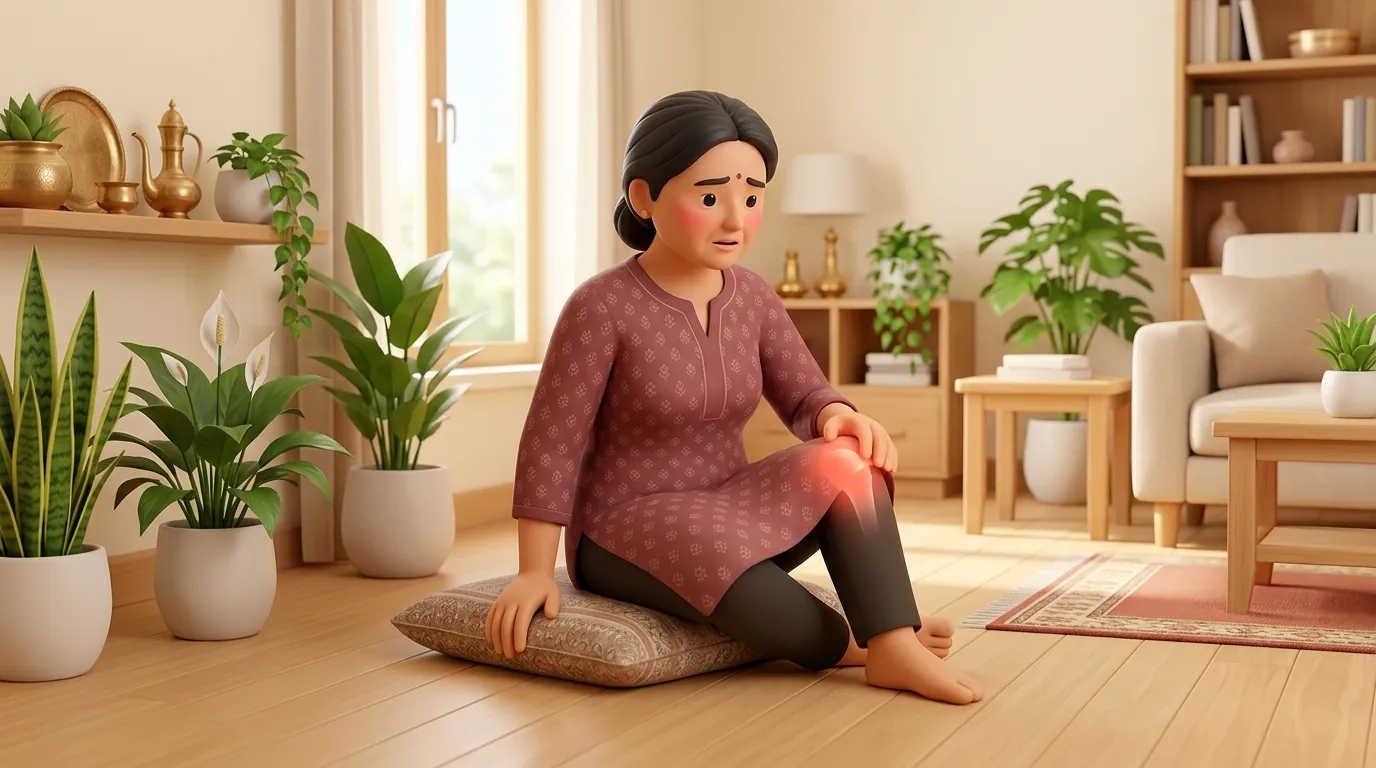
In Indian homes, rising from deep squatting positions on the floor generates extreme posterior horn shear forces.
Physiotherapists mandate complete avoidance of cross-legged sitting (sukhasana) and deep squats below 90 degrees for a minimum of 6 months post-repair.
Frequently Asked Questions
What is the success rate of arthroscopic meniscal repair?
Isolated meniscal repairs have a healing success rate of 70 to 80 percent. When performed concurrently with ACL reconstruction, healing rates increase to over 90 percent due to bone marrow mesenchymal stem cells released during tunnel drilling.
What happens if a patient bends their knee past 90 degrees too early?
Bending past 90 degrees causes the femoral condyle to translate backward, exerting high shear stresses that can pull suture anchors out of fragile meniscal tissue, causing repair failure.
How do you know if a meniscal repair has failed?
Warning signs of repair failure include recurrent joint line pain, mechanical clicking or locking, and persistent knee joint effusion after increasing walking loads.
Related condition guides

Related recovery guides & articles
BookPhysio.in Editorial Team
The BookPhysio.in editorial team writes and maintains this content, checking it against reliable clinical sources. Content follows our medical review policy: general information only, and no page claims a clinical review until a named registered physiotherapist has signed it off.
Read our medical review policy