
Passive Modalities Critique: Therapeutic Ultrasound, Laser, and SWD in Tendinopathy
In short
Passive electrotherapy modalities remain ubiquitous despite weak clinical evidence. Discover why active loading must replace reliance on ultrasound, laser, and SWD.
In this guide (4 sections)
In outpatient physiotherapy clinics across India, patients presenting with lateral epicondylalgia frequently receive extensive courses of passive electrophysical modalities, including therapeutic ultrasound (US), low-level laser therapy (LLLT), and shortwave diathermy (SWD). For decades, these machines served as standard clinical fixtures, promoted as non-invasive tools to accelerate tissue healing and extinguish localized inflammation. However, high-quality systematic reviews, Cochrane analyses, and international clinical guidelines consistently conclude that passive modalities provide little more than transient placebo analgesia, failing to produce meaningful structural tendon regeneration or long-term functional recovery.
The 15-Session Machine Package Phenomenon in Indian Clinics
A common clinical pattern in Indian healthcare involves prescribing ten to fifteen consecutive daily sessions of passive machine therapy. Patients sit passively attached to electrical stimulation leads or have an ultrasound transducer rubbed over their lateral elbow for ten minutes, pay substantial out-of-pocket sums, and receive zero education regarding tendon mechanics, load tolerance, or active exercise. While patients may experience brief soothing warmth during treatment, their underlying tendon pathology remains unaddressed. Upon resuming normal daily demands like lifting heavy iron kadhais or operating office computers, symptoms immediately flare up, fostering therapeutic disillusionment.
Thermal Acoustics, Photobiomodulation, and the Limits of Passive Energy
The theoretical mechanisms behind passive modalities fail to align with the histopathology of chronic tendinopathy. Therapeutic ultrasound claims to stimulate cellular protein synthesis through acoustic cavitation and micro-streaming; however, in vivo human trials demonstrate that acoustic energy levels delivered at safe clinical intensities (0.5 to 1.5 Watts per square centimeter) fail to stimulate tenocyte collagen deposition. Low-level laser therapy attempts photobiomodulation of mitochondrial cytochrome c oxidase, yet fails to generate the mechanical strain necessary to stimulate integrin receptors on tenocyte membranes. Without physical tensile deformation, the cellular signaling pathways that govern collagen cross-linking and tenocyte matrix turnover remain completely dormant.
Evidence-Based De-Adoption, Active Mechanotherapy, and Clinical Re-Education
Modern, ethical physiotherapy practice demands the de-adoption of passive machines as primary interventions for lateral epicondylalgia. International consensus statements recommend that electrotherapy modalities, if utilized at all, be restricted to brief adjunctive roles during acute, highly irritable flare-ups to facilitate immediate patient comfort. The true engine of tendon recovery is active mechanotherapy: progressive isometric loading, heavy slow resistance training, and functional kinetic chain re-education. Educating patients that tendons remodel in response to mechanical loading rather than electrical currents or acoustic waves empowers them to take an active, successful role in their recovery.
Active Load-Tolerance Wrist Extension Warm-Up Drill
Objective: Stimulate cellular mechanotransduction actively as a superior alternative to passive machine application
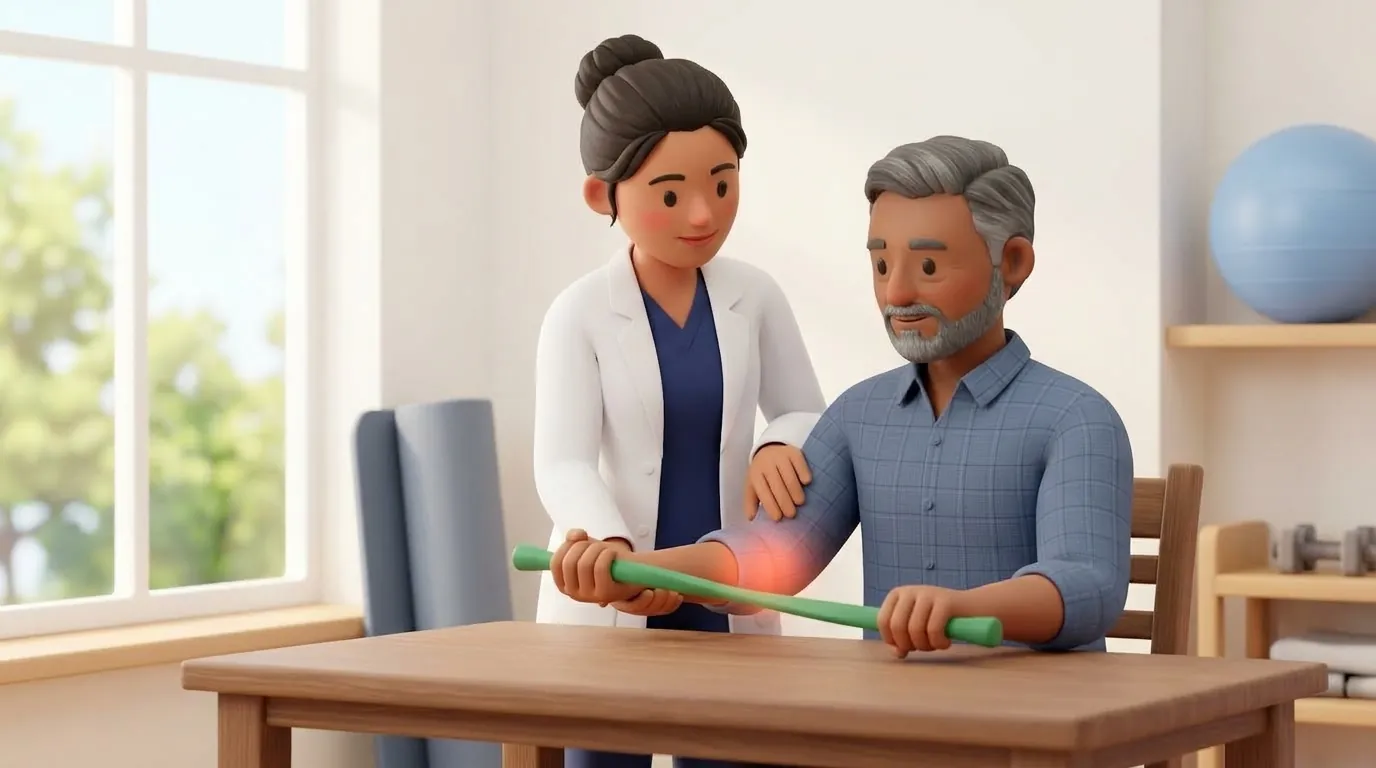
- 1Sit comfortably at a table, resting your forearm along the surface with your hand hanging over the edge.
- 2Without holding any weight, slowly curl your fingers into a light fist and extend your wrist upward into comfortable extension.
- 3Hold the top position for 3 seconds, focusing on feeling the muscular engagement across your outer forearm.
- 4Slowly lower the wrist downward into gentle flexion over a count of 3 seconds.
- 5Repeat this smooth, active movement continuously for 15 repetitions to promote physiological hyperaemia and muscle recruitment.
| Intervention Modality | Proposed Biological Mechanism | Clinical Trial Evidence Quality and Recommendation |
|---|---|---|
| Therapeutic Ultrasound (US) | Acoustic micro-streaming and thermal effects to accelerate fibroblast activity | Strong evidence of no benefit over sham/placebo; not recommended in modern guidelines |
| Low-Level Laser Therapy (LLLT) | Photobiomodulation of mitochondrial energy production and local microcirculation | Conflicting, weak evidence; small short-term analgesic effect with zero long-term matrix change |
| Shortwave Diathermy (SWD) | Deep electromagnetic thermal heating to increase local blood flow and tissue extensibility | Very low-quality evidence; risks thermal burns; lacks evidence for structural tendon remodelling |
| Active Progressive Loading (HSR) | Direct mechanical cellular strain (mechanotransduction) stimulating type I collagen synthesis | High-quality Level 1 evidence; designated gold-standard first-line medical intervention |
Clinicians should never apply deep heating modalities like shortwave diathermy over acute lateral elbow swelling without first ruling out septic olecranon bursitis, acute inflammatory gouty arthritis, or radiocapitellar joint effusion, as thermal heating accelerates infectious spread and inflammatory destruction.
Frequently Asked Questions
Why did my previous physiotherapist give me 10 days of ultrasound therapy if it does not work?
Passive machines were historically taught as standard care and remain commercially convenient for busy clinics because they require minimal one-on-one clinician time. However, modern medical evidence has decisively shown that passive machines cannot rebuild tendon strength, which is why current clinical standards emphasize active exercise.
Do I need a doctor referral to see a tennis elbow physiotherapist on BookPhysio.in?
BookPhysio.in does not require a physician prescription. Under the National Commission for Allied and Healthcare Professions (NCAHP) Act 2021, patients across India enjoy direct access to autonomous registered physiotherapists. Through BookPhysio.in, you connect directly with verified clinicians and pay per session with transparent fees, completely free from advance package commitments, commission markups, or platform subscription charges.
Related condition guides



Related recovery guides & articles
BookPhysio.in Editorial Team
The BookPhysio.in editorial team writes and maintains this content, checking it against reliable clinical sources. Content follows our medical review policy: general information only, and no page claims a clinical review until a named registered physiotherapist has signed it off.
Read our medical review policy