
Monsoon Footwear and Wet Slipping: Gait Adjustments, Micro-Trauma, and Plantar Fascia Flare-Ups
In short
Understand how rainy season slipping hazards, waterlogged plastic footwear, and toe-clawing gait adaptations trigger severe plantar fasciopathy flare-ups.
In this guide (4 sections)
The annual southwest monsoon brings transformative seasonal rains across the Indian subcontinent, accompanied by significant infrastructure and environmental challenges. Flooded city streets, waterlogged sidewalks, and slick, moss-covered stone pavements create highly hazardous walking conditions in urban hubs like Mumbai, Kolkata, Kochi, and Chennai. To navigate wet streets, millions of commuters transition to waterproof plastic or rubber footwear, including cheap molded sandals, open rainy-season chappals, or loose rubber clogs. While these materials withstand water immersion without damage, they present profound biomechanical hazards to the lower extremities. Walking on slick surfaces in poorly structured, waterlogged footwear forces individuals to adopt abnormal, guarded gait kinematics characterized by continuous muscular co-contraction, shortened stride lengths, and intense digital clawing. This protective gait adaptation dramatically amplifies mechanical tensile loading across the plantar aponeurosis, precipitating a dramatic surge in acute plantar fasciopathy flare-ups throughout the monsoon months.
Barefoot Marble Floor Living, Prolonged Kitchen Standing, and Thin Flat Slippers
During the monsoon season, domestic flooring hazards inside Indian homes escalate dramatically. Rainwater tracked indoors onto polished marble, vitrified ceramic tile, or granite flooring transforms domestic corridors into dangerously slick surfaces. Homemakers and family members navigating wet tiled kitchens and bathrooms frequently experience minor slipping episodes or near-falls. To prevent slipping on wet marble, individuals instinctively tense their feet and grip the floor with their toes during every step. Furthermore, wearing cheap molded plastic rainy chappals inside or outside the home provides zero arch support and no heel cushioning. The thin plastic soles become slippery against the foot when wet, forcing the intrinsic foot muscles to contract continuously just to keep the shoe attached to the foot, rapidly overloading the vulnerable calcaneal enthesis.
Windlass Mechanism Strain, Calcaneal Enthesopathy, and Plantar Thickness
The pathomechanics of monsoon-induced fascial flare-ups involve sudden eccentric contractions and abnormal digital gripping. On slick wet pavements, ground friction coefficients drop precipitously. To maintain stability, the central nervous system activates continuous, high-amplitude co-contraction of the gastrocnemius, soleus, tibialis posterior, and flexor hallucis longus muscles. When the foot experiences a minor slip, these muscles fire violently in an involuntary eccentric braking effort to arrest forward momentum. This sudden, high-velocity contraction generates immense tensile spikes along the Achilles-calcaneus-fascia continuum. Concurrently, persistent toe-clawing to keep loose waterlogged sandals on the feet locks the metatarsophalangeal joints in abnormal postures, disrupting normal Windlass mechanics and creating destructive shear stresses at the medial calcaneal tuberosity, leading to acute enthesitis and reactive fascial thickening.
Rathleff High-Load Towel Training, Low-Dye Taping, and Intrinsic Foot Doming
Managing monsoon-related heel pain requires immediate footwear upgrading combined with neuromuscular stability training. Clinicians strongly advise patients to avoid cheap, unstructured plastic chappals, transitioning instead to purpose-built, water-resistant trekking sandals or waterproof walking shoes featuring deep, multi-directional rubber lug outsoles and secure heel straps that eliminate toe-clawing. Inside homes, wet marble floors must be dried immediately, and non-slip rubberized runner mats should be installed along high-traffic corridors. Physiotherapy rehabilitation focuses on restoring tissue load capacity through the Rathleff high-load strength protocol, eccentric calf strengthening on an elevated step, and dynamic single-leg balance perturbations to rebuild proprioceptive joint stability, protecting the fascia from unpredictable wet terrain.
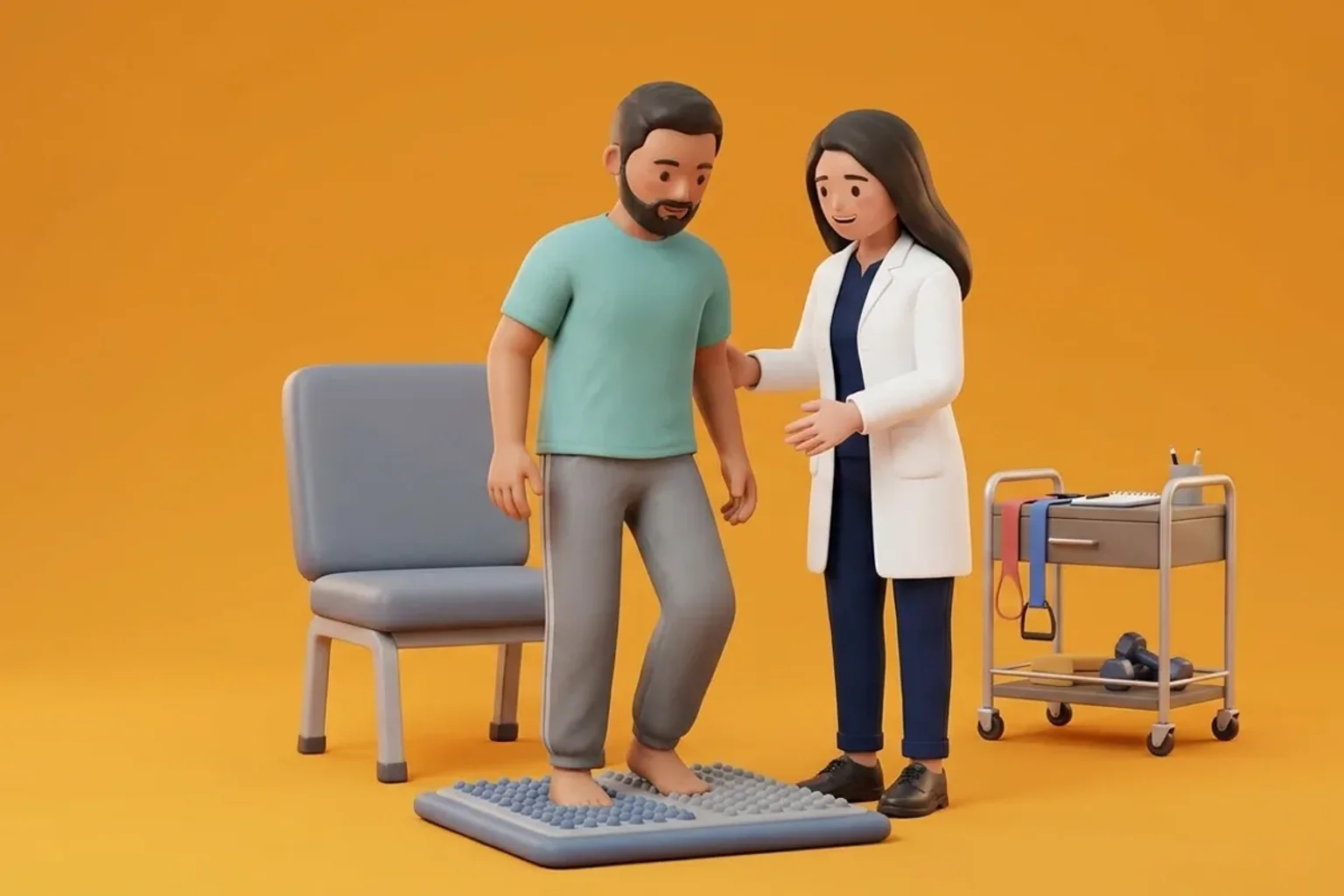
Single-Leg Balance Perturbation Drill on Cushioned Surface
Objective: Enhance proprioceptive ankle stability and dynamic foot arch control to prevent slipping-related fascial strain
- 1Stand bare-foot near a sturdy wall or handrail so you can touch it with your fingertips if you lose balance.
- 2Place a folded bath towel or balance foam pad on the floor and step onto it with your affected foot.
- 3Lift your opposite foot slightly off the floor, balancing your entire body weight on the single leg with your knee slightly unlocked.
- 4Actively engage your foot arch muscles, keeping your great toe grounded and your arch domed without clawing your smaller toes.
- 5Maintain steady, calm balance for 20 to 30 seconds while keeping your torso upright, then slowly switch legs.
| Footwear Parameter | Cheap Molded Plastic / Rubber Chappals | Ergonomic Waterproof Trekking Sandals | Clinical Impact on Plantar Fascia |
|---|---|---|---|
| Outsole Wet Traction & Grip | Smooth, shallow plastic tread; extremely slippery on wet tiles and mossy concrete | Deep, multi-directional lugged rubber outsole formulated for wet-surface grip | Eliminates involuntary eccentric slipping episodes and violent fascial tensile spikes |
| Foot Retention & Strapping | Open back, loose strap; mandates constant toe-clawing to keep shoe on foot | Secure adjustable heel and instep straps; holds foot firmly without digital effort | Relieves continuous hyperactivity in flexor digitorum brevis and longus muscles |
| Arch Contour & Shock Cushioning | Completely flat, unyielding plastic footbed with zero shock attenuation | Anatomically contoured EVA midsole with arch support and cushioned heel cup | Maintains medial arch height and attenuates vertical ground reaction forces |
Slipping on wet floors can cause severe acute injuries. If you experience a sudden slip followed by an audible pop under your foot arch, immediate sharp pain, and the rapid development of dark purple bruising along your sole, an acute plantar fascia rupture is suspected. If severe bone pain is elicited by squeezing the calcaneus from both sides, suspect a calcaneal stress fracture. Seek immediate orthopaedic evaluation and diagnostic imaging.
Frequently Asked Questions
What kind of footwear should I wear during the rainy season if I already have heel pain?
During the monsoon, you should wear water-resistant, closed-toe walking shoes or supportive outdoor trekking sandals that feature a secure heel strap and a slip-resistant rubber outsole with deep treads. Ensure the footbed has an anatomically contoured arch support and a cushioned heel. Completely avoid cheap, flat plastic flip-flops or open chappals, which become dangerously slick when wet and force your toes to claw constantly, severely aggravating your plantar fasciitis.
Do I need a doctor referral to treat plantar fasciitis on BookPhysio.in?
BookPhysio.in does not require a doctor referral. Under the National Commission for Allied and Healthcare Professions (NCAHP) Act 2021, patients across India enjoy direct access to autonomous registered physiotherapists. Through BookPhysio.in, you connect directly with verified clinicians and pay per session with transparent fees, completely free from advance package commitments, commission markups, or platform subscription charges.
Related condition guides



Related recovery guides & articles
BookPhysio.in Editorial Team
The BookPhysio.in editorial team writes and maintains this content, checking it against reliable clinical sources. Content follows our medical review policy: general information only, and no page claims a clinical review until a named registered physiotherapist has signed it off.
Read our medical review policy