
Mulligan Mobilization with Movement (MWM) for Restoring Pain-Free Ankle Dorsiflexion
In short
Learn how Mulligan Mobilization with Movement (MWM) corrects lateral malleolus and talar positional faults to restore immediate pain-free dorsiflexion.
In this guide (4 sections)
In modern musculoskeletal manual physiotherapy, Brian Mulligan's concept of Mobilization with Movement (MWM) has revolutionized the treatment of acute and chronic joint stiffness following trauma. Traditional manual therapy often applied passive, non-weight-bearing joint glides while the patient remained relaxed on a treatment plinth. In contrast, Mulligan's paradigm combines a sustained, pain-free accessory glide applied by the clinician (or a specialized mobilization belt) with active, physiological weight-bearing movement performed simultaneously by the patient. In the context of ankle rehabilitation following an inversion sprain, MWM specifically targets positional faults of the talocrural joint and distal fibula. By mechanically correcting the subtle anterior-inferior subluxation of the lateral malleolus or anterior translation of the talus during active lunging, MWM frequently produces an immediate, measurable increase in pain-free dorsiflexion range of motion, following the PILL (Pain-free, Instant result, Long-Lasting) clinical principle.
Navigating High Bus Steps, Indian Market Stairs, and Crossing Roads
Restricted ankle mobility profoundly interferes with dynamic daily activities across Indian cities. Consider stepping down from a DTC or BEST city bus onto the road. The step height frequently exceeds twenty-five to thirty centimetres, demanding substantial eccentric dorsiflexion on the trailing limb to achieve a controlled descent. A commuter with a post-sprain positional fault experiences sharp anterior ankle blocking, forcing them to jump or twist awkwardly, risking immediate re-injury on chaotic road surfaces. Similarly, descending foot-over-bridges at suburban railway stations or navigating steep staircases in multi-story residential chawls and apartment complexes requires fluid sagittal-plane motion. Applying Mulligan MWM techniques in the clinic unlocks this restricted movement rapidly, allowing patients to regain the joint clearance needed to negotiate high public transport steps and pedestrian obstacles safely.
The Positional Fault Hypothesis and Distal Fibular Biomechanics
The theoretical foundation of Mulligan MWM centers on the positional fault hypothesis. During a violent inversion-plantarflexion sprain, the anterior talofibular ligament is stretched or torn as the talus is forcefully displaced. Simultaneously, the lateral malleolus of the fibula can be drawn forward and downward by the tensile stress of the tearing ATFL, resulting in an anterior-inferior positional fault of the distal fibula relative to the tibia. Even a subtle displacement of one to two millimetres alters the normal biomechanics of the syndesmosis and talocrural mortise. When the patient attempts to dorsiflex, the widened anterior portion of the talar trochlea cannot enter the mortise smoothly, resulting in painful impingement and mechanical blockage. By applying a sustained posterocranial glide to the distal fibula or a sustained posterior-inferior glide to the talus during active dorsiflexion, the clinician realigns the joint surfaces, enabling normal arthrokinematic gliding and immediate restoration of physiological motion.
Clinical Application Protocol: Belt Mechanics, Repetitions, and Overpressure
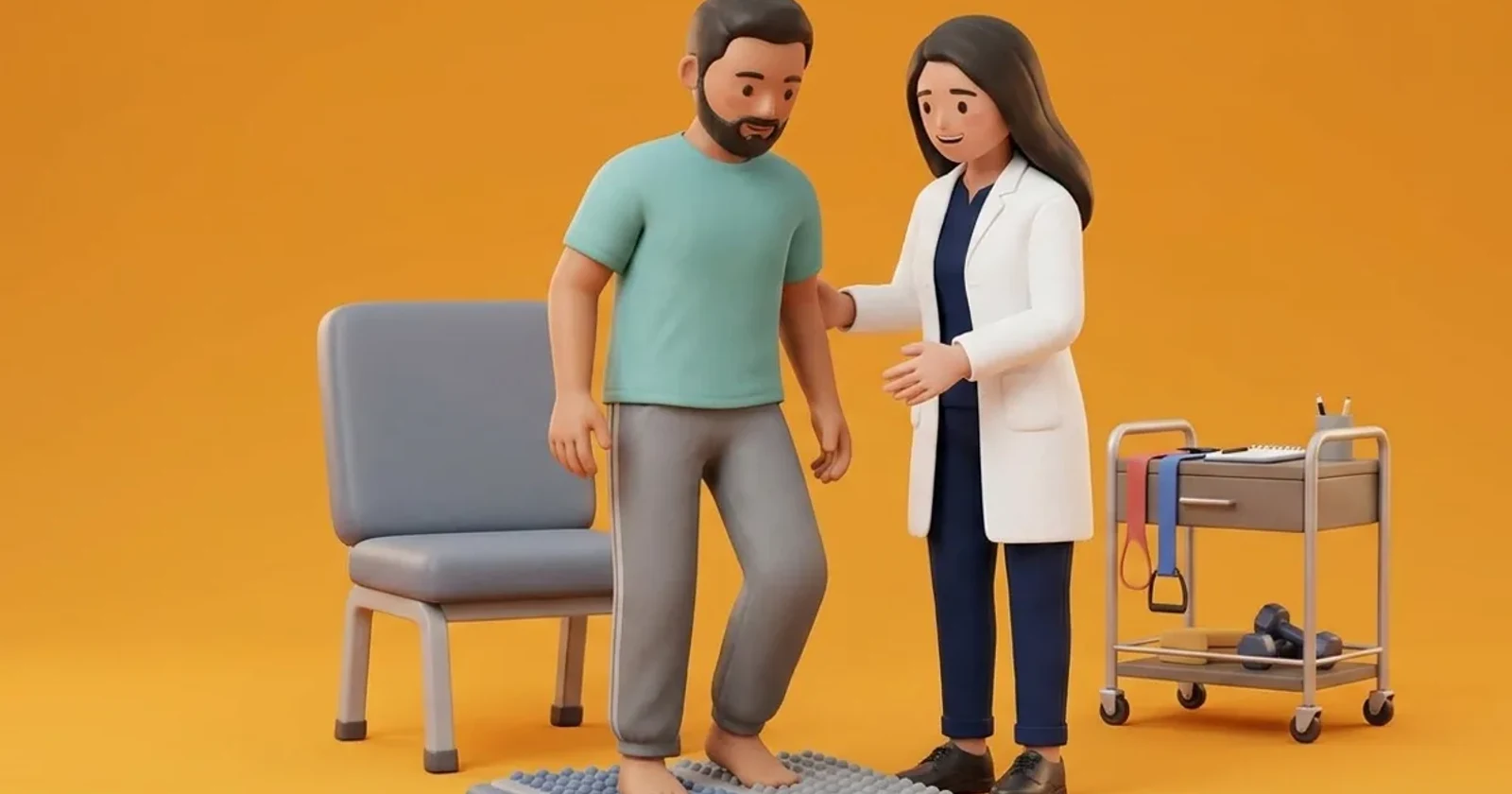
The clinical execution of an ankle dorsiflexion MWM requires precise biomechanical setup. The patient places the affected foot on a treatment stool or chair in a half-kneeling or standing lunge position. The physiotherapist loops a padded mobilization belt around their own pelvis and across the anterior aspect of the patient's talus, directly inferior to the malleoli. The clinician stabilizes the patient's distal anterior tibia with their hands while leaning backward into the belt, delivering a sustained, gentle posterior-inferior glide to the talar dome. While maintaining this continuous traction force, the patient actively lunges the knee forward over the foot to end-range dorsiflexion. Crucially, the entire movement must be completely pain-free; if pinching occurs, the angle of the belt glide is adjusted slightly medial or lateral. Once full pain-free range is achieved, gentle self-overpressure is applied by the patient placing their hands on the knee, performing three sets of ten repetitions followed by functional reassessment.
Self-Administered Mulligan Ankle Dorsiflexion MWM with Heavy Belt
Objective: Apply an autonomous posterior talar glide during active lunging to restore pain-free closed-chain dorsiflexion
- 1Place your affected foot on a sturdy chair, low bench, or the second step of a flight of stairs, keeping your foot flat.
- 2Loop a wide luggage strap or thick mobilization belt around the base of a secure wall post and around the front crease of your ankle.
- 3Ensure the strap rests snugly across the talus bone, below your ankle bone bumps, angled downward at forty-five degrees toward the floor anchor.
- 4Step back slightly so the strap is taut, pulling firmly backward and downward against the front of your ankle.
- 5Keeping your heel pressed firmly into the bench, smoothly lunge your knee forward directly over your toes into comfortable dorsiflexion, hold for 2 seconds, and return.
| Mulligan Treatment Principle | Clinical Operational Requirement | Sign of Correct Execution | Required Action if Principle Fails |
|---|---|---|---|
| Pain-Free Performance (P) | The accessory glide and active movement must be 100 percent pain-free | Complete absence of the baseline anterior pinching sensation | Alter glide vector angle (more medial, lateral, or posterior); do not force |
| Instant Result (I) | Immediate objective improvement in range of motion or weight-bearing | Weight-bearing lunge test distance increases by at least 1.5 to 3 cm | Re-evaluate diagnosis; check for syndesmotic tear or talar dome fracture |
| Long-Lasting Change (LL) | Gains achieved during the treatment session persist post-exercise | Maintained dorsiflexion during subsequent walking and stair descent | Reinforce with supportive taping and home self-MWM exercises twice daily |
| Overpressure Integration | Pain-free overpressure applied at end-range to consolidate tissue gains | Patient applies firm downward pressure on the knee at full lunge depth | Omit overpressure if irritability is acute; progress gradually |
The definitive hallmark of Mulligan Mobilization with Movement is the total absence of pain during execution. If a clinician or patient attempts to push through discomfort during a mobilization with movement, joint irritation and reactive capsular swelling will escalate. If an MWM cannot be performed completely pain-free regardless of glide angle, the technique must be discontinued immediately and alternative gentle unloaded modalities utilized.
Frequently Asked Questions
How quickly does Mulligan Mobilization with Movement improve ankle mobility?
When applied correctly to a suitable positional fault, Mulligan MWM provides an immediate, noticeable improvement in ankle range of motion within the very first treatment session. Patients typically experience an instant disappearance of anterior joint pinching and a visible increase in how far their knee can bend forward over their toes.
Do I need a doctor referral to see an ankle sprain physiotherapist on BookPhysio.in?
BookPhysio.in does not require a doctor referral. Under the National Commission for Allied and Healthcare Professions (NCAHP) Act 2021, patients across India enjoy direct access to autonomous registered physiotherapists. Through BookPhysio.in, you connect directly with verified clinicians and pay per session with transparent fees, completely free from advance package commitments, commission markups, or platform subscription charges.
Related condition guides



Related recovery guides & articles
BookPhysio.in Editorial Team
The BookPhysio.in editorial team writes and maintains this content, checking it against reliable clinical sources. Content follows our medical review policy: general information only, and no page claims a clinical review until a named registered physiotherapist has signed it off.
Read our medical review policy