
Mulligan Mobilization with Movement (MWM): Lateral Glide Biomechanics for Tennis Elbow
In short
Mulligan Mobilization with Movement delivers immediate, pain-free grip recovery. Learn the lateral glide mechanics, clinical techniques, and self-treatment straps.
In this guide (4 sections)
Among manual therapy approaches for lateral epicondylalgia, the Mulligan Concept of Mobilization with Movement (MWM) stands out for its capacity to produce immediate, dramatic improvements in pain-free grip strength and joint function. Developed by New Zealand physiotherapist Brian Mulligan, MWM combines a sustained passive articular glide applied by the clinician with active physiological movement or functional loading performed simultaneously by the patient. In lateral epicondylalgia, the application of a sustained lateral glide to the humeroulnar or humeroradial joint during active gripping or wrist extension frequently abolishes pain instantaneously, allowing immediate therapeutic loading.
Rapid Functional Restoration for Working Professionals and Caregivers
In Indian clinical practice, patients suffering from acute lateral elbow pain frequently present with severe functional limitations that threaten their livelihoods. School teachers unable to write on blackboards, mothers unable to lift infants, and retail shop owners unable to handle inventory boxes require rapid pain reduction to remain functional. Mulligan MWM provides clinicians with a rapid, evidence-based manual technique that immediately demonstrates to the patient that pain-free movement is possible, breaking the cycle of kinesiophobia and movement avoidance.
Positional Fault Theory, Articular Neurophysiology, and Mechanical Realignment
The theoretical underpinning of Mulligan MWM rests upon two complementary mechanisms: biomechanical positional fault correction and neurophysiological pain modulation. Mulligan proposed that minor, undetectable positional faults occur at the humeroulnar or radiocapitellar joint following repetitive micro-trauma, causing abnormal mechanical tracking and painful impingement during muscle contraction. A sustained lateral glide realigns articular contact surfaces, eliminating mechanical conflict. Simultaneously, rapid joint mobilization stimulates low-threshold articular mechanoreceptors (types I and II), activating descending pain inhibitory pathways in the periaqueductal gray (PAG) matter of the brainstem to elicit rapid non-opioid analgesia.
The PILL Principle, Clinical Execution, and Home Mobilization Belt Setup
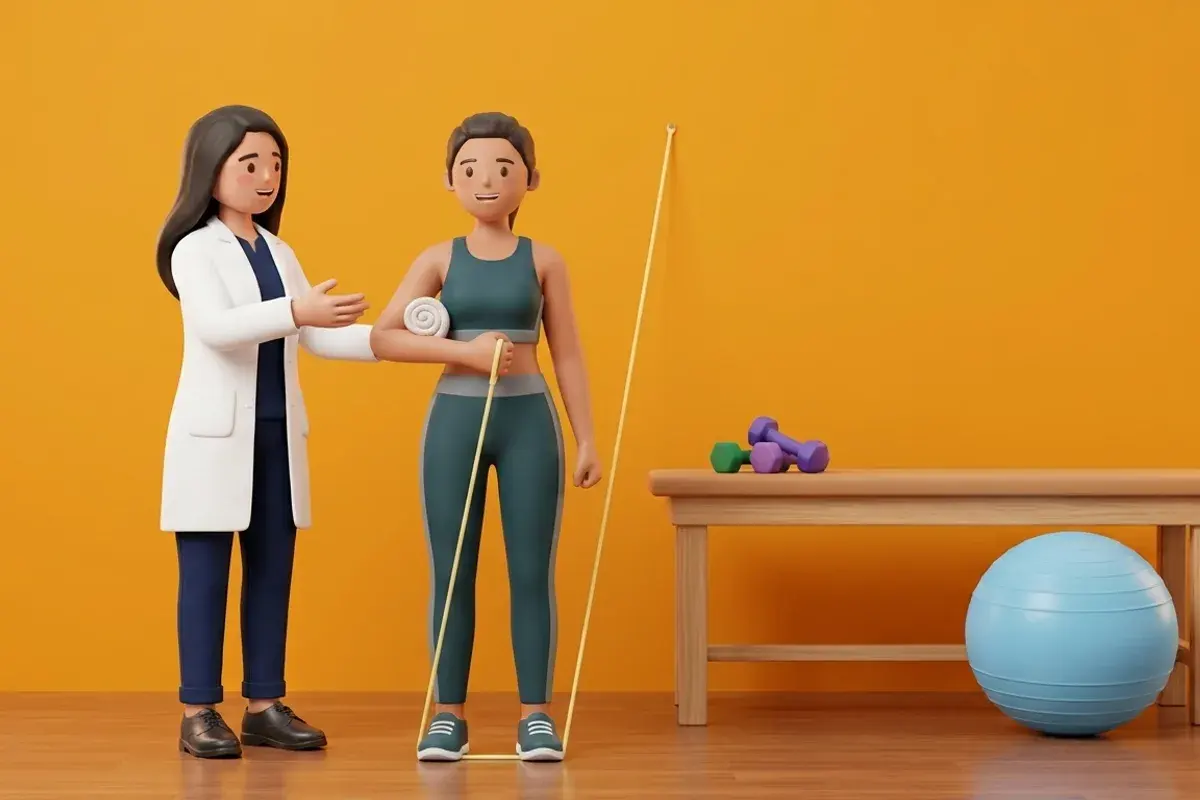
All Mulligan techniques must strictly adhere to the PILL principle: Pain-free, Instant result, Long-Lasting improvement. If an MWM glide does not abolish pain completely during the movement, the angle, direction, or force of the glide must be modified; if pain persists, the technique is abandoned. In clinical execution, the physiotherapist stabilizes the distal humerus medially while applying a firm, sustained lateral glide to the proximal ulna and radius, instructing the patient to perform their previously painful task (such as gripping a dynamometer). Patients are then taught to replicate this technique at home using an inelastic mobilization belt or luggage strap secured around a door handle.
Self-MWM Lateral Glide with Mobilization Belt and Gripping
Objective: Replicate clinical Mulligan lateral glide independently at home to reinforce pain-free neuromuscular patterns
- 1Secure a wide, inelastic mobilization strap or sturdy fabric belt around a fixed doorknob or heavy table leg at elbow height.
- 2Stand sideways to the anchor point and step into the loop with your affected arm, placing the strap across your upper forearm just below the elbow crease.
- 3Step away from the anchor point so the belt pulls firmly in a lateral direction across your proximal forearm while you stabilize your lower humerus against your side.
- 4While maintaining this firm, pain-free lateral belt traction, slowly squeeze a soft rubber ball or perform active wrist extension.
- 5Verify that the movement is 100 percent pain-free; perform 10 repetitions, release tension, and rest.
| Mulligan Concept Component | Clinical Execution Protocol | Criteria for Success and Actionable Rules |
|---|---|---|
| The PILL Principle | Pain-free application, Instant therapeutic result, Long-Lasting functional recovery | Absolute zero pain during movement is mandatory; any residual pain requires angle alteration |
| Gliding Vector and Hand Placement | Stabilize distal humerus medially; apply sustained lateral glide across proximal forearm bones | Glide must be sustained continuously throughout the entire active gripping movement and return |
| Active Patient Integration | Patient actively performs their previously painful activity (fist clenching, wrist extension) | Pain-free grip strength typically increases by 30 to 80% immediately upon correct glide application |
| Overpressure and Dosage | Apply gentle manual overpressure at end-range only if completely pain-free; 3 sets of 10 reps | Discontinue immediately if symptoms worsen post-session; reinforce with home strap setup |
Never apply joint mobilization glides in the presence of acute elbow joint effusion, suspected occult radial head fracture, active inflammatory arthritis, or ligamentous gross instability. Forceful joint glides across an unstable joint risk damaging collateral ligaments.
Frequently Asked Questions
How many sessions of Mulligan mobilization will I need to permanently fix my tennis elbow?
While Mulligan MWM often provides dramatic, instantaneous pain relief during the session, it is not a standalone cure. Long-term resolution requires three to six weeks of combining manual mobilizations with progressive tendon loading exercises to rebuild the tendon's structural load capacity.
Do I need a doctor referral to see a tennis elbow physiotherapist on BookPhysio.in?
BookPhysio.in does not require a physician prescription. Under the National Commission for Allied and Healthcare Professions (NCAHP) Act 2021, patients across India enjoy direct access to autonomous registered physiotherapists. Through BookPhysio.in, you connect directly with verified clinicians and pay per session with transparent fees, completely free from advance package commitments, commission markups, or platform subscription charges.
Related condition guides
Related recovery guides & articles
BookPhysio.in Editorial Team
The BookPhysio.in editorial team writes and maintains this content, checking it against reliable clinical sources. Content follows our medical review policy: general information only, and no page claims a clinical review until a named registered physiotherapist has signed it off.
Read our medical review policy