
Multi-Sport vs Early Single-Sport Specialisation in Youth
In short
Early single-sport specialisation dramatically increases overuse injury rates in young athletes. Learn how multi-sport diversification builds resilient athletes.
In this guide (6 sections)
Early sports specialisation is defined as year-round intensive training in a single sport (for more than 8 months per year) to the exclusion of other sports, initiated before the age of 12 years. Numerous clinical studies confirm that early single-sport specialisation doubles the risk of overuse injuries: particularly traction apophysitis, bone stress injuries, and anterior cruciate ligament tears: compared to multi-sport participation. Multi-sport sampling builds diverse motor engrams, distributes mechanical loads across varying anatomical tissues, and establishes athletic longevity.
Domestic and Cultural Indian Realities
In India, commercial sports academies increasingly market specialised programs to children as young as 7 or 8 years in cricket, badminton, tennis, and swimming, promising fast-track national selection. Parents frequently withdraw children from other recreational sports to focus exclusively on one discipline. Young cricket fast bowlers bowl thousands of deliveries year-round, while junior badminton players execute thousands of overhead lunges, without participating in swimming, football, or gymnastics to balance motor skills and muscular symmetry.
Clinical Biomechanics and Physeal Physiology
Repetitive single-sport movements subject specific growth plates and joint structures to stereotypical, unidirectional mechanical loading. For example, year-round tennis creates unilateral shoulder internal rotation contractures and humeral retroversion, while year-round distance running concentrates repetitive sagittal shear on the tibial tuberosity and calcaneus. Multi-sport participation exposes the growing skeleton to multi-planar forces, promoting circumferential bone mineral accretion and balanced tendon stiffness.
Clinical Assessment and Diagnostic Differentiation
Screening protocols evaluate the adolescent specialisation volume: training hours per week, months per year in the primary sport, and ratio of organised sports to unstructured free play. Physical examination assesses fundamental movement literacy using tests like the Functional Movement Screen (FMS) or Y-balance test. Specialised youth frequently present with marked asymmetries in joint range of motion, poor rotational core control, and localized apophyseal point tenderness.
Targeted Rehabilitation and Loading Protocols
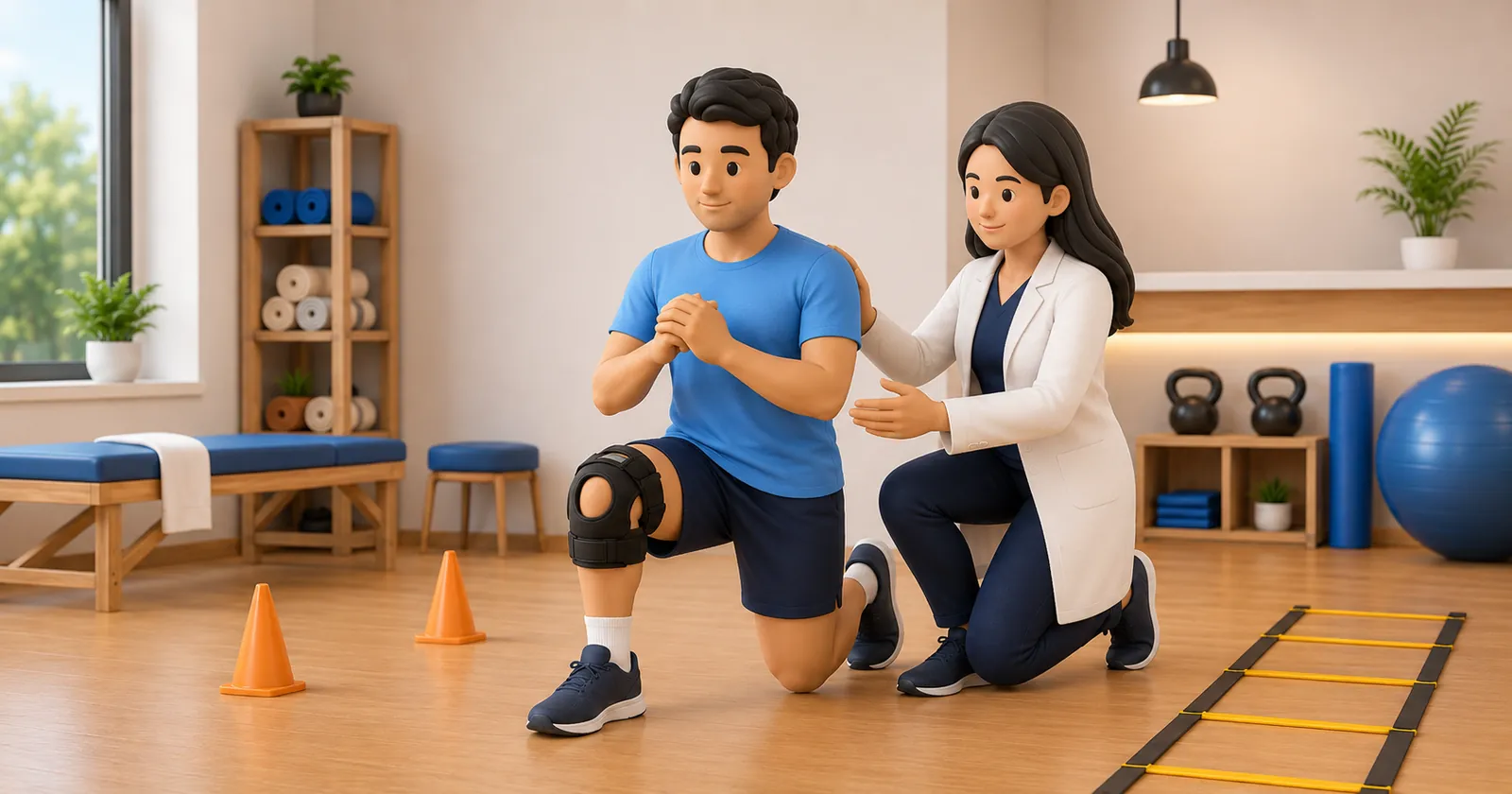
For early specialised athletes presenting with overuse injuries, physiotherapy introduces cross-training that loads complementary muscle groups and planes of motion. A young cricketer with lumbar stress is cross-trained with swimming and low-impact cycling; a badminton player with knee apophysitis is introduced to multi-directional movement games. Neuromuscular training emphasizes universal movement skills: jumping, landing, hopping, throwing, and tumbling: to restore balanced kinetic chain function.
Multi-Directional Agility Hop and Stick Matrix
Objective: Develop diverse multi-planar deceleration motor engrams to distribute impact forces across multiple joints
- 1Stand balanced on your right leg in the centre of a 4-square floor grid marked with tape.
- 2Hop forward into the front square, landing softly on your right midfoot while bending your hip and knee to absorb shock.
- 3Hold the landing stick balance statically for 3 seconds without wobbling or dropping your arch.
- 4Hop laterally to the right square and stick the landing for 3 seconds, then hop diagonally backwards and stick.
- 5Complete the full 4-point circuit smoothly on your right leg before switching to your left leg.
| Athletic Parameter | Early Single-Sport Specialisation (<12 yrs) | Multi-Sport Sampling Pathway |
|---|---|---|
| Overuse Injury Risk | Over 2 to 3 times higher incidence of apophysitis, stress fractures, and ACL tears | Significantly lower injury rates; distributed mechanical loading across tissues |
| Motor Skill Development | Narrow, sport-specific motor skills; poor multi-planar movement adaptability | Broad fundamental movement literacy; superior long-term athletic potential |
| Athletic Career Longevity | High rate of adolescent burnout, psychological fatigue, and early sports dropout | Higher rates of lifelong sports participation and greater senior elite success |
Red Flags and Specialist Escalation
Immediate clinical orthopaedic consultation is required if the specialised young athlete demonstrates signs of structural overuse injury, such as bone stress reactions on MRI, joint contractures, persistent limp, or severe psychological distress and resistance to training. Early multi-disciplinary intervention prevents career-ending physical or psychological breakdown.
Frequently Asked Questions
At what age should a young athlete specialise in a single sport to succeed?
International sports medicine consensus recommends delaying sport specialisation until late adolescence (at least 15 to 16 years of age) for most team and endurance sports, which maximizes athletic success while minimizing overuse injury risk.
Do parents in India require a doctor referral to consult a sports physiotherapist for youth training guidance?
BookPhysio.in does not ask for a doctor referral. Under the National Commission for Allied and Healthcare Professions (NCAHP) Act 2021, registered physiotherapists are recognized as independent primary care providers. You can schedule consultations directly and pay directly per session.
Related condition guides


Related recovery guides & articles
BookPhysio.in Editorial Team
The BookPhysio.in editorial team writes and maintains this content, checking it against reliable clinical sources. Content follows our medical review policy: general information only, and no page claims a clinical review until a named registered physiotherapist has signed it off.
Read our medical review policy